|
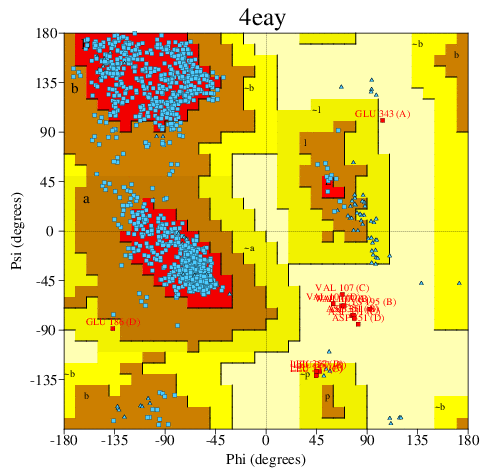
PDBsum entry 4eay
|
|
|
|
References listed in PDB file
|
 |
|
Key reference
|
|
|
Title
|
|
Structural insights into decreased enzymatic activity induced by an insert sequence in mannonate dehydratase from gram negative bacterium.
|
|
|
Authors
|
|
X.Qiu,
Y.Tao,
Y.Zhu,
Y.Yuan,
Y.Zhang,
H.Liu,
Y.Gao,
M.Teng,
L.Niu.
|
|
|
Ref.
|
|
J Struct Biol, 2012,
180,
327-334.
[DOI no: ]
|
|
|
PubMed id
|
|
|
|
|
|
Abstract
|
|
|
Mannonate dehydratase (ManD; EC4.2.1.8) catalyzes the dehydration of D-mannonate
to 2-keto-3-deoxygluconate. It is the third enzyme in the pathway for
dissimilation of D-glucuronate to 2-keto-3-deoxygluconate involving in the
Entner-Doudoroff pathway in certain bacterial and archaeal species. ManD from
Gram negative bacteria has an insert sequence as compared to those from Gram
positives revealed by sequence analysis. To evaluate the impact of this insert
sequence on the catalytic efficiency, we solved the crystal structures of ManD
from Escherichia coli strain K12 and its complex with D-mannonate, which reveal
that this insert sequence forms two α helices locating above the active site.
The two insert α helices introduce a loop that forms a cap covering the
substrate binding pocket, which restricts the tunnels of substrate entering and
product releasing from the active site. Site-directed mutations and enzymatic
activity assays confirm that the catalytic rate is decreased by this loop. These
features are conserved among Gram negative bacteria. Thus, the insert sequence
of ManD from Gram negative bacteria acts as a common inducer to decrease the
catalytic rate and consequently the glucuronate metabolic rate as compared to
those from Gram positives. Moreover, residues essential for substrate to enter
the active site were characterized via structural analysis and enzymatic
activity assays.
|
|
|
|
|
|
|