 |
PDBsum entry 4dgg
 |
|
|
|
|
|
|
Enzyme class:
|
|
E.C.2.7.10.2
- non-specific protein-tyrosine kinase.
|
|
|
|
|
|
|
Reaction:
|
|
L-tyrosyl-[protein] + ATP = O-phospho-L-tyrosyl-[protein] + ADP + H+
|
|
|
|
|
|
L-tyrosyl-[protein]
|
+
|
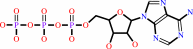 ATP
ATP
|
=
|
O-phospho-L-tyrosyl-[protein]
|
+
|
 ADP
ADP
|
+
|
H(+)
|
|
|
|
|
|
|
|
|
|
|
|
|
Molecule diagrams generated from .mol files obtained from the
KEGG ftp site
|
|
|
|
|
|
|
|
|
|
|
|
|
|
 |
|
|
|
|
|
|
| |
|
|
| |
|
|
Nat Chem Biol
9:43-50
(2013)
|
|
PubMed id:
|
|
|
|
|
|
| |
|
Active site profiling reveals coupling between domains in SRC-family kinases.
|
|
R.Krishnamurty,
J.L.Brigham,
S.E.Leonard,
P.Ranjitkar,
E.T.Larson,
E.J.Dale,
E.A.Merritt,
D.J.Maly.
|
|
|
|
|
| |
ABSTRACT
|
|
|
|
| |
|
|
Protein kinases, key regulators of intracellular signal transduction, have
emerged as an important class of drug targets. Chemical proteomic tools that
facilitate the functional interrogation of protein kinase active sites are
powerful reagents for studying the regulation of this large enzyme family and
performing inhibitor selectivity screens. Here we describe a new crosslinking
strategy that enables rapid and quantitative profiling of protein kinase active
sites in lysates and live cells. Applying this methodology to the SRC-family
kinases (SFKs) SRC and HCK led to the identification of a series of
conformation-specific, ATP-competitive inhibitors that have a distinct
preference for the autoinhibited forms of these kinases. Furthermore, we show
that ligands that have this selectivity are able to modulate the ability of the
regulatory domains of SRC and HCK to engage in intermolecular binding
interactions. These studies provide insight into the regulation of this
important family of tyrosine kinases.
|
|
|
|
|
|
|
|
|
|
|
|
|
|
|
|
|
|
 |
 |
 |
|


 Links
Links


