 |
PDBsum entry 4xam

|
|
|
|
|
|

|

|

|

|
|

|
|

|
|

|
|

|
|
|
 |

|

|
|
|
|
|
|
|
|
|
|
|
|
|
|
|
|
|
|
|
|
|
|
|
|
|
|
|
|
|
|
|
|
|
Immune system
|
PDB id
|
|
|
|
4xam
|
|
|
|
|
|
|
|
|
|
|
|
|
|
|

|

|

|
|
|
|
|
|
|
|
 |
Contents |
 |
|
|
|
|
|
|
|
|
|
|
|

 651 a.a.
|
|
|
|
|
|
|
|
|
|
|

 632 a.a.
|
|
|
|
|
|
|
|
|
|
|

 281 a.a.
|
|
|
|
|
|
|
|
|
|
| Superseded by: |
|
|
|
|
PDB id:
|
|
|
|
| Name: |
|
Immune system
|
|
|
Title:
|
|
Complement component c4b
|
|
Structure:
|
|
Complement c4 beta chain. Chain: a, b. Fragment: unp residues 20-675. Complement c4-a alpha chain. Chain: c, e. Fragment: unp residues 757-1446. Complement c4 gamma chain. Chain: d, f. Fragment: unp residues 1454-1744
|
|
Source:
|
|
Homo sapiens. Human. Organism_taxid: 9606. Tissue: blood. Tissue: blood
|
|
Resolution:
|
|
|
4.20Å
|
R-factor:
|
0.219
|
R-free:
|
0.273
|
|
|
Authors:
|
|
S.Mortensen,R.T.Kidmose,S.V.Petersen,A.Szilagyi,G.R.Andersen
|
|
Key ref:
|
|
S.Mortensen
et al.
(2015).
Structural Basis for the Function of Complement Component C4 within the Classical and Lectin Pathways of Complement.
J Immunol,
194,
5488-5496.
PubMed id:
DOI:
|
|
|
Date:
|
|
|
15-Dec-14
|
Release date:
|
06-May-15
|
|
|
|
|
|
|
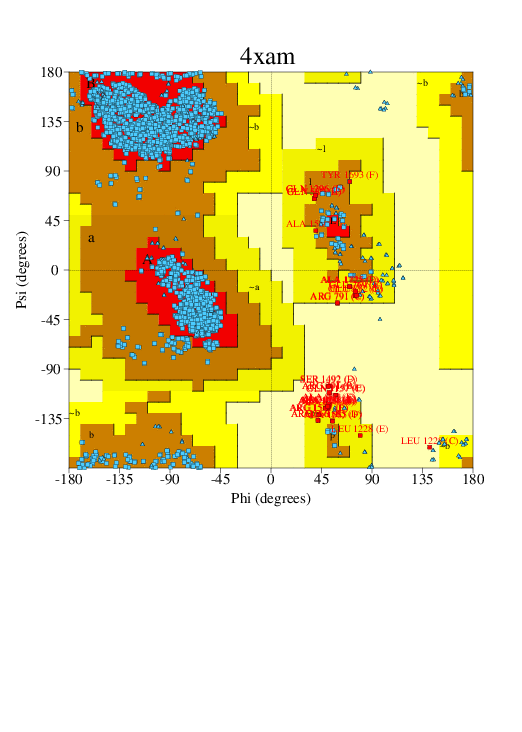
PROCHECK
|
|
|
|
|
|
Headers
|
|
|
|
References
|
|
|
|
|
|

|
|
P0C0L4
(CO4A_HUMAN) -
Complement C4-A from Homo sapiens
|
|
|
|
Seq:
Struc:
|
|
|
|
1744 a.a.
651 a.a.
|
|

|

|
|
|
|
|
|
|
|
|
|
|
|
|
|
|
|
|
|
|
|
|
|
 |
|
|
|
|
|
|
| |
|
DOI no:
|
J Immunol
194:5488-5496
(2015)
|
|
PubMed id:
|
|
|
|
|
|
| |
|
Structural Basis for the Function of Complement Component C4 within the Classical and Lectin Pathways of Complement.
|
|
S.Mortensen,
R.T.Kidmose,
S.V.Petersen,
Ã.�.Szilágyi,
Z.Prohászka,
G.R.Andersen.
|
|
|
|
|
| |
ABSTRACT
|
|
|
|
| |
|
|
Complement component C4 is a central protein in the classical and lectin
pathways within the complement system. During activation of complement, its
major fragment C4b becomes covalently attached to the surface of pathogens and
altered self-tissue, where it acts as an opsonin marking the surface for
removal. Moreover, C4b provides a platform for assembly of the proteolytically
active convertases that mediate downstream complement activation by cleavage of
C3 and C5. In this article, we present the crystal and solution structures of
the 195-kDa C4b. Our results provide the molecular details of the rearrangement
accompanying C4 cleavage and suggest intramolecular flexibility of C4b. The
conformations of C4b and its paralogue C3b are shown to be remarkably conserved,
suggesting that the convertases from the classical and alternative pathways are
likely to share their overall architecture and mode of substrate recognition. We
propose an overall molecular model for the classical pathway C5 convertase in
complex with C5, suggesting that C3b increases the affinity for the substrate by
inducing conformational changes in C4b rather than a direct interaction with C5.
C4b-specific features revealed by our structural studies are probably involved
in the assembly of the classical pathway C3/C5 convertases and C4b binding to
regulators.
|
|
|
|
|
|
|
|
|
|
|
|
|
|
|
|
|
|
 |
 |
 |
|
| |


 Links
Links





















