 |
PDBsum entry 4pbv

|
|
|
|
|
|

|

|

|

|
|

|
|

|
|

|
|

|
|

|
|
|
 |

|

|
|
|
|
|
|
|
|
|
|
|
|
|
|
|
|
|
|
|
|
|
|
|
|
|
|
|
|
|
|
|
|
|
|
Signaling protein
|
PDB id
|
|
|
|
4pbv
|
|
|
|
|
|
|
|
|
|
|
|
|
|
|

|

|

|
|
|
|
|
|
|
PDB id:
|
|
|
|
| Name: |
|
Signaling protein
|
|
|
Title:
|
|
Crystal structure of chicken receptor protein tyrosine phosphatase sigma in complex with trkc
|
|
Structure:
|
|
Nt-3 growth factor receptor. Chain: a, b. Fragment: residues 31-302. Synonym: neurotrophic tyrosine kinase receptor type 3,trkc tyrosine kinase,trk-c. Engineered: yes. Mutation: yes. Protein-tyrosine phosphatase crypalpha1 isoform. Chain: c, d, e.
|
|
Source:
|
|
Gallus gallus. Chicken. Organism_taxid: 9031. Gene: ntrk3, trkc. Expressed in: homo sapiens. Expression_system_taxid: 9606. Expression_system_cell_line: hek293s. Gene: crypalpha1.
|
|
Resolution:
|
|
|
2.50Å
|
R-factor:
|
0.211
|
R-free:
|
0.247
|
|
|
Authors:
|
|
C.H.Coles,N.Mitakidis,P.Zhang,J.Elegheert,W.Lu,A.W.Stoker,T.Nakagawa, A.M.Craig,E.Y.Jones,A.R.Aricescu
|
|
Key ref:
|
|
C.H.Coles
et al.
(2014).
Structural basis for extracellular cis and trans RPTPσ signal competition in synaptogenesis.
Nat Commun,
5,
5209.
PubMed id:
DOI:
|
|
|
Date:
|
|
|
14-Apr-14
|
Release date:
|
12-Nov-14
|
|
|
|
|
|
|
PROCHECK
|

|
|
|
|
|
Headers
|
|
|
|
References
|
|
|
|
|
|
|
|
|
|
|
|
Enzyme class 1:
|
|
Chains A, B:
E.C.2.7.10.1
- receptor protein-tyrosine kinase.
|
|
|
|
|
|
|
Reaction:
|
|
L-tyrosyl-[protein] + ATP = O-phospho-L-tyrosyl-[protein] + ADP + H+
|
|
|
|
|
|
L-tyrosyl-[protein]
|
+
|
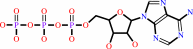 ATP
ATP
|
=
|
O-phospho-L-tyrosyl-[protein]
Bound ligand (Het Group name = )
matches with 41.38% similarity
|
+
|
 ADP
ADP
|
+
|
H(+)
|
|
|
|
|
|
|
|
|
|
Enzyme class 2:
|
|
Chains C, D, E:
E.C.3.1.3.48
- protein-tyrosine-phosphatase.
|
|
|
|
|
|
|
Reaction:
|
|
O-phospho-L-tyrosyl-[protein] + H2O = L-tyrosyl-[protein] + phosphate
|
|
|
|
|
|
O-phospho-L-tyrosyl-[protein]
|
+
|
H2O
|
=
|
L-tyrosyl-[protein]
|
+
|
 phosphate
|
|
|
|
|
|
|
|
|
|
|
|
|
Note, where more than one E.C. class is given (as above), each may
correspond to a different protein domain or, in the case of polyprotein
precursors, to a different mature protein.
|
|
|
|
Molecule diagrams generated from .mol files obtained from the
KEGG ftp site
|
|
|
|
|
|
|
|
|
|
|
|
|
|
 |
|
|
|
|
|
|
| |
|
|
| |
|
DOI no:
|
Nat Commun
5:5209
(2014)
|
|
PubMed id:
|
|
|
|
|
|
| |
|
Structural basis for extracellular cis and trans RPTPσ signal competition in synaptogenesis.
|
|
C.H.Coles,
N.Mitakidis,
P.Zhang,
J.Elegheert,
W.Lu,
A.W.Stoker,
T.Nakagawa,
A.M.Craig,
E.Y.Jones,
A.R.Aricescu.
|
|
|
|
|
| |
ABSTRACT
|
|
|
|
| |
|
|
Receptor protein tyrosine phosphatase sigma (RPTPσ) regulates neuronal
extension and acts as a presynaptic nexus for multiple protein and proteoglycan
interactions during synaptogenesis. Unknown mechanisms govern the shift in
RPTPσ function, from outgrowth promotion to synaptic organization. Here, we
report crystallographic, electron microscopic and small-angle X-ray scattering
analyses, which reveal sufficient inter-domain flexibility in the RPTPσ
extracellular region for interaction with both cis (same cell) and trans
(opposite cell) ligands. Crystal structures of RPTPσ bound to its postsynaptic
ligand TrkC detail an interaction surface partially overlapping the
glycosaminoglycan-binding site. Accordingly, heparan sulphate and heparin
oligomers compete with TrkC for RPTPσ binding in vitro and disrupt
TrkC-dependent synaptic differentiation in neuronal co-culture assays. We
propose that transient RPTPσ ectodomain emergence from the presynaptic
proteoglycan layer allows capture by TrkC to form a trans-synaptic complex, the
consequent reduction in RPTPσ flexibility potentiating interactions with
additional ligands to orchestrate excitatory synapse formation.
|
|
|
|
|
|
|
|
|
|
|
|
|
|
|
|
|
|
 |
 |
 |
|
|


 Links
Links


