 |
PDBsum entry 3zob

|
|
|
|
|
|

|

|

|

|
|

|
|

|
|
|
 |

|

|
|
|
|
|
|
|
|
|
|
|
|
|
|
|
|
|
|
|
|
|
|
|
|
|
|
|
|
|
|
|
DNA binding protein
|
PDB id
|
|
|
|
3zob
|
|
|
|
|
|
|
|
|
|
|
|
|
|
|

|

|

|
|
|
|
|
|
|
PDB id:
|
|
|
|
| Name: |
|
DNA binding protein
|
|
|
Title:
|
|
Solution structure of chicken engrailed 2 homeodomain
|
|
Structure:
|
|
Homeobox protein engrailed-2. Chain: a. Fragment: homeodomain, residues 200-259. Synonym: gg-en-2, homeobox protein en-2, engrailed 2 homeoprotein. Engineered: yes
|
|
Source:
|
|
Gallus gallus. Chicken. Organism_taxid: 9031. Expressed in: escherichia coli. Expression_system_taxid: 469008. Expression_system_variant: codonplus-rp.
|
|
NMR struc:
|
|
20 models
|
|
|
Authors:
|
|
L.Carlier,S.Balayssac,F.X.Cantrelle,L.Khemtemourian,G.Chassaing, A.Joliot,O.Lequin
|
|
Key ref:
|
|
L.Carlier
et al.
(2013).
Investigation of homeodomain membrane translocation properties: insights from the structure determination of engrailed-2 homeodomain in aqueous and membrane-mimetic environments.
Biophys J,
105,
667-678.
PubMed id:
DOI:
|
|
|
Date:
|
|
|
21-Feb-13
|
Release date:
|
28-Aug-13
|
|
|
|
|
|
|
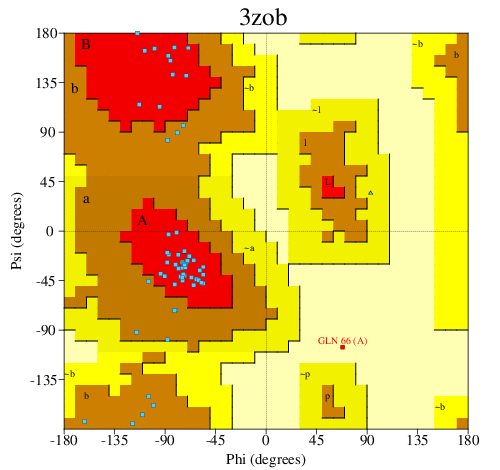
PROCHECK
|
|
|
|
|
|
Headers
|
|
|
|
References
|
|
|
|
|
|

|
|
Q05917
(HME2_CHICK) -
Homeobox protein engrailed-2 from Gallus gallus
|
|
|
|
Seq:
Struc:
|
|
|
|
289 a.a.
67 a.a.*
|
|

|

|

|
|
|
|
|
|
|
|
|
|
|
Key: |
 |
PfamA domain |
|
|
 |
Secondary structure |
|
 |
CATH domain |
|
|
*
PDB and UniProt seqs differ
at 6 residue positions (black
crosses)
|
|
|
|
|
|
|
|
|
|
|
|
|
|
|
|
|
 |
|
|
|
|
|
|
| |
|
DOI no:
|
Biophys J
105:667-678
(2013)
|
|
PubMed id:
|
|
|
|
|
|
| |
|
Investigation of homeodomain membrane translocation properties: insights from the structure determination of engrailed-2 homeodomain in aqueous and membrane-mimetic environments.
|
|
L.Carlier,
S.Balayssac,
F.X.Cantrelle,
L.Khemtémourian,
G.Chassaing,
A.Joliot,
O.Lequin.
|
|
|
|
|
| |
ABSTRACT
|
|
|
|
| |
|
|
In addition to their well-known DNA-binding properties, homeodomains have the
ability to efficiently translocate across biological membranes through still
poorly-characterized mechanisms. To date, most biophysical studies addressing
the mechanisms of internalization have focused on small synthetic peptides
rather than full-length globular homeodomains. In this work, we characterized
the conformational properties of chicken Engrailed 2 homeodomain (En2HD) in
aqueous solution and in membrane mimetic environments using circular dichroism,
Trp fluorescence, and NMR spectroscopy. En2HD adopts a well-defined
three-helical bundle fold in aqueous solution. The Trp-48 residue, which is
critical for internalization, is fully buried in the hydrophobic core. Circular
dichroism and fluorescence reveal that a conformational transition occurs in
anionic lipid vesicles and in micelles. En2HD loses its native three-dimensional
structure in micellar environments but, remarkably, near-native helical
secondary structures are maintained. Long-range interactions could be detected
using site-directed spin labels, indicating that the three helices do not adopt
extended orientations. Noncovalent paramagnetic probes yielded information about
helix positioning and unveiled the burial of critical aromatic and basic
residues within the micelles. Our results suggest that electrostatic
interactions with membranes may be determinant in inducing a conformational
change enabling Trp-48 to insert into membranes.
|
|
|
|
|
|
|
|
|
|
|
|
|
|
|
|
|
|
 |
 |
 |
|


 Links
Links


