 |
PDBsum entry 3zfx
|
|

|
|
PDB id:
|
|
|
|
| Name: |
|
Transferase
|
|
|
Title:
|
|
Crystal structure of ephb1
|
|
Structure:
|
|
Ephrin type-b receptor 1. Chain: a, b, c, d, e, f, g, h, i. Fragment: kinase domain. Synonym: 2.7.10.1, elk, eph tyrosine kinase 2, eph-like kinase 6, ek6, hek6, neuronally-expressed eph-related tyrosine kinase, net, tyrosine-protein kinase receptor eph-2, ephb1. Engineered: yes
|
|
Source:
|
|
Homo sapiens. Human. Organism_taxid: 9606. Expressed in: escherichia coli. Expression_system_taxid: 469008. Expression_system_variant: star.
|
|
Resolution:
|
|
|
2.50Å
|
R-factor:
|
0.190
|
R-free:
|
0.217
|
|
|
Authors:
|
|
J.E.Debreczeni,R.Overman,C.Truman,M.Mcalister,T.K.Attwood
|
|
Key ref:
|
|
R.C.Overman
et al.
(2014).
Completing the structural family portrait of the human EphB tyrosine kinase domains.
Protein Sci,
23,
627-638.
PubMed id:
DOI:
|
|
|
Date:
|
|
|
12-Dec-12
|
Release date:
|
08-Jan-14
|
|
|
|
|
|
|
PROCHECK
|

|
|
|
|
|
Headers
|
|
|
|
References
|
|
|
|
|
|
|
|
|
|
|
|
Enzyme class:
|
|
Chains A, B, C, D, E, F, G, H, I:
E.C.2.7.10.1
- receptor protein-tyrosine kinase.
|
|
|
|
|
|
|
Reaction:
|
|
L-tyrosyl-[protein] + ATP = O-phospho-L-tyrosyl-[protein] + ADP + H+
|
|
|
|
|
|
L-tyrosyl-[protein]
|
+
|
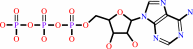 ATP
ATP
|
=
|
O-phospho-L-tyrosyl-[protein]
|
+
|
 ADP
ADP
|
+
|
H(+)
|
|
|
|
|
|
|
|
|
|
|
|
|
Molecule diagrams generated from .mol files obtained from the
KEGG ftp site
|
|
|
|
|
|
|
|
|
|
|
|
|
|
 |
|
|
|
|
|
|
| |
|
|
| |
|
DOI no:
|
Protein Sci
23:627-638
(2014)
|
|
PubMed id:
|
|
|
|
|
|
| |
|
Completing the structural family portrait of the human EphB tyrosine kinase domains.
|
|
R.C.Overman,
J.E.Debreczeni,
C.M.Truman,
M.S.McAlister,
T.K.Attwood.
|
|
|
|
|
| |
ABSTRACT
|
|
|
|
| |
|
|
The EphB receptors have key roles in cell morphology, adhesion, migration and
invasion, and their aberrant action has been linked with the development and
progression of many different tumor types. Their conflicting expression patterns
in cancer tissues, combined with their high sequence and structural identity,
present interesting challenges to those seeking to develop selective therapeutic
molecules targeting this large receptor family. Here, we present the first
structure of the EphB1 tyrosine kinase domain determined by X-ray
crystallography to 2.5Å. Our comparative crystalisation analysis of the human
EphB family kinases has also yielded new crystal forms of the human EphB2 and
EphB4 catalytic domains. Unable to crystallize the wild-type EphB3 kinase
domain, we used rational engineering (based on our new structures of EphB1,
EphB2, and EphB4) to identify a single point mutation which facilitated its
crystallization and structure determination to 2.2 Å. This mutation also
improved the soluble recombinant yield of this kinase within Escherichia coli,
and increased both its intrinsic stability and catalytic turnover, without
affecting its ligand-binding profile. The partial ordering of the activation
loop in the EphB3 structure alludes to a potential cis-phosphorylation mechanism
for the EphB kinases. With the kinase domain structures of all four
catalytically competent human EphB receptors now determined, a picture begins to
emerge of possible opportunities to produce EphB isozyme-selective kinase
inhibitors for mechanistic studies and therapeutic applications.
|
|
|
|
|
|
|
|
|
|
|
|
|
|
|
|
|
|
 |
 |
 |
|
|


 Links
Links


