 |
PDBsum entry 3snh
 |
|
|
|
|
|
|
Enzyme class:
|
|
E.C.3.6.5.5
- dynamin GTPase.
|
|
|
|
|
|
|
Reaction:
|
|
GTP + H2O = GDP + phosphate + H+
|
|
|
|
|
|
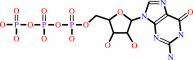 GTP
GTP
|
+
|
H2O
|
=
|
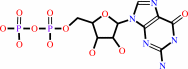 GDP
GDP
|
+
|
 phosphate
|
+
|
H(+)
|
|
|
|
|
|
|
|
|
|
|
|
|
Molecule diagrams generated from .mol files obtained from the
KEGG ftp site
|
|
|
|
|
|
|
|
|
|
|
|
|
|
 |
|
|
|
|
|
|
| |
|
|
| |
|
|
Nature
477:556-560
(2011)
|
|
PubMed id:
|
|
|
|
|
|
| |
|
Crystal structure of nucleotide-free dynamin.
|
|
K.Faelber,
Y.Posor,
S.Gao,
M.Held,
Y.Roske,
D.Schulze,
V.Haucke,
F.Noé,
O.Daumke.
|
|
|
|
|
| |
ABSTRACT
|
|
|
|
| |
|
|
Dynamin is a mechanochemical GTPase that oligomerizes around the neck of
clathrin-coated pits and catalyses vesicle scission in a
GTP-hydrolysis-dependent manner. The molecular details of oligomerization and
the mechanism of the mechanochemical coupling are currently unknown. Here we
present the crystal structure of human dynamin 1 in the nucleotide-free state
with a four-domain architecture comprising the GTPase domain, the bundle
signalling element, the stalk and the pleckstrin homology domain. Dynamin 1
oligomerized in the crystals via the stalks, which assemble in a criss-cross
fashion. The stalks further interact via conserved surfaces with the pleckstrin
homology domain and the bundle signalling element of the neighbouring dynamin
molecule. This intricate domain interaction rationalizes a number of
disease-related mutations in dynamin 2 and suggests a structural model for the
mechanochemical coupling that reconciles previous models of dynamin function.
|
|
|
|
|
|
|
|
|
|
|
|
|
|
|
|
|
|
 |
 |
 |
|


 Links
Links


