 |
PDBsum entry 3sg6

|
|
|
|
|
|

|

|

|

|
|

|
|

|
|

|
|

|
|
|
 |

|

|
|
|
|
|
|
|
|
|
|
|
|
|
|
|
|
|
|
|
|
|
|
|
|
|
|
|
|
|
|
|
|
|
Fluorescent protein
|
PDB id
|
|
|
|
3sg6
|
|
|
|
|
|
|
|
|
|
|
|
|
|
|

|

|

|
|
|
|
|
|
|
PDB id:
|
|
|
|
| Name: |
|
Fluorescent protein
|
|
|
Title:
|
|
Crystal structure of dimeric gcamp2-lia(linker 1)
|
|
Structure:
|
|
Myosin light chain kinase, green fluorescent protein, calmodulin-1 chimera. Chain: a. Fragment: see remark 999. Engineered: yes. Mutation: yes
|
|
Source:
|
|
Gallus gallus, aequorea victoria, rattus norvegicus. Chicken, jellyfish, rat. Organism_taxid: 9031, 6100, 10116. Gene: gfp, calm1, calm, cam, cam1, cami. Expressed in: escherichia coli. Expression_system_taxid: 562
|
|
Resolution:
|
|
|
1.70Å
|
R-factor:
|
0.206
|
R-free:
|
0.249
|
|
|
Authors:
|
|
E.R.Schreiter,J.Akerboom,L.L.Looger
|
|
Key ref:
|
|
J.Akerboom
et al.
(2012).
Optimization of a GCaMP calcium indicator for neural activity imaging.
J Neurosci,
32,
13819-13840.
PubMed id:
|
|
|
Date:
|
|
|
14-Jun-11
|
Release date:
|
20-Jun-12
|
|
|
|
|
|
|
PROCHECK
|

|
|
|
|
|
Headers
|
|
|
|
References
|
|
|
|
|
|

|
|
P0DP29
(CALM1_RAT) -
Calmodulin-1 from Rattus norvegicus
|
|
|
|
Seq:
Struc:
|
|
|
|
149 a.a.
384 a.a.*
|
|

|

|

|
|
|
|
|
|
|
|
|
|
|
|
|
|
|
|
|
Enzyme class:
|
|
E.C.2.7.11.18
- [myosin light-chain] kinase.
|
|
|
|
|
|
|
Reaction:
|
|
|
1.
|
L-seryl-[myosin light chain] + ATP = O-phospho-L-seryl-[myosin light chain] + ADP + H+
|
|
2.
|
L-threonyl-[myosin light chain] + ATP = O-phospho-L-threonyl-[myosin light chain] + ADP + H+
|
|
|
|
|
|
|
L-seryl-[myosin light chain]
|
+
|
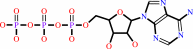 ATP
ATP
|
=
|
O-phospho-L-seryl-[myosin light chain]
|
+
|
 ADP
ADP
|
+
|
H(+)
|
|
|
|
|
|
|
L-threonyl-[myosin light chain]
|
+
|
ATP
|
=
|
O-phospho-L-threonyl-[myosin light chain]
|
+
|
ADP
|
+
|
H(+)
|
|
|
|
|
|
|
|
|
|
Cofactor:
|
|
Ca(2+)
|
|
|
|
|
|
|
|
|
Molecule diagrams generated from .mol files obtained from the
KEGG ftp site
|
|
|
|
|
|
|
|
|
|
|
|
|
|
 |
|
|
|
|
|
|
| |
|
|
| |
|
|
J Neurosci
32:13819-13840
(2012)
|
|
PubMed id:
|
|
|
|
|
|
| |
|
Optimization of a GCaMP calcium indicator for neural activity imaging.
|
|
J.Akerboom,
T.W.Chen,
T.J.Wardill,
L.Tian,
J.S.Marvin,
S.Mutlu,
N.C.Calderón,
F.Esposti,
B.G.Borghuis,
X.R.Sun,
A.Gordus,
M.B.Orger,
R.Portugues,
F.Engert,
J.J.Macklin,
A.Filosa,
A.Aggarwal,
R.A.Kerr,
R.Takagi,
S.Kracun,
E.Shigetomi,
B.S.Khakh,
H.Baier,
L.Lagnado,
S.S.Wang,
C.I.Bargmann,
B.E.Kimmel,
V.Jayaraman,
K.Svoboda,
D.S.Kim,
E.R.Schreiter,
L.L.Looger.
|
|
|
|
|
| |
ABSTRACT
|
|
|
|
| |
|
|
Genetically encoded calcium indicators (GECIs) are powerful tools for systems
neuroscience. Recent efforts in protein engineering have significantly increased
the performance of GECIs. The state-of-the art single-wavelength GECI, GCaMP3,
has been deployed in a number of model organisms and can reliably detect three
or more action potentials in short bursts in several systems in vivo. Through
protein structure determination, targeted mutagenesis, high-throughput
screening, and a battery of in vitro assays, we have increased the dynamic range
of GCaMP3 by severalfold, creating a family of "GCaMP5" sensors. We
tested GCaMP5s in several systems: cultured neurons and astrocytes, mouse
retina, and in vivo in Caenorhabditis chemosensory neurons, Drosophila larval
neuromuscular junction and adult antennal lobe, zebrafish retina and tectum, and
mouse visual cortex. Signal-to-noise ratio was improved by at least 2- to
3-fold. In the visual cortex, two GCaMP5 variants detected twice as many visual
stimulus-responsive cells as GCaMP3. By combining in vivo imaging with
electrophysiology we show that GCaMP5 fluorescence provides a more reliable
measure of neuronal activity than its predecessor GCaMP3. GCaMP5 allows more
sensitive detection of neural activity in vivo and may find widespread
applications for cellular imaging in general.
|
|
|
|
|
|
|
|
|
|
|
|
|
|
|
|
|
|
 |
 |
 |
|
| |


 Links
Links


