 |
PDBsum entry 3lxn

|
|
|
|
|
 |
Contents |
 |
|
|
|
|
|
|
|
|
|
|
|
|
* Residue conservation analysis
|
|
|
|
|
|
|
|
|
|
|
Enzyme class:
|
|
E.C.2.7.10.2
- non-specific protein-tyrosine kinase.
|
|
|
|
|
|
|
Reaction:
|
|
L-tyrosyl-[protein] + ATP = O-phospho-L-tyrosyl-[protein] + ADP + H+
|
|
|
|
|
|
L-tyrosyl-[protein]
|
+
|
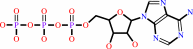 ATP
ATP
|
=
|
O-phospho-L-tyrosyl-[protein]
|
+
|
 ADP
ADP
|
+
|
H(+)
|
|
|
|
|
|
|
|
|
|
|
|
|
Molecule diagrams generated from .mol files obtained from the
KEGG ftp site
|
|
|
|
|
|
|
|
|
|
|
|
|
|
 |
|
|
|
|
|
|
| |
|
|
| |
|
|
J Mol Biol
400:413-433
(2010)
|
|
PubMed id:
|
|
|
|
|
|
| |
|
Structural and thermodynamic characterization of the TYK2 and JAK3 kinase domains in complex with CP-690550 and CMP-6.
|
|
J.E.Chrencik,
A.Patny,
I.K.Leung,
B.Korniski,
T.L.Emmons,
T.Hall,
R.A.Weinberg,
J.A.Gormley,
J.M.Williams,
J.E.Day,
J.L.Hirsch,
J.R.Kiefer,
J.W.Leone,
H.D.Fischer,
C.D.Sommers,
H.C.Huang,
E.J.Jacobsen,
R.E.Tenbrink,
A.G.Tomasselli,
T.E.Benson.
|
|
|
|
|
| |
ABSTRACT
|
|
|
|
| |
|
|
Janus kinases (JAK's) are critical regulators of cytokine pathways and
attractive targets of therapeutic value in both inflammatory and
myeloproliferative diseases. Although crystal structures of active JAK1 and JAK2
kinase domains have recently been reported with the clinical compound CP-690550,
the structures of both TYK2 and JAK3 with CP-690550 have remained outstanding.
Herein, we report the crystal structures of TYK2, a first in class structure,
and JAK3 in complex with PAN-JAK inhibitors CP-690550
((3R,4R)-3-[4-methyl-3-[N-methyl-N-(7H-pyrrolo[2,3-d]pyrimidin-4-yl)amino]piperidin-1-yl]-3-oxopropionitrile)
and CMP-6 (tetracyclic pyridone
2-t-butyl-9-fluoro-3,6-dihydro-7H-benz[h]-imidaz[4,5-f]isoquinoline-7-one), both
of which bind in the ATP binding cavities of both JAK isozymes in orientations
similar to that observed in crystal structures of JAK1 and JAK2. Additionally, a
complete thermodynamic characterization was completed by isothermal titration
calorimetry (ITC) for JAK/CP-690550 complex formation, indicating the critical
role of the nitrile group from the CP-690550 compound. Finally, computational
analysis using WaterMap further highlights the critical positioning of the
CP-690550 nitrile group in the displacement of an unfavorable water beneath the
glycine rich loop. Taken together, the data emphasizes the outstanding
properties of the kinome selective JAK inhibitor CP-690550, as well as the
challenges in obtaining JAK isozyme-selective inhibitors due to the overall
structural and sequence similarities between the TYK2, JAK1, JAK2 and JAK3
isozymes. Nevertheless, subtle amino acid variations of residues lining the
ligand binding cavity of the JAK enzymes, as well as the global positioning of
the glycine rich loop, may provide the initial clues into obtaining JAK-isozyme
selective inhibitors.
|
|
|
|
|
|
|
|
|
|
|
|
|
|
|
|
|
|
 |
 |
 |
|
Literature references that cite this PDB file's key reference
|
|
|
| |
PubMed id
|
|
Reference
|
|
|
|
|
|
R.M.Bandaranayake,
D.Ungureanu,
Y.Shan,
D.E.Shaw,
O.Silvennoinen,
and
S.R.Hubbard
(2012).
Crystal structures of the JAK2 pseudokinase domain and the pathogenic mutant V617F.
|
| |
Nat Struct Mol Biol,
19,
754-759.
|
|
|
PDB codes:
|
|
|
|
|
|
|
|
P.J.Lupardus,
G.Skiniotis,
A.J.Rice,
C.Thomas,
S.Fischer,
T.Walz,
and
K.C.Garcia
(2011).
Structural snapshots of full-length Jak1, a transmembrane gp130/IL-6/IL-6Rα cytokine receptor complex, and the receptor-Jak1 holocomplex.
|
| |
Structure,
19,
45-55.
|
|
|
|
|
|
|
V.Tsui,
P.Gibbons,
M.Ultsch,
K.Mortara,
C.Chang,
W.Blair,
R.Pulk,
M.Stanley,
M.Starovasnik,
D.Williams,
M.Lamers,
P.Leonard,
S.Magnuson,
J.Liang,
and
C.Eigenbrot
(2011).
A new regulatory switch in a JAK protein kinase.
|
| |
Proteins,
79,
393-401.
|
|
|
PDB codes:
|
|
|
|
|
|
|
The most recent references are shown first.
Citation data come partly from CiteXplore and partly
from an automated harvesting procedure. Note that this is likely to be
only a partial list as not all journals are covered by
either method. However, we are continually building up the citation data
so more and more references will be included with time.
Where a reference describes a PDB structure, the PDB
codes are
shown on the right.
|
|


 Links
Links


