 |
PDBsum entry 3k5v

|
|
|
|
|
 |
Contents |
 |
|
|
|
|
|
|
|
|
|
|
|
|
|
|
* Residue conservation analysis
|
|
|
|
|
|
|
|
|
|
|
Enzyme class:
|
|
E.C.2.7.10.2
- non-specific protein-tyrosine kinase.
|
|
|
|
|
|
|
Reaction:
|
|
L-tyrosyl-[protein] + ATP = O-phospho-L-tyrosyl-[protein] + ADP + H+
|
|
|
|
|
|
L-tyrosyl-[protein]
|
+
|
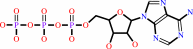 ATP
ATP
|
=
|
O-phospho-L-tyrosyl-[protein]
|
+
|
 ADP
ADP
|
+
|
H(+)
|
|
|
|
|
|
|
|
|
|
|
|
|
Molecule diagrams generated from .mol files obtained from the
KEGG ftp site
|
|
|
|
|
|
|
|
|
|
|
|
|
|
 |
|
|
|
|
|
|
| |
|
|
| |
|
|
Nature
463:501-506
(2010)
|
|
PubMed id:
|
|
|
|
|
|
| |
|
Targeting Bcr-Abl by combining allosteric with ATP-binding-site inhibitors.
|
|
J.Zhang,
F.J.Adrián,
W.Jahnke,
S.W.Cowan-Jacob,
A.G.Li,
R.E.Iacob,
T.Sim,
J.Powers,
C.Dierks,
F.Sun,
G.R.Guo,
Q.Ding,
B.Okram,
Y.Choi,
A.Wojciechowski,
X.Deng,
G.Liu,
G.Fendrich,
A.Strauss,
N.Vajpai,
S.Grzesiek,
T.Tuntland,
Y.Liu,
B.Bursulaya,
M.Azam,
P.W.Manley,
J.R.Engen,
G.Q.Daley,
M.Warmuth,
N.S.Gray.
|
|
|
|
|
| |
ABSTRACT
|
|
|
|
| |
|
|
In an effort to find new pharmacological modalities to overcome resistance to
ATP-binding-site inhibitors of Bcr-Abl, we recently reported the discovery of
GNF-2, a selective allosteric Bcr-Abl inhibitor. Here, using solution NMR, X-ray
crystallography, mutagenesis and hydrogen exchange mass spectrometry, we show
that GNF-2 binds to the myristate-binding site of Abl, leading to changes in the
structural dynamics of the ATP-binding site. GNF-5, an analogue of GNF-2 with
improved pharmacokinetic properties, when used in combination with the
ATP-competitive inhibitors imatinib or nilotinib, suppressed the emergence of
resistance mutations in vitro, displayed additive inhibitory activity in
biochemical and cellular assays against T315I mutant human Bcr-Abl and displayed
in vivo efficacy against this recalcitrant mutant in a murine bone-marrow
transplantation model. These results show that therapeutically relevant
inhibition of Bcr-Abl activity can be achieved with inhibitors that bind to the
myristate-binding site and that combining allosteric and ATP-competitive
inhibitors can overcome resistance to either agent alone.
|
|
|
|
|
|
|
|
|
|
|
|
|
|
|
|
|
|
 |
 |
 |
|
Literature references that cite this PDB file's key reference
|
|
|
| |
PubMed id
|
|
Reference
|
|
|
|
|
|
E.Gherardi,
W.Birchmeier,
C.Birchmeier,
and
G.Vande Woude
(2012).
Targeting MET in cancer: rationale and progress.
|
| |
Nat Rev Cancer,
12,
89.
|
|
|
|
|
|
|
T.O'Hare,
M.S.Zabriskie,
A.M.Eiring,
and
M.W.Deininger
(2012).
Pushing the limits of targeted therapy in chronic myeloid leukaemia.
|
| |
Nat Rev Cancer,
12,
513-526.
|
|
|
|
|
|
|
A.C.Burke,
R.T.Swords,
K.Kelly,
and
F.J.Giles
(2011).
Current status of agents active against the T315I chronic myeloid leukemia phenotype.
|
| |
Expert Opin Emerg Drugs,
16,
85.
|
|
|
|
|
|
|
C.Dalvit,
and
A.Vulpetti
(2011).
Fluorine-protein interactions and ¹⁹F NMR isotropic chemical shifts: An empirical correlation with implications for drug design.
|
| |
ChemMedChem,
6,
104-114.
|
|
|
|
|
|
|
C.R.Antonescu
(2011).
The GIST paradigm: lessons for other kinase-driven cancers.
|
| |
J Pathol,
223,
251-261.
|
|
|
|
|
|
|
E.Salah,
E.Ugochukwu,
A.J.Barr,
F.von Delft,
S.Knapp,
and
J.M.Elkins
(2011).
Crystal structures of ABL-related gene (ABL2) in complex with imatinib, tozasertib (VX-680), and a type I inhibitor of the triazole carbothioamide class.
|
| |
J Med Chem,
54,
2359-2367.
|
|
|
PDB code:
|
|
|
|
|
|
|
|
H.Sun,
V.Kapuria,
L.F.Peterson,
D.Fang,
W.G.Bornmann,
G.Bartholomeusz,
M.Talpaz,
and
N.J.Donato
(2011).
Bcr-Abl ubiquitination and Usp9x inhibition block kinase signaling and promote CML cell apoptosis.
|
| |
Blood,
117,
3151-3162.
|
|
|
|
|
|
|
J.Yang,
N.Campobasso,
M.P.Biju,
K.Fisher,
X.Q.Pan,
J.Cottom,
S.Galbraith,
T.Ho,
H.Zhang,
X.Hong,
P.Ward,
G.Hofmann,
B.Siegfried,
F.Zappacosta,
Y.Washio,
P.Cao,
J.Qu,
S.Bertrand,
D.Y.Wang,
M.S.Head,
H.Li,
S.Moores,
Z.Lai,
K.Johanson,
G.Burton,
C.Erickson-Miller,
G.Simpson,
P.Tummino,
R.A.Copeland,
and
A.Oliff
(2011).
Discovery and characterization of a cell-permeable, small-molecule c-Abl kinase activator that binds to the myristoyl binding site.
|
| |
Chem Biol,
18,
177-186.
|
|
|
PDB code:
|
|
|
|
|
|
|
|
L.Packer,
and
R.Marais
(2011).
Unswitch-ABL drugs overcome resistance in chronic myeloid leukemia.
|
| |
Cancer Cell,
19,
435-437.
|
|
|
|
|
|
|
L.R.Masterson,
L.Shi,
E.Metcalfe,
J.Gao,
S.S.Taylor,
and
G.Veglia
(2011).
Dynamically committed, uncommitted, and quenched states encoded in protein kinase A revealed by NMR spectroscopy.
|
| |
Proc Natl Acad Sci U S A,
108,
6969-6974.
|
|
|
|
|
|
|
M.J.Chalmers,
S.A.Busby,
B.D.Pascal,
G.M.West,
and
P.R.Griffin
(2011).
Differential hydrogen/deuterium exchange mass spectrometry analysis of protein-ligand interactions.
|
| |
Expert Rev Proteomics,
8,
43-59.
|
|
|
|
|
|
|
R.E.Iacob,
J.Zhang,
N.S.Gray,
and
J.R.Engen
(2011).
Allosteric interactions between the myristate- and ATP-site of the Abl kinase.
|
| |
PLoS One,
6,
e15929.
|
|
|
|
|
|
|
R.Eglen,
and
T.Reisine
(2011).
Drug discovery and the human kinome: recent trends.
|
| |
Pharmacol Ther,
130,
144-156.
|
|
|
|
|
|
|
S.Branford,
and
T.P.Hughes
(2011).
Mutational analysis in chronic myeloid leukemia: when and what to do?
|
| |
Curr Opin Hematol,
18,
111-116.
|
|
|
|
|
|
|
V.V.Vintonyak,
H.Waldmann,
and
D.Rauh
(2011).
Using small molecules to target protein phosphatases.
|
| |
Bioorg Med Chem,
19,
2145-2155.
|
|
|
|
|
|
|
A.A.Katouli,
and
N.L.Komarova
(2010).
Optimizing combination therapies with existing and future CML drugs.
|
| |
PLoS One,
5,
e12300.
|
|
|
|
|
|
|
A.Levitzki,
and
S.Klein
(2010).
Signal transduction therapy of cancer.
|
| |
Mol Aspects Med,
31,
287-329.
|
|
|
|
|
|
|
C.J.Lord,
and
A.Ashworth
(2010).
Biology-driven cancer drug development: back to the future.
|
| |
BMC Biol,
8,
38.
|
|
|
|
|
|
|
D.B.Kell
(2010).
Towards a unifying, systems biology understanding of large-scale cellular death and destruction caused by poorly liganded iron: Parkinson's, Huntington's, Alzheimer's, prions, bactericides, chemical toxicology and others as examples.
|
| |
Arch Toxicol,
84,
825-889.
|
|
|
|
|
|
|
E.Weisberg,
X.Deng,
H.G.Choi,
R.Barrett,
S.Adamia,
A.Ray,
D.Moreno,
A.L.Kung,
N.Gray,
and
J.D.Griffin
(2010).
Beneficial effects of combining a type II ATP competitive inhibitor with an allosteric competitive inhibitor of BCR-ABL for the treatment of imatinib-sensitive and imatinib-resistant CML.
|
| |
Leukemia,
24,
1375-1378.
|
|
|
|
|
|
|
J.Colicelli
(2010).
ABL tyrosine kinases: evolution of function, regulation, and specificity.
|
| |
Sci Signal,
3,
re6.
|
|
|
|
|
|
|
M.Radi,
E.Crespan,
F.Falchi,
V.Bernardo,
S.Zanoli,
F.Manetti,
S.Schenone,
G.Maga,
and
M.Botta
(2010).
Design and synthesis of thiadiazoles and thiazoles targeting the Bcr-Abl T315I mutant: from docking false positives to ATP-noncompetitive inhibitors.
|
| |
ChemMedChem,
5,
1226-1231.
|
|
|
|
|
|
|
N.Carayol,
E.Vakana,
A.Sassano,
S.Kaur,
D.J.Goussetis,
H.Glaser,
B.J.Druker,
N.J.Donato,
J.K.Altman,
S.Barr,
and
L.C.Platanias
(2010).
Critical roles for mTORC2- and rapamycin-insensitive mTORC1-complexes in growth and survival of BCR-ABL-expressing leukemic cells.
|
| |
Proc Natl Acad Sci U S A,
107,
12469-12474.
|
|
|
|
|
|
|
R.Huang,
I.Martinez-Ferrando,
and
P.A.Cole
(2010).
Enhanced interrogation: emerging strategies for cell signaling inhibition.
|
| |
Nat Struct Mol Biol,
17,
646-649.
|
|
|
|
|
|
|
S.Gonfloni
(2010).
DNA damage stress response in germ cells: role of c-Abl and clinical implications.
|
| |
Oncogene,
29,
6193-6202.
|
|
|
|
|
|
|
X.Deng,
B.Okram,
Q.Ding,
J.Zhang,
Y.Choi,
F.J.Adrián,
A.Wojciechowski,
G.Zhang,
J.Che,
B.Bursulaya,
S.W.Cowan-Jacob,
G.Rummel,
T.Sim,
and
N.S.Gray
(2010).
Expanding the diversity of allosteric bcr-abl inhibitors.
|
| |
J Med Chem,
53,
6934-6946.
|
|
|
|
|
|
The most recent references are shown first.
Citation data come partly from CiteXplore and partly
from an automated harvesting procedure. Note that this is likely to be
only a partial list as not all journals are covered by
either method. However, we are continually building up the citation data
so more and more references will be included with time.
Where a reference describes a PDB structure, the PDB
code is
shown on the right.
|
|


 Links
Links


