 |
PDBsum entry 3g58

|
|
|
|
|
 |
Contents |
 |
|
|
|
|
|
|
|
|
|
|
|
|
|
|
* Residue conservation analysis
|
|
|
|
|
|
|
|
|
|
|
Enzyme class:
|
|
E.C.3.1.4.53
- 3',5'-cyclic-AMP phosphodiesterase.
|
|
|
|
|
|
|
Reaction:
|
|
3',5'-cyclic AMP + H2O = AMP + H+
|
|
|
|
|
|
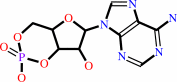 3',5'-cyclic AMP
|
+
|
H2O
|
=
|
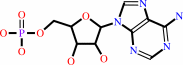 AMP
AMP
|
+
|
H(+)
|
|
|
|
|
|
|
|
|
|
|
|
|
Molecule diagrams generated from .mol files obtained from the
KEGG ftp site
|
|
|
|
|
|
|
|
|
|
|
|
|
|
 |
|
|
|
|
|
|
| |
|
|
| |
|
DOI no:
|
Nat Biotechnol
28:63-70
(2010)
|
|
PubMed id:
|
|
|
|
|
|
| |
|
Design of phosphodiesterase 4D (PDE4D) allosteric modulators for enhancing cognition with improved safety.
|
|
A.B.Burgin,
O.T.Magnusson,
J.Singh,
P.Witte,
B.L.Staker,
J.M.Bjornsson,
M.Thorsteinsdottir,
S.Hrafnsdottir,
T.Hagen,
A.S.Kiselyov,
L.J.Stewart,
M.E.Gurney.
|
|
|
|
|
| |
ABSTRACT
|
|
|
|
| |
|
|
Phosphodiesterase 4 (PDE4), the primary cAMP-hydrolyzing enzyme in cells, is a
promising drug target for a wide range of conditions. Here we present seven
co-crystal structures of PDE4 and bound inhibitors that show the regulatory
domain closed across the active site, thereby revealing the structural basis of
PDE4 regulation. This structural insight, together with supporting mutagenesis
and kinetic studies, allowed us to design small-molecule allosteric modulators
of PDE4D that do not completely inhibit enzymatic activity (I(max) approximately
80-90%). These allosteric modulators have reduced potential to cause emesis, a
dose-limiting side effect of existing active site-directed PDE4 inhibitors,
while maintaining biological activity in cellular and in vivo models. Our
results may facilitate the design of CNS therapeutics modulating cAMP signaling
for the treatment of Alzheimer's disease, Huntington's disease, schizophrenia
and depression, where brain distribution is desired for therapeutic benefit.
|
|
|
|
|
|
| |
Selected figure(s)
|
|
|
|
| |
|
|

|
|

|
|
Figure 2.
(a) A surface representation of the PDE4D catalytic domain
(gray) bound with RS25344 (F[o]-F[c] omit maps in magenta)
interacting with UCR2 (green) (PDB ID: 3G4G). (b) Schematic
representation of RS25344 interacting with catalytic domain
residues (Met439, Phe506, Phe538, Ile502, Gln535) and UCR2
(Phe196). (c) A surface representation of the PDE4B catalytic
domain (gray) bound with PMNPQ (F[o]-F[c] omit maps in magenta)
interacting with UCR2 (green) (PDB ID: 3G45). (d) Schematic
representation of PMNPQ interacting with catalytic domain
residues (Met519, Phe586, Phe618, Ile582, Gln615) and UCR2
(Tyr274). (e) Key hydrophobic interactions between the UCR2
domain (PDE4D(PDB ID: 3G4G)) and the catalytic domain. The UCR2
helix is surface rendered, and key residues are highlighted in
green. The catalytic domain is surface rendered, and key
residues are highlighted in blue. (f) The UCR2 helix is shown
without surface rendering. Hydrophilic residues oriented toward
solvent are labeled. RS25344 is not illustrated in order to
simplify visualization of the interactions between UCR2 and the
catalytic domain.
|
|
Figure 4.
Key elements of the pharmacophore include a planar scaffold
providing a hydrogen bond acceptor, a linker and two aromatic
substituents that create a clamp to hold UCR2 in the closed
conformation across the active site. F and P signify compounds
with “full” or “partial” inhibition kinetic behavior.
(a) Scaffolds providing a hydrogen-bond acceptor to Gln535. (b)
Aromatic Ar[1] substituents providing a part of the UCR2 clamp.
(c) Aromatic Ar[2] substituents providing a part of the UCR2
clamp. (d) Co-crystal structure of a representative
methoxyphenyl allosteric modulator (D159153) bound to PDE4D
showing the UCR2 helix in the closed conformation. The
regulatory helix is shown as a ribbon (green), the Fo-Fc omit
map for the ligand is highlighted in magenta, and the active
site surface is rendered in gray with key residues colored cyan.
(e) Binding mode of D159153 to PDE4D indicating critical
interactions.
|
|
|
|
|
|
| |
The above figures are
reprinted
by permission from Macmillan Publishers Ltd:
Nat Biotechnol
(2010,
28,
63-70)
copyright 2010.
|
|
| |
Figures were
selected
by an automated process.
|
|
|
|
|
|
|
|
|
|
|
|
|
|
|
|
 |
 |
 |
|
Literature references that cite this PDB file's key reference
|
|
|
| |
PubMed id
|
|
Reference
|
|
|
|
|
|
K.F.MacKenzie,
D.A.Wallace,
E.V.Hill,
D.F.Anthony,
D.J.Henderson,
D.M.Houslay,
J.S.Arthur,
G.S.Baillie,
and
M.D.Houslay
(2011).
Phosphorylation of cAMP-specific PDE4A5 (phosphodiesterase-4A5) by MK2 (MAPKAPK2) attenuates its activation through protein kinase A phosphorylation.
|
| |
Biochem J,
435,
755-769.
|
|
|
|
|
|
|
L.X.Li,
Y.F.Cheng,
H.B.Lin,
C.Wang,
J.P.Xu,
and
H.T.Zhang
(2011).
Prevention of cerebral ischemia-induced memory deficits by inhibition of phosphodiesterase-4 in rats.
|
| |
Metab Brain Dis,
26,
37-47.
|
|
|
|
|
|
|
R.W.Allcock,
H.Blakli,
Z.Jiang,
K.A.Johnston,
K.M.Morgan,
G.M.Rosair,
K.Iwase,
Y.Kohno,
and
D.R.Adams
(2011).
Phosphodiesterase inhibitors. Part 1: Synthesis and structure-activity relationships of pyrazolopyridine-pyridazinone PDE inhibitors developed from ibudilast.
|
| |
Bioorg Med Chem Lett,
21,
3307-3312.
|
|
|
|
|
|
|
W.C.Ko,
L.H.Lin,
H.Y.Shen,
C.Y.Lai,
C.M.Chen,
and
C.H.Shih
(2011).
Biochanin a, a phytoestrogenic isoflavone with selective inhibition of phosphodiesterase 4, suppresses ovalbumin-induced airway hyperresponsiveness.
|
| |
Evid Based Complement Alternat Med,
2011,
635058.
|
|
|
|
|
|
|
X.D.Wang,
Y.Chen,
M.Wolf,
K.V.Wagner,
C.Liebl,
S.H.Scharf,
D.Harbich,
B.Mayer,
W.Wurst,
F.Holsboer,
J.M.Deussing,
T.Z.Baram,
M.B.Müller,
and
M.V.Schmidt
(2011).
Forebrain CRHR1 deficiency attenuates chronic stress-induced cognitive deficits and dendritic remodeling.
|
| |
Neurobiol Dis,
42,
300-310.
|
|
|
|
|
|
|
K.R.Johnson,
J.Nicodemus-Johnson,
and
R.S.Danziger
(2010).
An evolutionary analysis of cAMP-specific Phosphodiesterase 4 alternative splicing.
|
| |
BMC Evol Biol,
10,
247.
|
|
|
|
|
|
|
M.D.Houslay,
and
D.R.Adams
(2010).
Putting the lid on phosphodiesterase 4.
|
| |
Nat Biotechnol,
28,
38-40.
|
|
|
|
|
|
|
N.J.Gross,
M.A.Giembycz,
and
S.I.Rennard
(2010).
Treatment of chronic obstructive pulmonary disease with roflumilast, a new phosphodiesterase 4 inhibitor.
|
| |
COPD,
7,
141-153.
|
|
|
|
|
|
|
X.Li,
S.Vadrevu,
A.Dunlop,
J.Day,
N.Advant,
J.Troeger,
E.Klussmann,
E.Jaffrey,
R.T.Hay,
D.R.Adams,
M.D.Houslay,
and
G.S.Baillie
(2010).
Selective SUMO modification of cAMP-specific phosphodiesterase-4D5 (PDE4D5) regulates the functional consequences of phosphorylation by PKA and ERK.
|
| |
Biochem J,
428,
55-65.
|
|
|
|
|
|
The most recent references are shown first.
Citation data come partly from CiteXplore and partly
from an automated harvesting procedure. Note that this is likely to be
only a partial list as not all journals are covered by
either method. However, we are continually building up the citation data
so more and more references will be included with time.
|
|


 Links
Links


