
|
|
|
|
|
 |
Contents |
 |
|
|
|
|
|
|
|
|
|
|
|

 316 a.a.
|
|
|
|
|
|
|
|
|
|
|

 254 a.a.
|
|
|
|
|
|
|
|
|
|
|


 371 a.a.
|
|
|
|
|
|
|
* Residue conservation analysis
|
|
|
|
|
|
PDB id:
|
|
|
|
| Name: |
|
Transport protein
|
|
|
Title:
|
|
Crystal structure of the resting state maltose transporter from e. Coli
|
|
Structure:
|
|
Maltose transport system permease protein malf. Chain: f, h. Engineered: yes. Maltose transport system permease protein malg. Chain: g, i. Engineered: yes. Maltose/maltodextrin import atp-binding protein malk. Chain: a, b, c, d. Engineered: yes
|
|
Source:
|
|
Escherichia coli. Organism_taxid: 83333. Strain: k-12. Gene: b4033, jw3993, malf. Expressed in: escherichia coli. Expression_system_taxid: 562. Gene: b4032, jw3992, malg. Gene: b4035, jw3995, malk. Expression_system_taxid: 562
|
|
Resolution:
|
|
|
4.50Å
|
R-factor:
|
0.340
|
R-free:
|
0.363
|
|
|
Authors:
|
|
D.Khare,M.L.Oldham,C.Orelle,A.L.Davidson,J.Chen
|
Key ref:

|
|
D.Khare
et al.
(2009).
Alternating access in maltose transporter mediated by rigid-body rotations.
Mol Cell,
33,
528-536.
PubMed id:
DOI:

|
|
|
Date:
|
|
|
08-Dec-08
|
Release date:
|
03-Mar-09
|
|
|
|
|
|
|
PROCHECK
|

|
|
|
|
|
Headers
|
|
|
|
References
|
|
|
|
|
|

|
|
P02916
(MALF_ECOLI) -
Maltose/maltodextrin transport system permease protein MalF from Escherichia coli (strain K12)
|
|
|
|
Seq:
Struc:
|
|
|
|
514 a.a.
316 a.a.
|
|

|

|

|
|
|
|
|
|
|
|
|
|
|
|
|
|
|
|
|
Enzyme class:
|
|
Chains A, B, C, D:
E.C.7.5.2.1
- ABC-type maltose transporter.
|
|
|
|
|
|
|
Reaction:
|
|
D-maltose(out) + ATP + H2O = D-maltose(in) + ADP + phosphate + H+
|
|
|
|
|
|
D-maltose(out)
|
+
|
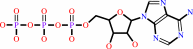 ATP
ATP
|
+
|
H2O
|
=
|
D-maltose(in)
|
+
|
 ADP
ADP
|
+
|
 phosphate
|
+
|
H(+)
|
|
|
|
|
|
|
|
|
|
|
|
|
Molecule diagrams generated from .mol files obtained from the
KEGG ftp site
|
|
|
|
|
|
|
|
|
|
|
|
|
|
 |
|
|
|
|
|
|
| |
|
|
| |
|
DOI no:
|
Mol Cell
33:528-536
(2009)
|
|
PubMed id:
|
|
|
|
|
|
| |
|
Alternating access in maltose transporter mediated by rigid-body rotations.
|
|
D.Khare,
M.L.Oldham,
C.Orelle,
A.L.Davidson,
J.Chen.
|
|
|
|
|
| |
ABSTRACT
|
|
|
|
| |
|
|
ATP-binding cassette transporters couple ATP hydrolysis to substrate
translocation through an alternating access mechanism, but the nature of the
conformational changes in a transport cycle remains elusive. Previously we
reported the structure of the maltose transporter MalFGK(2) in an outward-facing
conformation in which the transmembrane (TM) helices outline a substrate-binding
pocket open toward the periplasmic surface and ATP is poised for hydrolysis
along the closed nucleotide-binding dimer interface. Here we report the
structure of the nucleotide-free maltose transporter in which the substrate
binding pocket is only accessible from the cytoplasm and the nucleotide-binding
interface is open. Comparison of the same transporter crystallized in two
different conformations reveals that alternating access involves rigid-body
rotations of the TM subdomains that are coupled to the closure and opening of
the nucleotide-binding domain interface. The comparison also reveals that point
mutations enabling binding protein-independent transport line dynamic interfaces
in the TM region.
|
|
|
|
|
|
| |
Selected figure(s)
|
|
|
|
| |
|
|

|
|

|
|
Figure 2.
Figure 2. Alternating Access in the Maltose Transporter
Ribbon diagram (left) and a 12 Å slab view (right) of the
maltose transporter in (A) the inward-facing, resting-state
conformation and (B) the outward-facing, catalytic intermediate
conformation (Oldham et al., 2007). The maltose and ATP are
shown in CPK and ball-and-stick models, respectively.
|
|
Figure 4.
Figure 4. Conformational Changes in the MalK Subunits
(A
and B) Ribbon diagram of the MalK (A) open dimer in the
inward-facing structure and (B) closed dimer in the
outward-facing structure. The two NBDs are colored in green and
red, and the regulatory domains are colored in gray. The helical
subdomains are indicated and colored in light green or red. The
Walker A (WA) and the LSGGQ motifs are colored in blue and
yellow, respectively. ATP is shown in stick models.
(C)
Stereodiagram of MalK in the resting state. Using the regulatory
domains (gray) as the frame of reference, rotations of the two
NBDs (green and red) leading to the closed dimer are indicated.
|
|
|
|
|
|
| |
The above figures are
reprinted
from an Open Access publication published by Cell Press:
Mol Cell
(2009,
33,
528-536)
copyright 2009.
|
|
| |
Figures were
selected
by an automated process.
|
|
|
|
|
|
|
|
|
|
|
|
|
|
|
|
 |
 |
 |
|
Literature references that cite this PDB file's key reference
|
|
|
| |
PubMed id
|
|
Reference
|
|
|
|
|
|
A.Picollo,
Y.Xu,
N.Johner,
S.Bernèche,
and
A.Accardi
(2012).
Synergistic substrate binding determines the stoichiometry of transport of a prokaryotic H(+)/Cl(-) exchanger.
|
| |
Nat Struct Mol Biol,
19,
525.
|
|
|
|
|
|
|
M.S.Jin,
M.L.Oldham,
Q.Zhang,
and
J.Chen
(2012).
Crystal structure of the multidrug transporter P-glycoprotein from Caenorhabditis elegans.
|
| |
Nature,
490,
566-569.
|
|
|
PDB code:
|
|
|
|
|
|
|
|
A.S.Oliveira,
A.M.Baptista,
and
C.M.Soares
(2011).
Conformational changes induced by ATP-hydrolysis in an ABC transporter: A molecular dynamics study of the Sav1866 exporter.
|
| |
Proteins,
79,
1977-1990.
|
|
|
|
|
|
|
S.Wu,
S.Liu,
C.H.Davis,
D.W.Stafford,
J.D.Kulman,
and
L.G.Pedersen
(2011).
A hetero-dimer model for concerted action of vitamin K carboxylase and vitamin K reductase in vitamin K cycle.
|
| |
J Theor Biol,
279,
143-149.
|
|
|
|
|
|
|
T.Eitinger,
D.A.Rodionov,
M.Grote,
and
E.Schneider
(2011).
Canonical and ECF-type ATP-binding cassette importers in prokaryotes: diversity in modular organization and cellular functions.
|
| |
FEMS Microbiol Rev,
35,
3.
|
|
|
|
|
|
|
A.D.Gould,
and
B.H.Shilton
(2010).
Studies of the maltose transport system reveal a mechanism for coupling ATP hydrolysis to substrate translocation without direct recognition of substrate.
|
| |
J Biol Chem,
285,
11290-11296.
|
|
|
PDB codes:
|
|
|
|
|
|
|
|
C.Orelle,
F.J.Alvarez,
M.L.Oldham,
A.Orelle,
T.E.Wiley,
J.Chen,
and
A.L.Davidson
(2010).
Dynamics of alpha-helical subdomain rotation in the intact maltose ATP-binding cassette transporter.
|
| |
Proc Natl Acad Sci U S A,
107,
20293-20298.
|
|
|
|
|
|
|
D.A.Gutmann,
A.Ward,
I.L.Urbatsch,
G.Chang,
and
H.W.van Veen
(2010).
Understanding polyspecificity of multidrug ABC transporters: closing in on the gaps in ABCB1.
|
| |
Trends Biochem Sci,
35,
36-42.
|
|
|
|
|
|
|
E.Bordignon,
M.Grote,
and
E.Schneider
(2010).
The maltose ATP-binding cassette transporter in the 21st century--towards a structural dynamic perspective on its mode of action.
|
| |
Mol Microbiol,
77,
1354-1366.
|
|
|
|
|
|
|
E.Crowley,
and
R.Callaghan
(2010).
Multidrug efflux pumps: drug binding--gates or cavity?
|
| |
FEBS J,
277,
530-539.
|
|
|
|
|
|
|
G.H.Thomas
(2010).
Homes for the orphans: utilization of multiple substrate-binding proteins by ABC transporters.
|
| |
Mol Microbiol,
75,
6-9.
|
|
|
|
|
|
|
H.W.van Veen
(2010).
Structural biology: Last of the multidrug transporters.
|
| |
Nature,
467,
926-927.
|
|
|
|
|
|
|
J.A.Lundbaek,
S.A.Collingwood,
H.I.Ingólfsson,
R.Kapoor,
and
O.S.Andersen
(2010).
Lipid bilayer regulation of membrane protein function: gramicidin channels as molecular force probes.
|
| |
J R Soc Interface,
7,
373-395.
|
|
|
|
|
|
|
J.V.Møller,
C.Olesen,
A.M.Winther,
and
P.Nissen
(2010).
The sarcoplasmic Ca2+-ATPase: design of a perfect chemi-osmotic pump.
|
| |
Q Rev Biophys,
43,
501-566.
|
|
|
|
|
|
|
J.W.Weng,
K.N.Fan,
and
W.N.Wang
(2010).
The conformational transition pathway of ATP binding cassette transporter MsbA revealed by atomistic simulations.
|
| |
J Biol Chem,
285,
3053-3063.
|
|
|
|
|
|
|
M.F.Tsai,
M.Li,
and
T.C.Hwang
(2010).
Stable ATP binding mediated by a partial NBD dimer of the CFTR chloride channel.
|
| |
J Gen Physiol,
135,
399-414.
|
|
|
|
|
|
|
O.Lewinson,
A.T.Lee,
K.P.Locher,
and
D.C.Rees
(2010).
A distinct mechanism for the ABC transporter BtuCD-BtuF revealed by the dynamics of complex formation.
|
| |
Nat Struct Mol Biol,
17,
332-338.
|
|
|
|
|
|
|
S.J.Facey,
and
A.Kuhn
(2010).
Biogenesis of bacterial inner-membrane proteins.
|
| |
Cell Mol Life Sci,
67,
2343-2362.
|
|
|
|
|
|
|
Y.Bai,
M.Li,
and
T.C.Hwang
(2010).
Dual roles of the sixth transmembrane segment of the CFTR chloride channel in gating and permeation.
|
| |
J Gen Physiol,
136,
293-309.
|
|
|
|
|
|
|
A.D.Gould,
P.G.Telmer,
and
B.H.Shilton
(2009).
Stimulation of the maltose transporter ATPase by unliganded maltose binding protein.
|
| |
Biochemistry,
48,
8051-8061.
|
|
|
|
|
|
|
C.Oswald,
S.H.Smits,
M.Höing,
E.Bremer,
and
L.Schmitt
(2009).
Structural analysis of the choline-binding protein ChoX in a semi-closed and ligand-free conformation.
|
| |
Biol Chem,
390,
1163-1170.
|
|
|
PDB code:
|
|
|
|
|
|
|
|
P.M.Jones,
M.L.O'Mara,
and
A.M.George
(2009).
ABC transporters: a riddle wrapped in a mystery inside an enigma.
|
| |
Trends Biochem Sci,
34,
520-531.
|
|
|
|
|
|
|
P.Zou,
and
H.S.McHaourab
(2009).
Alternating access of the putative substrate-binding chamber in the ABC transporter MsbA.
|
| |
J Mol Biol,
393,
574-585.
|
|
|
|
|
|
|
P.Zou,
M.Bortolus,
and
H.S.McHaourab
(2009).
Conformational cycle of the ABC transporter MsbA in liposomes: detailed analysis using double electron-electron resonance spectroscopy.
|
| |
J Mol Biol,
393,
586-597.
|
|
|
|
|
|
|
S.Newstead,
P.W.Fowler,
P.Bilton,
E.P.Carpenter,
P.J.Sadler,
D.J.Campopiano,
M.S.Sansom,
and
S.Iwata
(2009).
Insights into how nucleotide-binding domains power ABC transport.
|
| |
Structure,
17,
1213-1222.
|
|
|
PDB code:
|
|
|
|
|
|
|
|
V.Kos,
and
R.C.Ford
(2009).
The ATP-binding cassette family: a structural perspective.
|
| |
Cell Mol Life Sci,
66,
3111-3126.
|
|
|
|
|
|
|
Y.Zhou,
Y.Nie,
and
H.R.Kaback
(2009).
Residues gating the periplasmic pathway of LacY.
|
| |
J Mol Biol,
394,
219-225.
|
|
|
|
|
|
The most recent references are shown first.
Citation data come partly from CiteXplore and partly
from an automated harvesting procedure. Note that this is likely to be
only a partial list as not all journals are covered by
either method. However, we are continually building up the citation data
so more and more references will be included with time.
Where a reference describes a PDB structure, the PDB
code is
shown on the right.
|
 |
|


 Links
Links


