 |
PDBsum entry 3f6x

|
|
|
|
|
 |
Contents |
 |
|
|
|
|
|
|
|
|
|
|
|
|
* Residue conservation analysis
|
|
|
|
|
|
PDB id:
|
|
|
|
| Name: |
|
Transferase
|
|
|
Title:
|
|
C-src kinase domain in complex with small molecule inhibitor
|
|
Structure:
|
|
Proto-oncogene tyrosine-protein kinase src. Chain: a, b, c, d. Fragment: unp residues 251-533. Synonym: pp60c-src, p60-src, c-src. Engineered: yes
|
|
Source:
|
|
Gallus gallus. Bantam,chickens. Organism_taxid: 9031. Gene: src. Expressed in: escherichia coli. Expression_system_taxid: 562.
|
|
Resolution:
|
|
|
2.35Å
|
R-factor:
|
0.234
|
R-free:
|
0.266
|
|
|
Authors:
|
|
M.A.Seeliger,A.V.Statsuk,D.J.Maly,P.Z.Patrick,J.Kuriyan,K.M.Shokat
|
|
Key ref:
|
|
A.V.Statsuk
et al.
(2008).
Tuning a three-component reaction for trapping kinase substrate complexes.
J Am Chem Soc,
130,
17568-17574.
PubMed id:
|
|
|
Date:
|
|
|
06-Nov-08
|
Release date:
|
09-Dec-08
|
|
|
|
|
|
|
PROCHECK
|

|
|
|
|
|
Headers
|
|
|
|
References
|
|
|
|
|
|

|
|
P00523
(SRC_CHICK) -
Proto-oncogene tyrosine-protein kinase Src from Gallus gallus
|
|
|
|
Seq:
Struc:
|
|
|
|
533 a.a.
264 a.a.
|
|

|

|
|
|
|
|
|
|
|
|
|
|
|
Key: |
 |
PfamA domain |
|
|
 |
Secondary structure |
|
 |
CATH domain |
|
|
|
|
|
|
|
|
|
|
|
|
|
Enzyme class:
|
|
E.C.2.7.10.2
- non-specific protein-tyrosine kinase.
|
|
|
|
|
|
|
Reaction:
|
|
L-tyrosyl-[protein] + ATP = O-phospho-L-tyrosyl-[protein] + ADP + H+
|
|
|
|
|
|
L-tyrosyl-[protein]
|
+
|
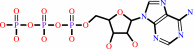 ATP
ATP
|
=
|
O-phospho-L-tyrosyl-[protein]
|
+
|
 ADP
ADP
|
+
|
H(+)
|
|
|
|
|
|
|
|
|
|
|
|
|
Molecule diagrams generated from .mol files obtained from the
KEGG ftp site
|
|
|
|
|
|
|
|
|
|
|
|
|
|
 |
|
|
|
|
|
|
| |
|
|
| |
|
|
J Am Chem Soc
130:17568-17574
(2008)
|
|
PubMed id:
|
|
|
|
|
|
| |
|
Tuning a three-component reaction for trapping kinase substrate complexes.
|
|
A.V.Statsuk,
D.J.Maly,
M.A.Seeliger,
M.A.Fabian,
W.H.Biggs,
D.J.Lockhart,
P.P.Zarrinkar,
J.Kuriyan,
K.M.Shokat.
|
|
|
|
|
| |
ABSTRACT
|
|
|
|
| |
|
|
The upstream protein kinases responsible for thousands of phosphorylation events
in the phosphoproteome remain to be discovered. We developed a three-component
chemical reaction which converts the transient noncovalent substrate-kinase
complex into a covalently cross-linked product by utilizing a dialdehyde-based
cross-linker, 1. Unfortunately, the reaction of 1 with a lysine in the kinase
active site and an engineered cysteine on the substrate to form an isoindole
cross-linked product could not be performed in the presence of competing
cellular proteins due to nonspecific side reactions. In order to more
selectively target the cross-linker to protein kinases in cell lysates, we
replaced the weak, kinase-binding adenosine moiety of 1 with a potent protein
kinase inhibitor scaffold. In addition, we replaced the o-phthaldialdehyde
moiety in 1 with a less-reactive thiophene-2,3-dicarboxaldehyde moiety. The
combination of these two structural modifications provides for cross-linking of
a cysteine-containing substrate to its corresponding kinase in the presence of
competing cellular proteins.
|
|
|
|
|
|
|
|
|
|
|
|
|
|
|
|
|
|
 |
 |
 |
|
Literature references that cite this PDB file's key reference
|
|
|
| |
PubMed id
|
|
Reference
|
|
|
|
|
|
D.F.Brennan,
A.C.Dar,
N.T.Hertz,
W.C.Chao,
A.L.Burlingame,
K.M.Shokat,
and
D.Barford
(2011).
A Raf-induced allosteric transition of KSR stimulates phosphorylation of MEK.
|
| |
Nature,
472,
366-369.
|
|
|
PDB code:
|
|
|
|
|
|
|
|
S.Suwal,
and
M.K.Pflum
(2010).
Phosphorylation-dependent kinase-substrate cross-linking.
|
| |
Angew Chem Int Ed Engl,
49,
1627-1630.
|
|
|
|
|
|
|
K.Kubota,
R.Anjum,
Y.Yu,
R.C.Kunz,
J.N.Andersen,
M.Kraus,
H.Keilhack,
K.Nagashima,
S.Krauss,
C.Paweletz,
R.C.Hendrickson,
A.S.Feldman,
C.L.Wu,
J.Rush,
J.Villén,
and
S.P.Gygi
(2009).
Sensitive multiplexed analysis of kinase activities and activity-based kinase identification.
|
| |
Nat Biotechnol,
27,
933-940.
|
|
|
|
|
|
The most recent references are shown first.
Citation data come partly from CiteXplore and partly
from an automated harvesting procedure. Note that this is likely to be
only a partial list as not all journals are covered by
either method. However, we are continually building up the citation data
so more and more references will be included with time.
Where a reference describes a PDB structure, the PDB
code is
shown on the right.
|
|


 Links
Links


