 |
PDBsum entry 3ds6

|
|
|
|
|
 |
Contents |
 |
|
|
|
|
|
|
|
|
|
|
* Residue conservation analysis
|
|
|
|
|
|
PDB id:
|
|
|
|
| Name: |
|
Transferase
|
|
|
Title:
|
|
P38 complex with a phthalazine inhibitor
|
|
Structure:
|
|
Mitogen-activated protein kinase 14. Chain: a, b, c, d. Fragment: human p38 kinase. Synonym: mitogen-activated protein kinase p38 alpha, map kinase p38 alpha, cytokine suppressive anti-inflammatory drug-binding protein, csaid-binding protein, csbp, max-interacting protein 2, map kinase mxi2, sapk2a. Engineered: yes. Mutation: yes
|
|
Source:
|
|
Homo sapiens. Human. Organism_taxid: 9606. Gene: mapk14, csbp, csbp1, csbp2, cspb1, mxi2. Expressed in: escherichia coli. Expression_system_taxid: 562
|
|
Resolution:
|
|
|
2.90Å
|
R-factor:
|
0.228
|
R-free:
|
0.319
|
|
|
Authors:
|
|
B.Herberich,R.Syed,V.Li,D.Grosfeld
|
|
Key ref:
|
|
B.Herberich
et al.
(2008).
Discovery of highly selective and potent p38 inhibitors based on a phthalazine scaffold.
J Med Chem,
51,
6271-6279.
PubMed id:
|
|
|
Date:
|
|
|
11-Jul-08
|
Release date:
|
07-Oct-08
|
|
|
|
|
|
|
PROCHECK
|

|
|
|
|
|
Headers
|
|
|
|
References
|
|
|
|
|
|

|
|
Q16539
(MK14_HUMAN) -
Mitogen-activated protein kinase 14 from Homo sapiens
|
|
|
|
Seq:
Struc:
|
|
|
|
360 a.a.
343 a.a.
|
|

|

|

|
|
|
|
|
|
|
|
|
|
|
Key: |
 |
PfamA domain |
|
|
 |
Secondary structure |
|
 |
CATH domain |
|
|
|
|
|
|
|
|
|
|
|
|
|
Enzyme class:
|
|
E.C.2.7.11.24
- mitogen-activated protein kinase.
|
|
|
|
|
|
|
Reaction:
|
|
|
1.
|
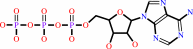
L-seryl-[protein] + ATP = O-phospho-L-seryl-[protein] + ADP + H+
|
|
2.
|
L-threonyl-[protein] + ATP = O-phospho-L-threonyl-[protein] + ADP + H+
|
|
|
|
|
|
|
L-seryl-[protein]
|
+
|
 ATP
ATP
|
=
|
O-phospho-L-seryl-[protein]
|
+
|
 ADP
ADP
|
+
|
H(+)
|
|
|
|
|
|
|
L-threonyl-[protein]
|
+
|
ATP
|
=
|
O-phospho-L-threonyl-[protein]
|
+
|
ADP
|
+
|
H(+)
|
|
|
|
|
|
|
|
|
|
|
|
|
Molecule diagrams generated from .mol files obtained from the
KEGG ftp site
|
|
|
|
|
|
|
|
|
|
|
|
|
|
 |
|
|
|
|
|
|
| |
|
|
| |
|
|
J Med Chem
51:6271-6279
(2008)
|
|
PubMed id:
|
|
|
|
|
|
| |
|
Discovery of highly selective and potent p38 inhibitors based on a phthalazine scaffold.
|
|
B.Herberich,
G.Q.Cao,
P.P.Chakrabarti,
J.R.Falsey,
L.Pettus,
R.M.Rzasa,
A.B.Reed,
A.Reichelt,
K.Sham,
M.Thaman,
R.P.Wurz,
S.Xu,
D.Zhang,
F.Hsieh,
M.R.Lee,
R.Syed,
V.Li,
D.Grosfeld,
M.H.Plant,
B.Henkle,
L.Sherman,
S.Middleton,
L.M.Wong,
A.S.Tasker.
|
|
|
|
|
| |
ABSTRACT
|
|
|
|
| |
|
|
Investigations into the structure-activity relationships (SAR) of a series of
phthalazine-based inhibitors of p38 are described. These efforts originated from
quinazoline 1 and through rational design led to the development of a series of
orally bioavailable, potent, and selective inhibitors. Kinase selectivity was
achieved by exploiting a collection of interactions with p38alpha including
close contact to Ala157, occupation of the hydrophobic gatekeeper pocket, and a
residue flip with Gly110. Substitutions on the phthalazine influenced the
pharmacokinetic properties, of which compound 16 displayed the most desirable
profile. Oral dosing (0.03 mg/kg) of 16 in rats 1 h prior to LPS challenge gave
a >50% decrease in TNFalpha production.
|
|
|
|
|
|
|
|
|
|
|
|
|
|
|
|
|
|
 |
 |
 |
|
Literature references that cite this PDB file's key reference
|
|
|
| |
PubMed id
|
|
Reference
|
|
|
|
|
|
M.Soth,
S.Abbot,
A.Abubakari,
N.Arora,
H.Arzeno,
R.Billedeau,
N.Dewdney,
K.Durkin,
S.Frauchiger,
M.Ghate,
D.M.Goldstein,
R.J.Hill,
A.Kuglstatter,
F.Li,
B.Loe,
K.McCaleb,
J.McIntosh,
E.Papp,
J.Park,
M.Stahl,
M.L.Sung,
R.Suttman,
D.C.Swinney,
P.Weller,
B.Wong,
H.Zecic,
and
T.Gabriel
(2011).
3-Amino-pyrazolo[3,4-d]pyrimidines as p38α kinase inhibitors: Design and development to a highly selective lead.
|
| |
Bioorg Med Chem Lett,
21,
3452-3456.
|
|
|
|
|
|
|
L.K.Chico,
L.J.Van Eldik,
and
D.M.Watterson
(2009).
Targeting protein kinases in central nervous system disorders.
|
| |
Nat Rev Drug Discov,
8,
892-909.
|
|
|
|
|
|
|
L.R.Coulthard,
D.E.White,
D.L.Jones,
M.F.McDermott,
and
S.A.Burchill
(2009).
p38(MAPK): stress responses from molecular mechanisms to therapeutics.
|
| |
Trends Mol Med,
15,
369-379.
|
|
|
|
|
|
The most recent references are shown first.
Citation data come partly from CiteXplore and partly
from an automated harvesting procedure. Note that this is likely to be
only a partial list as not all journals are covered by
either method. However, we are continually building up the citation data
so more and more references will be included with time.
|
|


 Links
Links


