 |
PDBsum entry 3dqw

|
|
|
|
|
 |
Contents |
 |
|
|
|
|
|
|
|
|
|
|
|
|
|
|
* Residue conservation analysis
|
|
|
|
|
|
PDB id:
|
|
|
|
| Name: |
|
Transferase
|
|
|
Title:
|
|
C-src kinase domain thr338ile mutant in complex with atpgs
|
|
Structure:
|
|
Proto-oncogene tyrosine-protein kinase src. Chain: a, b, c, d. Fragment: chicken c-src kinase domain 251-533. Synonym: pp60c-src, p60-src, c-src. Engineered: yes. Mutation: yes
|
|
Source:
|
|
Gallus gallus. Chicken. Organism_taxid: 9031. Gene: src. Expressed in: escherichia coli. Expression_system_taxid: 562.
|
|
Resolution:
|
|
|
2.02Å
|
R-factor:
|
0.207
|
R-free:
|
0.246
|
|
|
Authors:
|
|
M.Azam,M.A.Seeliger,N.Gray,J.Kuriyan,G.Q.Daley
|
Key ref:

|
|
M.Azam
et al.
(2008).
Activation of tyrosine kinases by mutation of the gatekeeper threonine.
Nat Struct Biol,
15,
1109-1118.
PubMed id:
DOI:

|
|
|
Date:
|
|
|
09-Jul-08
|
Release date:
|
23-Sep-08
|
|
|
|
|
|
|
PROCHECK
|

|
|
|
|
|
Headers
|
|
|
|
References
|
|
|
|
|
|

|
|
P00523
(SRC_CHICK) -
Proto-oncogene tyrosine-protein kinase Src from Gallus gallus
|
|
|
|
Seq:
Struc:
|
|
|
|
533 a.a.
279 a.a.*
|
|

|

|
|
|
|
|
|
|
|
|
|
|
|
Key: |
 |
PfamA domain |
|
|
 |
Secondary structure |
|
 |
CATH domain |
|
|
*
PDB and UniProt seqs differ
at 1 residue position (black
cross)
|
|
|
|
|
|
|
|
|
|
|
|
|
Enzyme class:
|
|
E.C.2.7.10.2
- non-specific protein-tyrosine kinase.
|
|
|
|
|
|
|
Reaction:
|
|
L-tyrosyl-[protein] + ATP = O-phospho-L-tyrosyl-[protein] + ADP + H+
|
|
|
|
|
|
L-tyrosyl-[protein]
Bound ligand (Het Group name = )
matches with 93.75% similarity
|
+
|
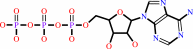 ATP
ATP
|
=
|
O-phospho-L-tyrosyl-[protein]
|
+
|
 ADP
ADP
|
+
|
H(+)
|
|
|
|
|
|
|
|
|
|
|
|
|
Molecule diagrams generated from .mol files obtained from the
KEGG ftp site
|
|
|
|
|
|
|
|
|
|
|
|
|
|
 |
|
|
|
|
|
|
| |
|
|
| |
|
DOI no:
|
Nat Struct Biol
15:1109-1118
(2008)
|
|
PubMed id:
|
|
|
|
|
|
| |
|
Activation of tyrosine kinases by mutation of the gatekeeper threonine.
|
|
M.Azam,
M.A.Seeliger,
N.S.Gray,
J.Kuriyan,
G.Q.Daley.
|
|
|
|
|
| |
ABSTRACT
|
|
|
|
| |
|
|
Protein kinases targeted by small-molecule inhibitors develop resistance through
mutation of the 'gatekeeper' threonine residue of the active site. Here we show
that the gatekeeper mutation in the cellular forms of c-ABL, c-SRC,
platelet-derived growth factor receptor-alpha and -beta, and epidermal growth
factor receptor activates the kinase and promotes malignant transformation of
BaF3 cells. Structural analysis reveals that a network of hydrophobic
interactions-the hydrophobic spine-characteristic of the active kinase
conformation is stabilized by the gatekeeper substitution. Substitution of
glycine for the residues constituting the spine disrupts the hydrophobic
connectivity and inactivates the kinase. Furthermore, a small-molecule inhibitor
that maximizes complementarity with the dismantled spine (compound 14) inhibits
the gatekeeper mutation of BCR-ABL-T315I. These results demonstrate that
mutation of the gatekeeper threonine is a common mechanism of activation for
tyrosine kinases and provide structural insights to guide the development of
next-generation inhibitors.
|
|
|
|
|
|
| |
Selected figure(s)
|
|
|
|
| |
|
|

|
|

|
|
Figure 4.
(a) The surface projections of the hydrophobic spine that
assembled during ABL kinase activation in ABL-ADP conformation
(shown in blue; PDB 2G2I). The gatekeeper residue, Thr334, is
shown as an orange surface. (b) The surface projections of the
dismantled hydrophobic spine in the inactive kinase conformation
of ABL–imatinib (PDB 1OPJ). Imatinib binds to the inactive
kinase which is stabilized by the DFG-out conformation caused by
dismantling of the hydrophobic spine.
|
|
Figure 5.
(a) Crystal structure of chicken c-SRC-T338I bound to ATP
 S.
SRC-T338I is homologous to T334I in human c-SRC. Chicken SRC
residues are numbered according to the human c-SRC kinase
numbering. The residues Leu328, Met317, Phe408 and His387, which
constitute the hydrophobic spine, are shown in blue. The
gatekeeper isoleucine residue is shown in orange. The activation
loop is shown in red. (b) The inactive conformation of chicken
c-SRC (PDB 2SRC), colored as in a. (c) Active site of Lck kinase
(PDB 1QPC) in the active state bound with AMP-PNP shown in
yellow. Gatekeeper residue Thr316 and the catalytic Lys273 are
shown as green surfaces. The water molecules sandwiched between
the residues Thr316 and Lys273 are shown as red circles. The
interactions of lysine with ANP and the catalytic Glu288 are
shown; bond distances are presented in angstroms. (d) Active
site of SRC-T341I kinase domain (PDB 3DQW) bound with ATP S
shown in yellow. The surfaces of the side chains for residues
Ile341 and Lys298 are shown in green. Interactions of Lys298
with Glu310 and ATP S
are mapped and the bond distances are indicated in angstroms.
(e) Active site of insulin receptor kinase (IRK; PDB entry 1GAG)
bound with ANP shown in yellow. The surfaces of the side chains
for residues Met1076 and Lys1030 are shown in green.
Interactions of catalytic Lys1030 with Glu1047 and ANP are
mapped, and the bond distances are indicated in angstroms. S.
SRC-T338I is homologous to T334I in human c-SRC. Chicken SRC
residues are numbered according to the human c-SRC kinase
numbering. The residues Leu328, Met317, Phe408 and His387, which
constitute the hydrophobic spine, are shown in blue. The
gatekeeper isoleucine residue is shown in orange. The activation
loop is shown in red. (b) The inactive conformation of chicken
c-SRC (PDB 2SRC), colored as in a. (c) Active site of Lck kinase
(PDB 1QPC) in the active state bound with AMP-PNP shown in
yellow. Gatekeeper residue Thr316 and the catalytic Lys273 are
shown as green surfaces. The water molecules sandwiched between
the residues Thr316 and Lys273 are shown as red circles. The
interactions of lysine with ANP and the catalytic Glu288 are
shown; bond distances are presented in angstroms. (d) Active
site of SRC-T341I kinase domain (PDB 3DQW) bound with ATP S
shown in yellow. The surfaces of the side chains for residues
Ile341 and Lys298 are shown in green. Interactions of Lys298
with Glu310 and ATP S
are mapped and the bond distances are indicated in angstroms.
(e) Active site of insulin receptor kinase (IRK; PDB entry 1GAG)
bound with ANP shown in yellow. The surfaces of the side chains
for residues Met1076 and Lys1030 are shown in green.
Interactions of catalytic Lys1030 with Glu1047 and ANP are
mapped, and the bond distances are indicated in angstroms.
|
|
|
|
|
|
| |
The above figures are
reprinted
from an Open Access publication published by Macmillan Publishers Ltd:
Nat Struct Biol
(2008,
15,
1109-1118)
copyright 2008.
|
|
| |
Figures were
selected
by an automated process.
|
|
|
|
|
|
|
|
|
|
|
|
|
|
|
|
 |
 |
 |
|
Literature references that cite this PDB file's key reference
|
|
|
| |
PubMed id
|
|
Reference
|
|
|
|
|
|
F.Guilhot,
and
J.Guilhot
(2011).
Predicting response in CML.
|
| |
Blood,
117,
1773-1774.
|
|
|
|
|
|
|
N.Jura,
X.Zhang,
N.F.Endres,
M.A.Seeliger,
T.Schindler,
and
J.Kuriyan
(2011).
Catalytic control in the EGF receptor and its connection to general kinase regulatory mechanisms.
|
| |
Mol Cell,
42,
9.
|
|
|
|
|
|
|
R.E.Iacob,
J.Zhang,
N.S.Gray,
and
J.R.Engen
(2011).
Allosteric interactions between the myristate- and ATP-site of the Abl kinase.
|
| |
PLoS One,
6,
e15929.
|
|
|
|
|
|
|
S.S.Taylor,
and
A.P.Kornev
(2011).
Protein kinases: evolution of dynamic regulatory proteins.
|
| |
Trends Biochem Sci,
36,
65-77.
|
|
|
|
|
|
|
S.Schenone,
O.Bruno,
M.Radi,
and
M.Botta
(2011).
New insights into small-molecule inhibitors of Bcr-Abl.
|
| |
Med Res Rev,
31,
1.
|
|
|
|
|
|
|
W.W.Chan,
S.C.Wise,
M.D.Kaufman,
Y.M.Ahn,
C.L.Ensinger,
T.Haack,
M.M.Hood,
J.Jones,
J.W.Lord,
W.P.Lu,
D.Miller,
W.C.Patt,
B.D.Smith,
P.A.Petillo,
T.J.Rutkoski,
H.Telikepalli,
L.Vogeti,
T.Yao,
L.Chun,
R.Clark,
P.Evangelista,
L.C.Gavrilescu,
K.Lazarides,
V.M.Zaleskas,
L.J.Stewart,
R.A.Van Etten,
and
D.L.Flynn
(2011).
Conformational control inhibition of the BCR-ABL1 tyrosine kinase, including the gatekeeper T315I mutant, by the switch-control inhibitor DCC-2036.
|
| |
Cancer Cell,
19,
556-568.
|
|
|
PDB codes:
|
|
|
|
|
|
|
|
Z.Wang,
P.A.Longo,
M.K.Tarrant,
K.Kim,
S.Head,
D.J.Leahy,
and
P.A.Cole
(2011).
Mechanistic insights into the activation of oncogenic forms of EGF receptor.
|
| |
Nat Struct Mol Biol,
18,
1388-1393.
|
|
|
|
|
|
|
E.Weisberg,
H.G.Choi,
A.Ray,
R.Barrett,
J.Zhang,
T.Sim,
W.Zhou,
M.Seeliger,
M.Cameron,
M.Azam,
J.A.Fletcher,
M.Debiec-Rychter,
M.Mayeda,
D.Moreno,
A.L.Kung,
P.A.Janne,
R.Khosravi-Far,
J.V.Melo,
P.W.Manley,
S.Adamia,
C.Wu,
N.Gray,
and
J.D.Griffin
(2010).
Discovery of a small-molecule type II inhibitor of wild-type and gatekeeper mutants of BCR-ABL, PDGFRalpha, Kit, and Src kinases: novel type II inhibitor of gatekeeper mutants.
|
| |
Blood,
115,
4206-4216.
|
|
|
PDB code:
|
|
|
|
|
|
|
|
J.C.Chomel,
N.Sorel,
M.L.Bonnet,
A.Bertrand,
F.Brizard,
L.Roy,
F.Guilhot,
and
A.G.Turhan
(2010).
Extensive analysis of the T315I substitution and detection of additional ABL mutations in progenitors and primitive stem cell compartment in a patient with tyrosine kinase inhibitor-resistant chronic myeloid leukemia.
|
| |
Leuk Lymphoma,
51,
2103-2111.
|
|
|
|
|
|
|
M.Azam,
J.T.Powers,
W.Einhorn,
W.S.Huang,
W.C.Shakespeare,
X.Zhu,
D.Dalgarno,
T.Clackson,
T.K.Sawyer,
and
G.Q.Daley
(2010).
AP24163 inhibits the gatekeeper mutant of BCR-ABL and suppresses in vitro resistance.
|
| |
Chem Biol Drug Des,
75,
223-227.
|
|
|
|
|
|
|
M.Radi,
E.Crespan,
F.Falchi,
V.Bernardo,
S.Zanoli,
F.Manetti,
S.Schenone,
G.Maga,
and
M.Botta
(2010).
Design and synthesis of thiadiazoles and thiazoles targeting the Bcr-Abl T315I mutant: from docking false positives to ATP-noncompetitive inhibitors.
|
| |
ChemMedChem,
5,
1226-1231.
|
|
|
|
|
|
|
P.La Rosée,
and
A.Hochhaus
(2010).
Molecular pathogenesis of tyrosine kinase resistance in chronic myeloid leukemia.
|
| |
Curr Opin Hematol,
17,
91-96.
|
|
|
|
|
|
|
R.Krishnamurty,
and
D.J.Maly
(2010).
Biochemical mechanisms of resistance to small-molecule protein kinase inhibitors.
|
| |
ACS Chem Biol,
5,
121-138.
|
|
|
|
|
|
|
S.Klüter,
J.R.Simard,
H.B.Rode,
C.Grütter,
V.Pawar,
H.C.Raaijmakers,
T.A.Barf,
M.Rabiller,
W.A.van Otterlo,
and
D.Rauh
(2010).
Characterization of irreversible kinase inhibitors by directly detecting covalent bond formation: a tool for dissecting kinase drug resistance.
|
| |
Chembiochem,
11,
2557-2566.
|
|
|
PDB code:
|
|
|
|
|
|
|
|
T.Zhou,
L.Commodore,
W.S.Huang,
Y.Wang,
T.K.Sawyer,
W.C.Shakespeare,
T.Clackson,
X.Zhu,
and
D.C.Dalgarno
(2010).
Structural analysis of DFG-in and DFG-out dual Src-Abl inhibitors sharing a common vinyl purine template.
|
| |
Chem Biol Drug Des,
75,
18-28.
|
|
|
PDB codes:
|
|
|
|
|
|
|
|
W.Zhou,
W.Hur,
U.McDermott,
A.Dutt,
W.Xian,
S.B.Ficarro,
J.Zhang,
S.V.Sharma,
J.Brugge,
M.Meyerson,
J.Settleman,
and
N.S.Gray
(2010).
A structure-guided approach to creating covalent FGFR inhibitors.
|
| |
Chem Biol,
17,
285-295.
|
|
|
|
|
|
|
A.A.Mian,
C.Oancea,
Z.Zhao,
O.G.Ottmann,
and
M.Ruthardt
(2009).
Oligomerization inhibition, combined with allosteric inhibition, abrogates the transformation potential of T315I-positive BCR/ABL.
|
| |
Leukemia,
23,
2242-2247.
|
|
|
|
|
|
|
A.A.Mian,
M.Schüll,
Z.Zhao,
C.Oancea,
A.Hundertmark,
T.Beissert,
O.G.Ottmann,
and
M.Ruthardt
(2009).
The gatekeeper mutation T315I confers resistance against small molecules by increasing or restoring the ABL-kinase activity accompanied by aberrant transphosphorylation of endogenous BCR, even in loss-of-function mutants of BCR/ABL.
|
| |
Leukemia,
23,
1614-1621.
|
|
|
|
|
|
|
A.Dixit,
and
G.M.Verkhivker
(2009).
Hierarchical modeling of activation mechanisms in the ABL and EGFR kinase domains: thermodynamic and mechanistic catalysts of kinase activation by cancer mutations.
|
| |
PLoS Comput Biol,
5,
e1000487.
|
|
|
|
|
|
|
A.Gárriz,
H.Qiu,
M.Dey,
E.J.Seo,
T.E.Dever,
and
A.G.Hinnebusch
(2009).
A network of hydrophobic residues impeding helix alphaC rotation maintains latency of kinase Gcn2, which phosphorylates the alpha subunit of translation initiation factor 2.
|
| |
Mol Cell Biol,
29,
1592-1607.
|
|
|
|
|
|
|
A.Quintás-Cardama,
H.Kantarjian,
and
J.Cortes
(2009).
Homoharringtonine, omacetaxine mepesuccinate, and chronic myeloid leukemia circa 2009.
|
| |
Cancer,
115,
5382-5393.
|
|
|
|
|
|
|
E.Lierman,
and
J.Cools
(2009).
Recent breakthroughs in the understanding and management of chronic eosinophilic leukemia.
|
| |
Expert Rev Anticancer Ther,
9,
1295-1304.
|
|
|
|
|
|
|
K.Ghoreschi,
A.Laurence,
and
J.J.O'Shea
(2009).
Selectivity and therapeutic inhibition of kinases: to be or not to be?
|
| |
Nat Immunol,
10,
356-360.
|
|
|
|
|
|
|
L.M.Elphick,
S.E.Lee,
E.S.Child,
A.Prasad,
C.Pignocchi,
S.Thibaudeau,
A.A.Anderson,
L.Bonnac,
V.Gouverneur,
and
D.J.Mann
(2009).
A quantitative comparison of wild-type and gatekeeper mutant cdk2 for chemical genetic studies with ATP analogues.
|
| |
Chembiochem,
10,
1519-1526.
|
|
|
|
|
|
|
M.A.Seeliger,
P.Ranjitkar,
C.Kasap,
Y.Shan,
D.E.Shaw,
N.P.Shah,
J.Kuriyan,
and
D.J.Maly
(2009).
Equally potent inhibition of c-Src and Abl by compounds that recognize inactive kinase conformations.
|
| |
Cancer Res,
69,
2384-2392.
|
|
|
PDB codes:
|
|
|
|
|
|
|
|
M.Yamauchi,
and
N.Gotoh
(2009).
Theme: oncology--molecular mechanisms determining the efficacy of EGF receptor-specific tyrosine kinase inhibitors help to identify biomarker candidates.
|
| |
Biomark Med,
3,
139-151.
|
|
|
|
|
|
|
R.E.Iacob,
T.Pene-Dumitrescu,
J.Zhang,
N.S.Gray,
T.E.Smithgall,
and
J.R.Engen
(2009).
Conformational disturbance in Abl kinase upon mutation and deregulation.
|
| |
Proc Natl Acad Sci U S A,
106,
1386-1391.
|
|
|
|
|
|
|
S.J.Deminoff,
V.Ramachandran,
and
P.K.Herman
(2009).
Distal recognition sites in substrates are required for efficient phosphorylation by the cAMP-dependent protein kinase.
|
| |
Genetics,
182,
529-539.
|
|
|
|
|
|
|
S.R.Viswanathan,
J.T.Powers,
W.Einhorn,
Y.Hoshida,
T.L.Ng,
S.Toffanin,
M.O'Sullivan,
J.Lu,
L.A.Phillips,
V.L.Lockhart,
S.P.Shah,
P.S.Tanwar,
C.H.Mermel,
R.Beroukhim,
M.Azam,
J.Teixeira,
M.Meyerson,
T.P.Hughes,
J.M.Llovet,
J.Radich,
C.G.Mullighan,
T.R.Golub,
P.H.Sorensen,
and
G.Q.Daley
(2009).
Lin28 promotes transformation and is associated with advanced human malignancies.
|
| |
Nat Genet,
41,
843-848.
|
|
|
|
|
|
The most recent references are shown first.
Citation data come partly from CiteXplore and partly
from an automated harvesting procedure. Note that this is likely to be
only a partial list as not all journals are covered by
either method. However, we are continually building up the citation data
so more and more references will be included with time.
Where a reference describes a PDB structure, the PDB
codes are
shown on the right.
|
|


 Links
Links


