 |
PDBsum entry 3cxr

|
|
|
|
|
|

|

|

|

|
|

|
|

|
|
|
 |

|

|
|
|
|
|
|
|
|
|
|
|
|
|
|
|
|
|
|
|
|
|
|
|
|
|
|
|
|
|
|
|
Oxidoreductase
|
PDB id
|
|
|
|
3cxr
|
|
|
|
|
|
|
|
|
|
|
|
|
|
|

|

|

|
|
|
|
|
|
|
|
 |
Contents |
 |
|
|
|
|
|
|
|
|
|
|
* Residue conservation analysis
|
|
|
|
|
|
|
|
|
|
|
Enzyme class:
|
|
E.C.1.1.1.69
- gluconate 5-dehydrogenase.
|
|
|
|
|
|
|
Reaction:
|
|
|
1.
|
D-gluconate + NADP+ = 5-dehydro-D-gluconate + NADPH + H+
|
|
2.
|
D-gluconate + NAD+ = 5-dehydro-D-gluconate + NADH + H+
|
|
|
|
|
|
|
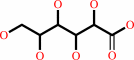 D-gluconate
|
+
|
 NADP(+)
|
=
|
 5-dehydro-D-gluconate
|
+
|
 NADPH
NADPH
|
+
|
H(+)
|
|
|
|
|
|
|
D-gluconate
|
+
|
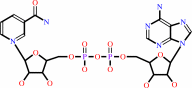 NAD(+)
|
=
|
5-dehydro-D-gluconate
|
+
|
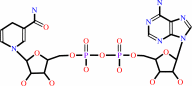 NADH
NADH
|
+
|
H(+)
|
|
|
|
|
|
|
|
|
|
|
|
|
Molecule diagrams generated from .mol files obtained from the
KEGG ftp site
|
|
|
|
|
|
|
|
|
|
|
|
|
|
 |
|
|
|
|
|
|
| |
|
|
| |
|
DOI no:
|
Protein Sci
18:294-303
(2009)
|
|
PubMed id:
|
|
|
|
|
|
| |
|
Structural insight into the catalytic mechanism of gluconate 5-dehydrogenase from Streptococcus suis: Crystal structures of the substrate-free and quaternary complex enzymes.
|
|
Q.Zhang,
H.Peng,
F.Gao,
Y.Liu,
H.Cheng,
J.Thompson,
G.F.Gao.
|
|
|
|
|
| |
ABSTRACT
|
|
|
|
| |
|
|
Gluconate 5-dehydrogenase (Ga5DH) is an NADP(H)-dependent enzyme that catalyzes
a reversible oxidoreduction reaction between D-gluconate and 5-keto-D-gluconate,
thereby regulating the flux of this important carbon and energy source in
bacteria. Despite the considerable amount of physiological and biochemical
knowledge of Ga5DH, there is little physical or structural information available
for this enzyme. To this end, we herein report the crystal structures of Ga5DH
from pathogenic Streptococcus suis serotype 2 in both substrate-free and
liganded (NADP(+)/D-gluconate/metal ion) quaternary complex forms at 2.0 A
resolution. Structural analysis reveals that Ga5DH adopts a protein fold similar
to that found in members of the short chain dehydrogenase/reductase (SDR)
family, while the enzyme itself represents a previously uncharacterized member
of this family. In solution, Ga5DH exists as a tetramer that comprised four
identical approximately 29 kDa subunits. The catalytic site of Ga5DH shows
considerable architectural similarity to that found in other enzymes of the SDR
family, but the S. suis protein contains an additional residue (Arg104) that
plays an important role in the binding and orientation of substrate. The
quaternary complex structure provides the first clear crystallographic evidence
for the role of a catalytically important serine residue and also reveals an
amino acid tetrad RSYK that differs from the SYK triad found in the majority of
SDR enzymes. Detailed analysis of the crystal structures reveals important
contributions of Ca(2+) ions to active site formation and of specific residues
at the C-termini of subunits to tetramer assembly. Because Ga5DH is a potential
target for therapy, our findings provide insight not only of catalytic
mechanism, but also suggest a target of structure-based drug design.
|
|
|
|
|
|
| |
Selected figure(s)
|
|
|
|
| |
|
|

|
|

|
|
Figure 4.
Protein-ligand interaction. The NADP^+ molecule is shown as
yellow stick, and the substrate is displayed as green stick.
Water molecules are shown as red spheres and metal ions as
magenta spheres. Hydrogen bonds are shown as dotted black lines.
(A) The interaction between NADP^+ and nucleotide-binding motif
GXXXGXG. Of note is that Tyr24, not a basic residue, forms
hydrogen bond contact with 2[prime prime or minute]-phosphate
group of the adenine ribose. (B) Stereo view of a detailed
network of hydrogen bonds formed by Ga5DH and its ligands. The
substrate and cofactor are fixed in a plausible position
favorable for the subsequent dehydrogenation reaction. The
catalytically important residues Tyr163 and Lys167 are shown as
cyan stick.
|
|
Figure 6.
Proposed reaction mechanism for Ga5DH from S. suis. Note that
Ser150 forms a hydrogen bond with the ---OH group at C6 (not C5)
of the substrate. The mechanism is described in detail in
Discussion.
|
|
|
|
|
|
| |
The above figures are
reprinted
from an Open Access publication published by the Protein Society:
Protein Sci
(2009,
18,
294-303)
copyright 2009.
|
|
| |
Figures were
selected
by an automated process.
|
|
|
|
|
|
|
|
|
|
|
|
|
|
|
|
 |
 |
 |
|
Literature references that cite this PDB file's key reference
|
|
|
| |
PubMed id
|
|
Reference
|
|
|
|
|
|
Y.Feng,
H.Zhang,
Y.Ma,
and
G.F.Gao
(2010).
Uncovering newly emerging variants of Streptococcus suis, an important zoonotic agent.
|
| |
Trends Microbiol,
18,
124-131.
|
|
|
|
|
|
|
Q.Zhang,
F.Gao,
H.Peng,
H.Cheng,
Y.Liu,
J.Tang,
J.Thompson,
G.Wei,
J.Zhang,
Y.Du,
J.Yan,
and
G.F.Gao
(2009).
Crystal structures of Streptococcus suis mannonate dehydratase (ManD) and its complex with substrate: genetic and biochemical evidence for a catalytic mechanism.
|
| |
J Bacteriol,
191,
5832-5837.
|
|
|
PDB codes:
|
|
|
|
|
|
|
The most recent references are shown first.
Citation data come partly from CiteXplore and partly
from an automated harvesting procedure. Note that this is likely to be
only a partial list as not all journals are covered by
either method. However, we are continually building up the citation data
so more and more references will be included with time.
Where a reference describes a PDB structure, the PDB
codes are
shown on the right.
|
|


 Links
Links


