
|
|
|
|
|
 |
Contents |
 |
|
|
|
|
|
|
|
|
|
|
|
 1349 a.a.
|
|
|
|
|
|
|
|
|
|
|
 1061 a.a.
|
|
|
|
|
|
|
|
|
|
|
 265 a.a.
|
|
|
|
|
|
|
|
|
|
|
 213 a.a.
|
|
|
|
|
|
|
|
|
|
|
 84 a.a.
|
|
|
|
|
|
|
|
|
|
|
 116 a.a.
|
|
|
|
|
|
|
|
|
|
|
 121 a.a.
|
|
|
|
|
|
|
|
|
|
|
 65 a.a.
|
|
|
|
|
|
|
|
|
|
|
 113 a.a.
|
|
|
|
|
|
|
|
|
|
|
 43 a.a.
|
|
|
|
|
|
|
|
|
|
|
|
|
* Residue conservation analysis
|
|
|
|
|
|
PDB id:
|
|
|
|
| Name: |
|
Transcription/toxin
|
|
|
Title:
|
|
Crystal structure of 10 subunit RNA polymerase ii in complex with the inhibitor alpha-amanitin
|
|
Structure:
|
|
DNA-directed RNA polymerase ii subunit rpb1. Chain: a. Synonym: RNA polymerase ii subunit b1, RNA polymerase ii subunit 1, DNA-directed RNA polymerase iii largest subunit, b220. DNA-directed RNA polymerase ii subunit rpb2. Chain: b. Synonym: RNA polymerase ii subunit 2, DNA-directed RNA polymerase ii 140 kda polypeptide, b150. DNA-directed RNA polymerase ii subunit rpb3.
|
|
Source:
|
|
Saccharomyces cerevisiae. Brewer's yeast, lager beer yeast, yeast. Organism_taxid: 4932. Synthetic: yes. Amanita phalloides. Organism_taxid: 67723
|
|
Resolution:
|
|
|
2.80Å
|
R-factor:
|
0.202
|
R-free:
|
0.273
|
|
|
Authors:
|
|
C.D.Kaplan,K.-M.Larsson,R.D.Kornberg
|
Key ref:

|
|
C.D.Kaplan
et al.
(2008).
The RNA polymerase II trigger loop functions in substrate selection and is directly targeted by alpha-amanitin.
Mol Cell,
30,
547-556.
PubMed id:
DOI:

|
|
|
Date:
|
|
|
03-Apr-08
|
Release date:
|
22-Jul-08
|
|
|
|
|
|
|
PROCHECK
|

|
|
|
|
|
Headers
|
|
|
|
References
|
|
|
|
|
|

|
|
P04050
(RPB1_YEAST) -
DNA-directed RNA polymerase II subunit RPB1 from Saccharomyces cerevisiae (strain ATCC 204508 / S288c)
|
|
|
|
Seq:
Struc:
|
|
|
|
1733 a.a.
1349 a.a.
|
|

|

|
|
|
|
|
|
|
|
|
|
|
|
|

|
|
P08518
(RPB2_YEAST) -
DNA-directed RNA polymerase II subunit RPB2 from Saccharomyces cerevisiae (strain ATCC 204508 / S288c)
|
|
|
|
Seq:
Struc:
|
|
|
|
1224 a.a.
1061 a.a.
|
|
|

|
|
|
|
|
|
|
|
|
|
|
|
|

|
|
P16370
(RPB3_YEAST) -
DNA-directed RNA polymerase II subunit RPB3 from Saccharomyces cerevisiae (strain ATCC 204508 / S288c)
|
|
|
|
Seq:
Struc:
|
|
|
|
318 a.a.
265 a.a.
|
|
|

|

|
|
|
|
|
|
|
|
|
|
|
|

|
|
P20434
(RPAB1_YEAST) -
DNA-directed RNA polymerases I, II, and III subunit RPABC1 from Saccharomyces cerevisiae (strain ATCC 204508 / S288c)
|
|
|
|
Seq:
Struc:
|
|
|
|
215 a.a.
213 a.a.
|
|
|

|
|
|
|
|
|
|
|
|
|
|
|
|

|
|
P20435
(RPAB2_YEAST) -
DNA-directed RNA polymerases I, II, and III subunit RPABC2 from Saccharomyces cerevisiae (strain ATCC 204508 / S288c)
|
|
|
|
Seq:
Struc:
|
|
|
|
155 a.a.
84 a.a.
|
|
|

|
|
|
|
|
|
|
|
|
|
|
|
|

|
|
P20436
(RPAB3_YEAST) -
DNA-directed RNA polymerases I, II, and III subunit RPABC3 from Saccharomyces cerevisiae (strain ATCC 204508 / S288c)
|
|
|
|
Seq:
Struc:
|
|
|
|
146 a.a.
116 a.a.
|
|
|

|
|
|
|
|
|
|
|
|
|
|
|
|

|
|
P27999
(RPB9_YEAST) -
DNA-directed RNA polymerase II subunit RPB9 from Saccharomyces cerevisiae (strain ATCC 204508 / S288c)
|
|
|
|
Seq:
Struc:
|
|
|
|
122 a.a.
121 a.a.
|
|
|

|
|
|
|
|
|
|
|
|
|
|
|
|

|
|
P22139
(RPAB5_YEAST) -
DNA-directed RNA polymerases I, II, and III subunit RPABC5 from Saccharomyces cerevisiae (strain ATCC 204508 / S288c)
|
|
|
|
Seq:
Struc:
|
|
|
|
70 a.a.
65 a.a.
|
|
|

|
|
|
|
|
|
|
|
|
|
|
|
|
|
|
|
|
|
Enzyme class:
|
|
Chains A, B:
E.C.2.7.7.6
- DNA-directed Rna polymerase.
|
|
|
|
|
|
|
Reaction:
|
|
RNA(n) + a ribonucleoside 5'-triphosphate = RNA(n+1) + diphosphate
|
|
|
|
|
|
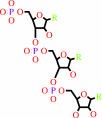 RNA(n)
|
+
|
ribonucleoside 5'-triphosphate
|
=
|
RNA(n+1)
|
+
|
 diphosphate
|
|
|
|
|
|
|
|
|
|
|
|
|
Molecule diagrams generated from .mol files obtained from the
KEGG ftp site
|
|
|
|
|
|
|
|
|
|
|
|
|
|
 |
|
|
|
|
|
|
| |
|
|
| |
|
DOI no:
|
Mol Cell
30:547-556
(2008)
|
|
PubMed id:
|
|
|
|
|
|
| |
|
The RNA polymerase II trigger loop functions in substrate selection and is directly targeted by alpha-amanitin.
|
|
C.D.Kaplan,
K.M.Larsson,
R.D.Kornberg.
|
|
|
|
|
| |
ABSTRACT
|
|
|
|
| |
|
|
Structural, biochemical, and genetic studies have led to proposals that a mobile
element of multisubunit RNA polymerases, the Trigger Loop (TL), plays a critical
role in catalysis and can be targeted by antibiotic inhibitors. Here we present
evidence that the Saccharomyces cerevisiae RNA Polymerase II (Pol II) TL
participates in substrate selection. Amino acid substitutions within the Pol II
TL preferentially alter substrate usage and enzyme fidelity, as does inhibition
of transcription by alpha-amanitin. Finally, substitution of His1085 in the TL
specifically renders Pol II highly resistant to alpha-amanitin, indicating a
functional interaction between His1085 and alpha-amanitin that is supported by
rerefinement of an alpha-amanitin-Pol II crystal structure. We propose that
alpha-amanitin-inhibited Pol II elongation, which is slow and exhibits reduced
substrate selectivity, results from direct alpha-amanitin interference with the
TL.
|
|
|
|
|
|
| |
Selected figure(s)
|
|
|
|
| |
|
|

|
|

|
|
Figure 2.
Figure 2. Elongation Defects and Altered Substrate Selection
by Rpb1 H1085Y Pol II
(A) H1085Y exhibits reduced
elongation rate using NTP substrates. Run-off transcription of
an oligonucleotide scaffold template generates a 61 nt RNA
product. Representative experiments for WT and H1085Y Pol II are
shown in the left and right panels, respectively. Average
elongation rates for each NTP concentration were measured as the
length of the transcribed region (51 nt) divided by the time of
half-maximal accumulation of run-off product (61 nt). Average
elongation rates were then plotted versus NTP concentration to
infer maximum average elongation rate (see Experimental
Procedures for details) (top right graph). Inferred maximum
average elongation rates are shown in the bottom right graph
with error bars representing the 95% confidence interval (See
Experimental Procedures for details).
(B) H1085Y Pol II
exhibits only modest defects for 2′-dNTP incorporation. WT and
H1085Y Pol II ECs were formed on oligonucleotide scaffolds
containing 10-mer RNAs with templates specifying addition of
different NTPs at position 11. Average incorporation rates for
different template-specified 2′-dNTPs were measured as
1/t[1/2] for maximal accumulation of 11-mer RNA. Incorporation
rates were then plotted versus 2′-dNTP concentration, and
maximum incorporation rate for either 2′-dATP or 2′-dGTP was
inferred (left panels). Maximum incorporation rates for WT Pol
II and H1085Y are shown in the right panels with error bars
representing the 95% confidence interval (See Experimental
Procedures for details).
(C) H1085Y Pol II exhibits modest
defects in GTP misincorporation. WT and H1085Y ECs were formed
and labeled as in (B) with templates specifying incorporation of
ATP at the position being measured, but were challenged with 1
mM GTP and misincorporation rate measured as the 1/t[1/2] for
maximal incorporation. Mean misincorporation rate from at least
three experiments is represented in the bar graph (error bars
represent ± SD).
|
|
Figure 7.
Figure 7. Direct Interaction between Rpb1 His1085 and
α-Amanitin and TL Capture May Underlie α-Amanitin Inhibition
of Transcription
(A) Overall view of α-amanitin and the
new TL conformation and their positions in relation to the
Bridge helix (BH). A superpositioned EC structure (PDB 2E2H)
showing DNA (magenta), RNA (red), nontemplate DNA (green), and
nucleotide GTP (orange) highlights the position of the inhibitor
and TL in relation to EC components.
(B) A 90° rotation
shows the α-amanitin position in relation to the Bridge helix
(BH) and its capture of the TL Rpb1 His1085.
(C) TL
residues Rpb1 1084–1086 and the entire α-amanitin modeled
into electron density (dark gray mesh) from an initial unbiased
2Fo-Fc electron density map contoured at 0.6 σ.
|
|
|
|
|
|
| |
The above figures are
reprinted
from an Open Access publication published by Cell Press:
Mol Cell
(2008,
30,
547-556)
copyright 2008.
|
|
| |
Figures were
selected
by an automated process.
|
|
|
|
|
|
|
|
|
|
|
|
|
|
|
|
 |
 |
 |
|
Literature references that cite this PDB file's key reference
|
|
|
| |
PubMed id
|
|
Reference
|
|
|
|
|
|
M.H.Larson,
R.Landick,
and
S.M.Block
(2011).
Single-molecule studies of RNA polymerase: one singular sensation, every little step it takes.
|
| |
Mol Cell,
41,
249-262.
|
|
|
|
|
|
|
S.R.Kennedy,
and
D.A.Erie
(2011).
Templated nucleoside triphosphate binding to a noncatalytic site on RNA polymerase regulates transcription.
|
| |
Proc Natl Acad Sci U S A,
108,
6079-6084.
|
|
|
|
|
|
|
C.D.Kaplan
(2010).
The architecture of RNA polymerase fidelity.
|
| |
BMC Biol,
8,
85.
|
|
|
|
|
|
|
H.Koyama,
T.Ueda,
T.Ito,
and
K.Sekimizu
(2010).
Novel RNA polymerase II mutation suppresses transcriptional fidelity and oxidative stress sensitivity in rpb9Delta yeast.
|
| |
Genes Cells,
15,
151-159.
|
|
|
|
|
|
|
J.B.Hollick
(2010).
Paramutation and development.
|
| |
Annu Rev Cell Dev Biol,
26,
557-579.
|
|
|
|
|
|
|
J.Zhang,
M.Palangat,
and
R.Landick
(2010).
Role of the RNA polymerase trigger loop in catalysis and pausing.
|
| |
Nat Struct Mol Biol,
17,
99.
|
|
|
|
|
|
|
L.A.Selth,
S.Sigurdsson,
and
J.Q.Svejstrup
(2010).
Transcript Elongation by RNA Polymerase II.
|
| |
Annu Rev Biochem,
79,
271-293.
|
|
|
|
|
|
|
N.Miropolskaya,
V.Nikiforov,
S.Klimašauskas,
I.Artsimovitch,
and
A.Kulbachinskiy
(2010).
Modulation of RNA polymerase activity through trigger loop folding.
|
| |
Transcr,
1,
89-94.
|
|
|
|
|
|
|
N.Opalka,
J.Brown,
W.J.Lane,
K.A.Twist,
R.Landick,
F.J.Asturias,
and
S.A.Darst
(2010).
Complete structural model of Escherichia coli RNA polymerase from a hybrid approach.
|
| |
PLoS Biol,
8,
0.
|
|
|
PDB codes:
|
|
|
|
|
|
|
|
R.O.Weinzierl
(2010).
The nucleotide addition cycle of RNA polymerase is controlled by two molecular hinges in the Bridge Helix domain.
|
| |
BMC Biol,
8,
134.
|
|
|
|
|
|
|
W.J.Lane,
and
S.A.Darst
(2010).
Molecular evolution of multisubunit RNA polymerases: structural analysis.
|
| |
J Mol Biol,
395,
686-704.
|
|
|
|
|
|
|
W.J.Lane,
and
S.A.Darst
(2010).
Molecular evolution of multisubunit RNA polymerases: sequence analysis.
|
| |
J Mol Biol,
395,
671-685.
|
|
|
|
|
|
|
X.Huang,
D.Wang,
D.R.Weiss,
D.A.Bushnell,
R.D.Kornberg,
and
M.Levitt
(2010).
RNA polymerase II trigger loop residues stabilize and position the incoming nucleotide triphosphate in transcription.
|
| |
Proc Natl Acad Sci U S A,
107,
15745-15750.
|
|
|
|
|
|
|
Y.Yuzenkova,
A.Bochkareva,
V.R.Tadigotla,
M.Roghanian,
S.Zorov,
K.Severinov,
and
N.Zenkin
(2010).
Stepwise mechanism for transcription fidelity.
|
| |
BMC Biol,
8,
54.
|
|
|
|
|
|
|
Y.Yuzenkova,
and
N.Zenkin
(2010).
Central role of the RNA polymerase trigger loop in intrinsic RNA hydrolysis.
|
| |
Proc Natl Acad Sci U S A,
107,
10878-10883.
|
|
|
|
|
|
|
C.Castro,
E.D.Smidansky,
J.J.Arnold,
K.R.Maksimchuk,
I.Moustafa,
A.Uchida,
M.Götte,
W.Konigsberg,
and
C.E.Cameron
(2009).
Nucleic acid polymerases use a general acid for nucleotidyl transfer.
|
| |
Nat Struct Mol Biol,
16,
212-218.
|
|
|
|
|
|
|
C.E.Cameron,
I.M.Moustafa,
and
J.J.Arnold
(2009).
Dynamics: the missing link between structure and function of the viral RNA-dependent RNA polymerase?
|
| |
Curr Opin Struct Biol,
19,
768-774.
|
|
|
|
|
|
|
C.Mosrin-Huaman,
R.Honorine,
and
A.R.Rahmouni
(2009).
Expression of bacterial Rho factor in yeast identifies new factors involved in the functional interplay between transcription and mRNP biogenesis.
|
| |
Mol Cell Biol,
29,
4033-4044.
|
|
|
|
|
|
|
C.Walmacq,
M.L.Kireeva,
J.Irvin,
Y.Nedialkov,
L.Lubkowska,
F.Malagon,
J.N.Strathern,
and
M.Kashlev
(2009).
Rpb9 Subunit Controls Transcription Fidelity by Delaying NTP Sequestration in RNA Polymerase II.
|
| |
J Biol Chem,
284,
19601-19612.
|
|
|
|
|
|
|
D.Wang,
D.A.Bushnell,
X.Huang,
K.D.Westover,
M.Levitt,
and
R.D.Kornberg
(2009).
Structural basis of transcription: backtracked RNA polymerase II at 3.4 angstrom resolution.
|
| |
Science,
324,
1203-1206.
|
|
|
PDB codes:
|
|
|
|
|
|
|
|
E.Nudler
(2009).
RNA polymerase active center: the molecular engine of transcription.
|
| |
Annu Rev Biochem,
78,
335-361.
|
|
|
|
|
|
|
F.Brueckner,
K.J.Armache,
A.Cheung,
G.E.Damsma,
H.Kettenberger,
E.Lehmann,
J.Sydow,
and
P.Cramer
(2009).
Structure-function studies of the RNA polymerase II elongation complex.
|
| |
Acta Crystallogr D Biol Crystallogr,
65,
112-120.
|
|
|
|
|
|
|
H.Spåhr,
G.Calero,
D.A.Bushnell,
and
R.D.Kornberg
(2009).
Schizosacharomyces pombe RNA polymerase II at 3.6-A resolution.
|
| |
Proc Natl Acad Sci U S A,
106,
9185-9190.
|
|
|
PDB code:
|
|
|
|
|
|
|
|
J.F.Sydow,
F.Brueckner,
A.C.Cheung,
G.E.Damsma,
S.Dengl,
E.Lehmann,
D.Vassylyev,
and
P.Cramer
(2009).
Structural basis of transcription: mismatch-specific fidelity mechanisms and paused RNA polymerase II with frayed RNA.
|
| |
Mol Cell,
34,
710-721.
|
|
|
PDB codes:
|
|
|
|
|
|
|
|
K.F.Erhard,
J.L.Stonaker,
S.E.Parkinson,
J.P.Lim,
C.J.Hale,
and
J.B.Hollick
(2009).
RNA polymerase IV functions in paramutation in Zea mays.
|
| |
Science,
323,
1201-1205.
|
|
|
|
|
|
|
M.L.Kireeva,
and
M.Kashlev
(2009).
Mechanism of sequence-specific pausing of bacterial RNA polymerase.
|
| |
Proc Natl Acad Sci U S A,
106,
8900-8905.
|
|
|
|
|
|
|
N.Miropolskaya,
I.Artsimovitch,
S.Klimasauskas,
V.Nikiforov,
and
A.Kulbachinskiy
(2009).
Allosteric control of catalysis by the F loop of RNA polymerase.
|
| |
Proc Natl Acad Sci U S A,
106,
18942-18947.
|
|
|
|
|
|
|
L.Tan,
S.Wiesler,
D.Trzaska,
H.C.Carney,
and
R.O.Weinzierl
(2008).
Bridge helix and trigger loop perturbations generate superactive RNA polymerases.
|
| |
J Biol,
7,
40.
|
|
|
|
|
|
|
R.Sousa
(2008).
Tie me up, tie me down: inhibiting RNA polymerase.
|
| |
Cell,
135,
205-207.
|
|
|
|
|
|
|
V.Svetlov,
and
E.Nudler
(2008).
Jamming the ratchet of transcription.
|
| |
Nat Struct Mol Biol,
15,
777-779.
|
|
|
|
|
|
The most recent references are shown first.
Citation data come partly from CiteXplore and partly
from an automated harvesting procedure. Note that this is likely to be
only a partial list as not all journals are covered by
either method. However, we are continually building up the citation data
so more and more references will be included with time.
Where a reference describes a PDB structure, the PDB
codes are
shown on the right.
|

| |


 Links
Links


