 |
PDBsum entry 3b5x

|
|
|
|
|
|

|

|

|

|
|

|
|
|
 |

|

|
|
|
|
|
|
|
|
|
|
|
|
|
|
|
|
|
|
|
|
|
|
|
|
|
|
|
|
|
|
Membrane protein
|
PDB id
|
|
|
|
3b5x
|
|
|
|
|
|
|
|
|
|
|
|
|
|
|

|

|

|
|
|
|
|
|
|
|
 |
Contents |
 |
|
|
|
|
|
|
|
|
* Residue conservation analysis
|
|
* C-alpha coords only
|
|
|
|
|
|
|
|
|
|
|
Enzyme class:
|
|
E.C.7.5.2.6
- ABC-type lipid A-core oligosaccharide transporter.
|
|
|
|
|
|
|
Reaction:
|
|
ATP + H2O + lipid A-core oligosaccharideSide 1 = ADP + phosphate + lipid A-core oligosaccharideSide 2
|
|
|
|
|
|
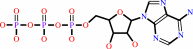 ATP
ATP
|
+
|
H2O
|
+
|
lipid A-core oligosaccharideSide 1
|
=
|
 ADP
ADP
|
+
|
 phosphate
|
+
|
lipid A-core oligosaccharideSide 2
|
|
|
|
|
|
|
|
|
|
|
|
|
Molecule diagrams generated from .mol files obtained from the
KEGG ftp site
|
|
|
|
|
|
|
|
|
|
|
|
|
|
 |
|
|
|
|
|
|
| |
|
|
| |
|
DOI no:
|
Proc Natl Acad Sci U S A
104:19005-19010
(2007)
|
|
PubMed id:
|
|
|
|
|
|
| |
|
Flexibility in the ABC transporter MsbA: Alternating access with a twist.
|
|
A.Ward,
C.L.Reyes,
J.Yu,
C.B.Roth,
G.Chang.
|
|
|
|
|
| |
ABSTRACT
|
|
|
|
| |
|
|
ATP-binding cassette (ABC) transporters are integral membrane proteins that
translocate a wide variety of substrates across cellular membranes and are
conserved from bacteria to humans. Here we compare four x-ray structures of the
bacterial ABC lipid flippase, MsbA, trapped in different conformations, two
nucleotide-bound structures and two in the absence of nucleotide. Comparison of
the nucleotide-free conformations of MsbA reveals a flexible hinge formed by
extracellular loops 2 and 3. This hinge allows the nucleotide-binding domains to
disassociate while the ATP-binding half sites remain facing each other. The
binding of the nucleotide causes a packing rearrangement of the transmembrane
helices and changes the accessibility of the transporter from cytoplasmic
(inward) facing to extracellular (outward) facing. The inward and outward
openings are mediated by two different sets of transmembrane helix interactions.
Altogether, the conformational changes between these structures suggest that
large ranges of motion may be required for substrate transport.
|
|
|
|
|
|
| |
Selected figure(s)
|
|
|
|
| |
|
|

|
|

|
|
Figure 1.
Fig. 1. Stereoviews of three conformations of MsbA. (A)
Nucleotide bound. (B) Open apo. (C) Closed apo. One monomer in
each model is colored with a rainbow gradient (N terminus is
blue, C terminus is red), and the other is white. TM helices
(TM1–TM6), extracellular loops (EL1–EL3), and intracellular
helices (IH1–IH2) are labeled accordingly. AMPPNP molecules
are displayed as blue sticks in the nucleotide-bound structure.
In all structures, TM4/TM5/IH2 (yellow and orange) associates
with the opposite monomer in a conserved manner.
|
|
Figure 5.
Fig. 5. Summary of conformational changes in MsbA. (A)
Conformational changes within the MsbA dimer alter the
accessibility to the internal chamber from inward to outward
facing. For clarity, only TM helices (labeled 1–6) of one
monomer (cyan) are shown inside a surface rendering of the
dimer. The open and closed apo conformations form an
inward-facing V between TM4/TM5 and TM3/TM6 (red asterisk). The
nucleotide-bound conformation (MsbA-AMPPNP) forms an
outward-facing V between TM3/TM6 and TM1/TM2, just above the
elbow helix (black asterisk). Upon nucleotide binding,
TM4/TM5/IH2 moves, causing TM3/TM6 to split away from TM1/TM2,
which results in an outward-facing conformation. Both inward-
and outward-facing conformations are mediated by intramolecular
interactions within a single monomer, but by different sets of
helices. (B) Simplified cartoon model illustrating the points
above. The relative position of each TM helix is labeled with a
number (one monomer in white and the other in gray). The arrows
illustrate the motions required to go to the next state. (C)
Top-down view of NBDs (one monomer shown in white and the other
in gray). IH1 (green) and IH2 (yellow) from both monomers are
shown. In the absence of nucleotide (apo), the NBDs are in
similar orientations with the ATP-binding half-sites (LSGGQ and
P-loop) facing each other; the P-loops (red) are roughly aligned
(dashed lines) with one another across the dimer interface. Upon
nucleotide binding (AMPPNP - magenta), the canonical ATP
sandwich is formed, aligning the nucleotide between the LSGGQ
and P-loop. IH1 tracks with the cis-monomer, whereas IH2 tracks
with the trans-monomer. The motion of the NBDs from closed-apo-
to nucleotide-bound transmits a structural change (described
above) to the TMs via IH1 and IH2, resulting in an
outward-facing conformation.
|
|
|
|
| |
Figures were
selected
by the author.
|
|
|
|
|
|
|
|
|
|
|
|
|
|
|
|
 |
 |
 |
|
Literature references that cite this PDB file's key reference
|
|
|
| |
PubMed id
|
|
Reference
|
|
|
|
|
|
M.Hohl,
C.Briand,
M.G.Grütter,
and
M.A.Seeger
(2012).
Crystal structure of a heterodimeric ABC transporter in its inward-facing conformation.
|
| |
Nat Struct Mol Biol,
19,
395-402.
|
|
|
PDB code:
|
|
|
|
|
|
|
|
M.S.Jin,
M.L.Oldham,
Q.Zhang,
and
J.Chen
(2012).
Crystal structure of the multidrug transporter P-glycoprotein from Caenorhabditis elegans.
|
| |
Nature,
490,
566-569.
|
|
|
PDB code:
|
|
|
|
|
|
|
|
V.M.Korkhov,
S.A.Mireku,
and
K.P.Locher
(2012).
Structure of AMP-PNP-bound vitamin B12 transporter BtuCD-F.
|
| |
Nature,
490,
367-372.
|
|
|
PDB code:
|
|
|
|
|
|
|
|
A.S.Oliveira,
A.M.Baptista,
and
C.M.Soares
(2011).
Conformational changes induced by ATP-hydrolysis in an ABC transporter: A molecular dynamics study of the Sav1866 exporter.
|
| |
Proteins,
79,
1977-1990.
|
|
|
|
|
|
|
E.Noy,
and
H.Senderowitz
(2011).
Combating cystic fibrosis: in search for CF transmembrane conductance regulator (CFTR) modulators.
|
| |
ChemMedChem,
6,
243-251.
|
|
|
|
|
|
|
N.Monroe,
G.Sennhauser,
M.A.Seeger,
C.Briand,
and
M.G.Grütter
(2011).
Designed ankyrin repeat protein binders for the crystallization of AcrB: plasticity of the dominant interface.
|
| |
J Struct Biol,
174,
269-281.
|
|
|
PDB codes:
|
|
|
|
|
|
|
|
C.Baldauf,
S.Schrodt,
M.Herget,
J.Koch,
and
R.Tampé
(2010).
Single residue within the antigen translocation complex TAP controls the epitope repertoire by stabilizing a receptive conformation.
|
| |
Proc Natl Acad Sci U S A,
107,
9135-9140.
|
|
|
|
|
|
|
D.A.Gutmann,
A.Ward,
I.L.Urbatsch,
G.Chang,
and
H.W.van Veen
(2010).
Understanding polyspecificity of multidrug ABC transporters: closing in on the gaps in ABCB1.
|
| |
Trends Biochem Sci,
35,
36-42.
|
|
|
|
|
|
|
D.Parcej,
and
R.Tampé
(2010).
ABC proteins in antigen translocation and viral inhibition.
|
| |
Nat Chem Biol,
6,
572-580.
|
|
|
|
|
|
|
D.W.Urry,
K.D.Urry,
W.Szaflarski,
and
M.Nowicki
(2010).
Elastic-contractile model proteins: Physical chemistry, protein function and drug design and delivery.
|
| |
Adv Drug Deliv Rev,
62,
1404-1455.
|
|
|
|
|
|
|
E.Crowley,
and
R.Callaghan
(2010).
Multidrug efflux pumps: drug binding--gates or cavity?
|
| |
FEBS J,
277,
530-539.
|
|
|
|
|
|
|
I.D.Kerr,
P.M.Jones,
and
A.M.George
(2010).
Multidrug efflux pumps: the structures of prokaryotic ATP-binding cassette transporter efflux pumps and implications for our understanding of eukaryotic P-glycoproteins and homologues.
|
| |
FEBS J,
277,
550-563.
|
|
|
|
|
|
|
J.A.Lundbaek,
S.A.Collingwood,
H.I.Ingólfsson,
R.Kapoor,
and
O.S.Andersen
(2010).
Lipid bilayer regulation of membrane protein function: gramicidin channels as molecular force probes.
|
| |
J R Soc Interface,
7,
373-395.
|
|
|
|
|
|
|
J.W.Weng,
K.N.Fan,
and
W.N.Wang
(2010).
The conformational transition pathway of ATP binding cassette transporter MsbA revealed by atomistic simulations.
|
| |
J Biol Chem,
285,
3053-3063.
|
|
|
|
|
|
|
K.McLuskey,
A.W.Roszak,
Y.Zhu,
and
N.W.Isaacs
(2010).
Crystal structures of all-alpha type membrane proteins.
|
| |
Eur Biophys J,
39,
723-755.
|
|
|
|
|
|
|
K.R.Vinothkumar,
and
R.Henderson
(2010).
Structures of membrane proteins.
|
| |
Q Rev Biophys,
43,
65.
|
|
|
|
|
|
|
K.Terakado,
A.Kodan,
H.Nakano,
Y.Kimura,
K.Ueda,
T.Nakatsu,
and
H.Kato
(2010).
Deleting two C-terminal alpha-helices is effective to crystallize the bacterial ABC transporter Escherichia coli MsbA complexed with AMP-PNP.
|
| |
Acta Crystallogr D Biol Crystallogr,
66,
319-323.
|
|
|
|
|
|
|
M.F.Rosenberg,
Z.Bikadi,
J.Chan,
X.Liu,
Z.Ni,
X.Cai,
R.C.Ford,
and
Q.Mao
(2010).
The human breast cancer resistance protein (BCRP/ABCG2) shows conformational changes with mitoxantrone.
|
| |
Structure,
18,
482-493.
|
|
|
|
|
|
|
M.F.Tsai,
M.Li,
and
T.C.Hwang
(2010).
Stable ATP binding mediated by a partial NBD dimer of the CFTR chloride channel.
|
| |
J Gen Physiol,
135,
399-414.
|
|
|
|
|
|
|
M.Kalman,
and
N.Ben-Tal
(2010).
Quality assessment of protein model-structures using evolutionary conservation.
|
| |
Bioinformatics,
26,
1299-1307.
|
|
|
|
|
|
|
N.A.Impellitteri,
J.A.Merten,
L.E.Bretscher,
and
C.S.Klug
(2010).
Identification of a functionally important loop in Salmonella typhimurium ArnT.
|
| |
Biochemistry,
49,
29-35.
|
|
|
|
|
|
|
P.D.Eckford,
and
F.J.Sharom
(2010).
The reconstituted Escherichia coli MsbA protein displays lipid flippase activity.
|
| |
Biochem J,
429,
195-203.
|
|
|
|
|
|
|
P.Zou,
and
H.S.McHaourab
(2010).
Increased sensitivity and extended range of distance measurements in spin-labeled membrane proteins: Q-band double electron-electron resonance and nanoscale bilayers.
|
| |
Biophys J,
98,
L18-L20.
|
|
|
|
|
|
|
R.Doshi,
B.Woebking,
and
H.W.van Veen
(2010).
Dissection of the conformational cycle of the multidrug/lipidA ABC exporter MsbA.
|
| |
Proteins,
78,
2867-2872.
|
|
|
|
|
|
|
S.Atwell,
C.G.Brouillette,
K.Conners,
S.Emtage,
T.Gheyi,
W.B.Guggino,
J.Hendle,
J.F.Hunt,
H.A.Lewis,
F.Lu,
I.I.Protasevich,
L.A.Rodgers,
R.Romero,
S.R.Wasserman,
P.C.Weber,
D.Wetmore,
F.F.Zhang,
and
X.Zhao
(2010).
Structures of a minimal human CFTR first nucleotide-binding domain as a monomer, head-to-tail homodimer, and pathogenic mutant.
|
| |
Protein Eng Des Sel,
23,
375-384.
|
|
|
PDB codes:
|
|
|
|
|
|
|
|
V.Kanelis,
R.P.Hudson,
P.H.Thibodeau,
P.J.Thomas,
and
J.D.Forman-Kay
(2010).
NMR evidence for differential phosphorylation-dependent interactions in WT and DeltaF508 CFTR.
|
| |
EMBO J,
29,
263-277.
|
|
|
|
|
|
|
W.Wang,
J.Wu,
K.Bernard,
G.Li,
G.Wang,
M.O.Bevensee,
and
K.L.Kirk
(2010).
ATP-independent CFTR channel gating and allosteric modulation by phosphorylation.
|
| |
Proc Natl Acad Sci U S A,
107,
3888-3893.
|
|
|
|
|
|
|
X.He,
P.Szewczyk,
A.Karyakin,
M.Evin,
W.X.Hong,
Q.Zhang,
and
G.Chang
(2010).
Structure of a cation-bound multidrug and toxic compound extrusion transporter.
|
| |
Nature,
467,
991-994.
|
|
|
PDB codes:
|
|
|
|
|
|
|
|
X.Wang,
and
P.J.Quinn
(2010).
Lipopolysaccharide: Biosynthetic pathway and structure modification.
|
| |
Prog Lipid Res,
49,
97.
|
|
|
|
|
|
|
Y.Bai,
M.Li,
and
T.C.Hwang
(2010).
Dual roles of the sixth transmembrane segment of the CFTR chloride channel in gating and permeation.
|
| |
J Gen Physiol,
136,
293-309.
|
|
|
|
|
|
|
Z.Ni,
Z.Bikadi,
M.F.Rosenberg,
and
Q.Mao
(2010).
Structure and function of the human breast cancer resistance protein (BCRP/ABCG2).
|
| |
Curr Drug Metab,
11,
603-617.
|
|
|
|
|
|
|
A.Siarheyeva,
and
F.J.Sharom
(2009).
The ABC transporter MsbA interacts with lipid A and amphipathic drugs at different sites.
|
| |
Biochem J,
419,
317-328.
|
|
|
|
|
|
|
A.W.Ravna,
I.Sylte,
and
G.Sager
(2009).
Binding site of ABC transporter homology models confirmed by ABCB1 crystal structure.
|
| |
Theor Biol Med Model,
6,
20.
|
|
|
|
|
|
|
A.W.Ravna,
I.Sylte,
and
S.G.Dahl
(2009).
Structure and localisation of drug binding sites on neurotransmitter transporters.
|
| |
J Mol Model,
15,
1155-1164.
|
|
|
|
|
|
|
A.Ward,
S.Mulligan,
B.Carragher,
G.Chang,
and
R.A.Milligan
(2009).
Nucleotide dependent packing differences in helical crystals of the ABC transporter MsbA.
|
| |
J Struct Biol,
165,
169-175.
|
|
|
|
|
|
|
C.A.Bippes,
A.Zeltina,
F.Casagrande,
M.Ratera,
M.Palacin,
D.J.Muller,
and
D.Fotiadis
(2009).
Substrate binding tunes conformational flexibility and kinetic stability of an amino acid antiporter.
|
| |
J Biol Chem,
284,
18651-18663.
|
|
|
|
|
|
|
C.A.McDevitt,
R.Collins,
I.D.Kerr,
and
R.Callaghan
(2009).
Purification and structural analyses of ABCG2.
|
| |
Adv Drug Deliv Rev,
61,
57-65.
|
|
|
|
|
|
|
C.Alexander,
A.Ivetac,
X.Liu,
Y.Norimatsu,
J.R.Serrano,
A.Landstrom,
M.Sansom,
and
D.C.Dawson
(2009).
Cystic fibrosis transmembrane conductance regulator: using differential reactivity toward channel-permeant and channel-impermeant thiol-reactive probes to test a molecular model for the pore.
|
| |
Biochemistry,
48,
10078-10088.
|
|
|
|
|
|
|
C.M.Reynolds,
and
C.R.Raetz
(2009).
Replacement of lipopolysaccharide with free lipid A molecules in Escherichia coli mutants lacking all core sugars.
|
| |
Biochemistry,
48,
9627-9640.
|
|
|
|
|
|
|
C.Schölz,
and
R.Tampé
(2009).
The peptide-loading complex--antigen translocation and MHC class I loading.
|
| |
Biol Chem,
390,
783-794.
|
|
|
|
|
|
|
D.C.Gadsby
(2009).
Ion channels versus ion pumps: the principal difference, in principle.
|
| |
Nat Rev Mol Cell Biol,
10,
344-352.
|
|
|
|
|
|
|
D.C.Rees,
E.Johnson,
and
O.Lewinson
(2009).
ABC transporters: the power to change.
|
| |
Nat Rev Mol Cell Biol,
10,
218-227.
|
|
|
|
|
|
|
D.Khare,
M.L.Oldham,
C.Orelle,
A.L.Davidson,
and
J.Chen
(2009).
Alternating access in maltose transporter mediated by rigid-body rotations.
|
| |
Mol Cell,
33,
528-536.
|
|
|
PDB code:
|
|
|
|
|
|
|
|
D.Parcej,
and
R.Tampé
(2009).
Solute-binding sites in ABC transporters for recognition, occlusion and trans-inhibition.
|
| |
ChemMedChem,
4,
25-28.
|
|
|
|
|
|
|
D.R.Voelker
(2009).
Genetic and biochemical analysis of non-vesicular lipid traffic.
|
| |
Annu Rev Biochem,
78,
827-856.
|
|
|
|
|
|
|
E.Nicolle,
A.Boumendjel,
S.Macalou,
E.Genoux,
A.Ahmed-Belkacem,
P.A.Carrupt,
and
A.Di Pietro
(2009).
QSAR analysis and molecular modeling of ABCG2-specific inhibitors.
|
| |
Adv Drug Deliv Rev,
61,
34-46.
|
|
|
|
|
|
|
E.Procko,
and
R.Gaudet
(2009).
Antigen processing and presentation: TAPping into ABC transporters.
|
| |
Curr Opin Immunol,
21,
84-91.
|
|
|
|
|
|
|
G.K.Wang,
J.Calderon,
S.J.Jaw,
and
S.Y.Wang
(2009).
State-dependent block of Na+ channels by articaine via the local anesthetic receptor.
|
| |
J Membr Biol,
229,
1-9.
|
|
|
|
|
|
|
G.Klein,
B.Lindner,
W.Brabetz,
H.Brade,
and
S.Raina
(2009).
Escherichia coli K-12 Suppressor-free Mutants Lacking Early Glycosyltransferases and Late Acyltransferases: minimal lipopolysaccharide structure and induction of envelope stress response.
|
| |
J Biol Chem,
284,
15369-15389.
|
|
|
|
|
|
|
G.Oancea,
M.L.O'Mara,
W.F.Bennett,
D.P.Tieleman,
R.Abele,
and
R.Tampé
(2009).
Structural arrangement of the transmission interface in the antigen ABC transport complex TAP.
|
| |
Proc Natl Acad Sci U S A,
106,
5551-5556.
|
|
|
|
|
|
|
H.T.Lin,
V.N.Bavro,
N.P.Barrera,
H.M.Frankish,
S.Velamakanni,
H.W.van Veen,
C.V.Robinson,
M.I.Borges-Walmsley,
and
A.R.Walmsley
(2009).
MacB ABC Transporter Is a Dimer Whose ATPase Activity and Macrolide-binding Capacity Are Regulated by the Membrane Fusion Protein MacA.
|
| |
J Biol Chem,
284,
1145-1154.
|
|
|
|
|
|
|
J.P.Becker,
G.Depret,
F.Van Bambeke,
P.M.Tulkens,
and
M.Prévost
(2009).
Molecular models of human P-glycoprotein in two different catalytic states.
|
| |
BMC Struct Biol,
9,
3.
|
|
|
|
|
|
|
J.P.Mornon,
P.Lehn,
and
I.Callebaut
(2009).
Molecular models of the open and closed states of the whole human CFTR protein.
|
| |
Cell Mol Life Sci,
66,
3469-3486.
|
|
|
|
|
|
|
J.Weng,
J.Ma,
K.Fan,
and
W.Wang
(2009).
Asymmetric conformational flexibility in the ATP-binding cassette transporter HI1470/1.
|
| |
Biophys J,
96,
1918-1930.
|
|
|
|
|
|
|
M.A.Demel,
O.Krämer,
P.Ettmayer,
E.E.Haaksma,
and
G.F.Ecker
(2009).
Predicting ligand interactions with ABC transporters in ADME.
|
| |
Chem Biodivers,
6,
1960-1969.
|
|
|
|
|
|
|
M.A.Do Cao,
S.Crouzy,
M.Kim,
M.Becchi,
D.S.Cafiso,
A.Di Pietro,
and
J.M.Jault
(2009).
Probing the conformation of the resting state of a bacterial multidrug ABC transporter, BmrA, by a site-directed spin labeling approach.
|
| |
Protein Sci,
18,
1507-1520.
|
|
|
|
|
|
|
N.Ruiz,
D.Kahne,
and
T.J.Silhavy
(2009).
Transport of lipopolysaccharide across the cell envelope: the long road of discovery.
|
| |
Nat Rev Microbiol,
7,
677-683.
|
|
|
|
|
|
|
P.D.Jeffrey
(2009).
Analysis of errors in the structure determination of MsbA.
|
| |
Acta Crystallogr D Biol Crystallogr,
65,
193-199.
|
|
|
|
|
|
|
P.M.Jones,
M.L.O'Mara,
and
A.M.George
(2009).
ABC transporters: a riddle wrapped in a mystery inside an enigma.
|
| |
Trends Biochem Sci,
34,
520-531.
|
|
|
|
|
|
|
P.Zou,
and
H.S.McHaourab
(2009).
Alternating access of the putative substrate-binding chamber in the ABC transporter MsbA.
|
| |
J Mol Biol,
393,
574-585.
|
|
|
|
|
|
|
P.Zou,
M.Bortolus,
and
H.S.McHaourab
(2009).
Conformational cycle of the ABC transporter MsbA in liposomes: detailed analysis using double electron-electron resonance spectroscopy.
|
| |
J Mol Biol,
393,
586-597.
|
|
|
|
|
|
|
S.G.Aller,
J.Yu,
A.Ward,
Y.Weng,
S.Chittaboina,
R.Zhuo,
P.M.Harrell,
Y.T.Trinh,
Q.Zhang,
I.L.Urbatsch,
and
G.Chang
(2009).
Structure of P-glycoprotein reveals a molecular basis for poly-specific drug binding.
|
| |
Science,
323,
1718-1722.
|
|
|
PDB codes:
|
|
|
|
|
|
|
|
S.Newstead,
P.W.Fowler,
P.Bilton,
E.P.Carpenter,
P.J.Sadler,
D.J.Campopiano,
M.S.Sansom,
and
S.Iwata
(2009).
Insights into how nucleotide-binding domains power ABC transport.
|
| |
Structure,
17,
1213-1222.
|
|
|
PDB code:
|
|
|
|
|
|
|
|
S.Velamakanni,
C.H.Lau,
D.A.Gutmann,
H.Venter,
N.P.Barrera,
M.A.Seeger,
B.Woebking,
D.Matak-Vinkovic,
L.Balakrishnan,
Y.Yao,
E.C.U,
R.A.Shilling,
C.V.Robinson,
P.Thorn,
and
H.W.van Veen
(2009).
A multidrug ABC transporter with a taste for salt.
|
| |
PLoS One,
4,
e6137.
|
|
|
|
|
|
|
S.Y.Huang,
D.Bolser,
H.Y.Liu,
T.C.Hwang,
and
X.Zou
(2009).
Molecular modeling of the heterodimer of human CFTR's nucleotide-binding domains using a protein-protein docking approach.
|
| |
J Mol Graph Model,
27,
822-828.
|
|
|
|
|
|
|
Smriti,
P.Zou,
and
H.S.McHaourab
(2009).
Mapping daunorubicin-binding Sites in the ATP-binding cassette transporter MsbA using site-specific quenching by spin labels.
|
| |
J Biol Chem,
284,
13904-13913.
|
|
|
|
|
|
|
T.Sato,
A.Kodan,
Y.Kimura,
K.Ueda,
T.Nakatsu,
and
H.Kato
(2009).
Functional role of the linker region in purified human P-glycoprotein.
|
| |
FEBS J,
276,
3504-3516.
|
|
|
|
|
|
|
U.A.Hellmich,
and
C.Glaubitz
(2009).
NMR and EPR studies of membrane transporters.
|
| |
Biol Chem,
390,
815-834.
|
|
|
|
|
|
|
V.Kos,
and
R.C.Ford
(2009).
The ATP-binding cassette family: a structural perspective.
|
| |
Cell Mol Life Sci,
66,
3111-3126.
|
|
|
|
|
|
|
X.Z.Li,
and
H.Nikaido
(2009).
Efflux-mediated drug resistance in bacteria: an update.
|
| |
Drugs,
69,
1555-1623.
|
|
|
|
|
|
|
A.L.Davidson,
E.Dassa,
C.Orelle,
and
J.Chen
(2008).
Structure, function, and evolution of bacterial ATP-binding cassette systems.
|
| |
Microbiol Mol Biol Rev,
72,
317.
|
|
|
|
|
|
|
A.W.Serohijos,
T.Hegedus,
A.A.Aleksandrov,
L.He,
L.Cui,
N.V.Dokholyan,
and
J.R.Riordan
(2008).
Phenylalanine-508 mediates a cytoplasmic-membrane domain contact in the CFTR 3D structure crucial to assembly and channel function.
|
| |
Proc Natl Acad Sci U S A,
105,
3256-3261.
|
|
|
|
|
|
|
B.Ma,
C.M.Reynolds,
and
C.R.Raetz
(2008).
Periplasmic orientation of nascent lipid A in the inner membrane of an Escherichia coli LptA mutant.
|
| |
Proc Natl Acad Sci U S A,
105,
13823-13828.
|
|
|
|
|
|
|
G.F.Ecker,
T.Stockner,
and
P.Chiba
(2008).
Computational models for prediction of interactions with ABC-transporters.
|
| |
Drug Discov Today,
13,
311-317.
|
|
|
|
|
|
|
K.M.Westfahl,
J.A.Merten,
A.H.Buchaklian,
and
C.S.Klug
(2008).
Functionally important ATP binding and hydrolysis sites in Escherichia coli MsbA.
|
| |
Biochemistry,
47,
13878-13886.
|
|
|
|
|
|
|
L.He,
A.A.Aleksandrov,
A.W.Serohijos,
T.Hegedus,
L.A.Aleksandrov,
L.Cui,
N.V.Dokholyan,
and
J.R.Riordan
(2008).
Multiple membrane-cytoplasmic domain contacts in the cystic fibrosis transmembrane conductance regulator (CFTR) mediate regulation of channel gating.
|
| |
J Biol Chem,
283,
26383-26390.
|
|
|
|
|
|
|
M.A.Demel,
R.Schwaha,
O.Krämer,
P.Ettmayer,
E.E.Haaksma,
and
G.F.Ecker
(2008).
In silico prediction of substrate properties for ABC-multidrug transporters.
|
| |
Expert Opin Drug Metab Toxicol,
4,
1167-1180.
|
|
|
|
|
|
|
M.L.Oldham,
A.L.Davidson,
and
J.Chen
(2008).
Structural insights into ABC transporter mechanism.
|
| |
Curr Opin Struct Biol,
18,
726-733.
|
|
|
|
|
|
|
M.Raghavan,
N.Del Cid,
S.M.Rizvi,
and
L.R.Peters
(2008).
MHC class I assembly: out and about.
|
| |
Trends Immunol,
29,
436-443.
|
|
|
|
|
|
|
P.C.Wen,
and
E.Tajkhorshid
(2008).
Dimer opening of the nucleotide binding domains of ABC transporters after ATP hydrolysis.
|
| |
Biophys J,
95,
5100-5110.
|
|
|
|
|
|
|
S.Pagant,
E.Y.Brovman,
J.J.Halliday,
and
E.A.Miller
(2008).
Mapping of interdomain interfaces required for the functional architecture of Yor1p, a eukaryotic ATP-binding cassette (ABC) transporter.
|
| |
J Biol Chem,
283,
26444-26451.
|
|
|
|
|
|
The most recent references are shown first.
Citation data come partly from CiteXplore and partly
from an automated harvesting procedure. Note that this is likely to be
only a partial list as not all journals are covered by
either method. However, we are continually building up the citation data
so more and more references will be included with time.
Where a reference describes a PDB structure, the PDB
code is
shown on the right.
|
|


 Links
Links


