
|
|
|
|
|
 |
Contents |
 |
|
|
|
|
|
|
|
|
|
|
|


 (+ 2 more)
213 a.a.
(+ 2 more)
213 a.a.
|
|
|
|
|
|
|
|
|
|
|


 (+ 2 more)
217 a.a.
(+ 2 more)
217 a.a.
|
|
|
|
|
|
|
|
|
|
|


 (+ 2 more)
195 a.a.
(+ 2 more)
195 a.a.
|
|
|
|
|
|
|
|
|
|
|
* Residue conservation analysis
|
|
|
|
|
|
PDB id:
|
|
|
|
| Name: |
|
Immune system/transferase
|
|
|
Title:
|
|
Crystal structure of isolated domain iii of the extracellular region of the epidermal growth factor receptor in complex with the fab fragment of imc-11f8
|
|
Structure:
|
|
Imc-11f8 fab light chain. Chain: l, d, g, k, o, r, u, x. Engineered: yes. Imc-11f8 fab heavy chain. Chain: h, c, f, j, n, q, t, w. Engineered: yes. Epidermal growth factor receptor. Chain: a, b, e, i, m, p, s, v. Fragment: sequence database residues 335-538.
|
|
Source:
|
|
Homo sapiens. Human. Organism_taxid: 9606. Gene: egfr. Expressed in: spodoptera frugiperda. Expression_system_taxid: 7108. Expressed in: mus musculus. Expression_system_taxid: 10090. Gene: egfr, erbb1.
|
|
Resolution:
|
|
|
2.58Å
|
R-factor:
|
0.230
|
R-free:
|
0.291
|
|
|
Authors:
|
|
K.M.Ferguson,S.Li,P.Kussie
|
Key ref:

|
|
S.Li
et al.
(2008).
Structural basis for EGF receptor inhibition by the therapeutic antibody IMC-11F8.
Structure,
16,
216-227.
PubMed id:
DOI:

|
|
|
Date:
|
|
|
19-Oct-07
|
Release date:
|
19-Feb-08
|
|
|
|
|
|
|
PROCHECK
|

|
|
|
|
|
Headers
|
|
|
|
References
|
|
|
|
|
|

|
|
No UniProt id for this chain
|
|
|
|
|
|
|
|
|
|
|
|
|
|
|
|
|
|
|
|
|
Enzyme class:
|
|
Chains A, B, E, I, M, P, S, V:
E.C.2.7.10.1
- receptor protein-tyrosine kinase.
|
|
|
|
|
|
|
Reaction:
|
|
L-tyrosyl-[protein] + ATP = O-phospho-L-tyrosyl-[protein] + ADP + H+
|
|
|
|
|
|
L-tyrosyl-[protein]
|
+
|
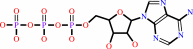 ATP
ATP
|
=
|
O-phospho-L-tyrosyl-[protein]
Bound ligand (Het Group name = )
matches with 41.38% similarity
|
+
|
 ADP
ADP
|
+
|
H(+)
|
|
|
|
|
|
|
|
|
|
|
|
|
Molecule diagrams generated from .mol files obtained from the
KEGG ftp site
|
|
|
|
|
|
|
|
|
|
|
|
|
|
 |
|
|
|
|
|
|
| |
|
|
| |
|
DOI no:
|
Structure
16:216-227
(2008)
|
|
PubMed id:
|
|
|
|
|
|
| |
|
Structural basis for EGF receptor inhibition by the therapeutic antibody IMC-11F8.
|
|
S.Li,
P.Kussie,
K.M.Ferguson.
|
|
|
|
|
| |
ABSTRACT
|
|
|
|
| |
|
|
Therapeutic anticancer strategies that target and inactivate the epidermal
growth factor receptor (EGFR) are under intense study in the clinic. Here we
describe the mechanism of EGFR inhibition by an antibody drug IMC-11F8. IMC-11F8
is a fully human antibody that has similar antitumor potency as the chimeric
cetuximab/Erbitux and might represent a safer therapeutic alternative. We report
the X-ray crystal structure of the Fab fragment of IMC-11F8 (Fab11F8) in complex
with the entire extracellular region and with isolated domain III of EGFR. We
compare this to our previous study of the cetuximab/EGFR interaction. Fab11F8
interacts with a remarkably similar epitope, but through a completely different
set of interactions. Both the similarities and differences in binding of these
two antibodies have important implications for the development of inhibitors
that could exploit this same mechanism of EGFR inhibition.
|
|
|
|
|
|
| |
Selected figure(s)
|
|
|
|
| |
|
|

|
|

|
|
Figure 4.
Figure 4. Features of the Shared Fab11F8, FabC225, and EGF
Binding Region on Domain III
(A) Molecular surface
representations of domain III of sEGFR with the contact regions
(as defined in Figure 3D) colored red for Fab11F8, yellow for
FabC225, and blue for EGF. Orientation is looking down onto the
domain III binding site.
(B) Functional features of the
domain III molecular surface. In the left panel, the surface is
colored by atom type: negative, red; positive, blue; polar
oxygen, pink; polar nitrogen, light blue; and apolar, white. The
right panel shows the electrostatic potential from −2.5 kT
(red) to +2.5 kT (blue) projected onto the surface.
Electrostatic potential calculations used the adaptive
Poisson-Boltzmann solver (APBS) implemented in PyMOL ([Baker et
al., 2001] and [DeLano, 2004]).
(C) Orthogonal views of
domain III. High-mannose chains (yellow) have been placed at
each position of glycosylation on sEGFR guided by the one or two
ordered sugar groups that are seen in the X-ray crystal
structures. For reference, the contact region of Fab11F8 is
shown (red).
(D) Three orientations of sEGFR are shown with
the electrostatic potential, as in (B), projected on the surface
and high-mannose chains shown. Both electrostatic and
carbohydrate steering might play a role in guiding Fabs or
ligands to the shared binding site on domain III.
|
|
Figure 8.
Figure 8. Mechanism of Inhibition of EGFR Activation by
IMC-11F8 and by Cetuximab
(A) Cartoon model of Fab11F8
bound to sEGFR colored as in Figure 3A. Domain I and the
N-terminal portion of domain II (gray) have been modeled using
the coordinates from PDB ID code 1YY9.
(B) Cartoon of the
FabC225/sEGFR complex (PDB ID code: 1YY9) colored as in (A).
(C) The mechanism of inhibition of ligand-induced
dimerization and activation of EGFR for IMC-11F8 and cetuximab
based on the structures presented here and in Li et al. (2005).
The binding of the antibody to domain III of EGFR prevents
ligand binding and might also sterically inhibit the
conformational change that must occur for dimerization.
|
|
|
|
|
|
| |
The above figures are
reprinted
by permission from Cell Press:
Structure
(2008,
16,
216-227)
copyright 2008.
|
|
| |
Figures were
selected
by an automated process.
|
|
|
|
|
|
|
|
|
|
|
|
|
|
|
|
 |
 |
 |
|
Literature references that cite this PDB file's key reference
|
|
|
| |
PubMed id
|
|
Reference
|
|
|
|
|
|
R.L.Rich,
and
D.G.Myszka
(2010).
Grading the commercial optical biosensor literature-Class of 2008: 'The Mighty Binders'.
|
| |
J Mol Recognit,
23,
1.
|
|
|
|
|
|
|
I.C.Wilkinson,
C.J.Hall,
V.Veverka,
J.Y.Shi,
F.W.Muskett,
P.E.Stephens,
R.J.Taylor,
A.J.Henry,
and
M.D.Carr
(2009).
High resolution NMR-based model for the structure of a scFv-IL-1beta complex: potential for NMR as a key tool in therapeutic antibody design and development.
|
| |
J Biol Chem,
284,
31928-31935.
|
|
|
PDB code:
|
|
|
|
|
|
|
|
K.R.Schmitz,
and
K.M.Ferguson
(2009).
Interaction of antibodies with ErbB receptor extracellular regions.
|
| |
Exp Cell Res,
315,
659-670.
|
|
|
|
|
|
|
T.P.Garrett,
A.W.Burgess,
H.K.Gan,
R.B.Luwor,
G.Cartwright,
F.Walker,
S.G.Orchard,
A.H.Clayton,
E.C.Nice,
J.Rothacker,
B.Catimel,
W.K.Cavenee,
L.J.Old,
E.Stockert,
G.Ritter,
T.E.Adams,
P.A.Hoyne,
D.Wittrup,
G.Chao,
J.R.Cochran,
C.Luo,
M.Lou,
T.Huyton,
Y.Xu,
W.D.Fairlie,
S.Yao,
A.M.Scott,
and
T.G.Johns
(2009).
Antibodies specifically targeting a locally misfolded region of tumor associated EGFR.
|
| |
Proc Natl Acad Sci U S A,
106,
5082-5087.
|
|
|
PDB codes:
|
|
|
|
|
|
|
|
V.Ratushny,
I.Astsaturov,
B.A.Burtness,
E.A.Golemis,
and
J.S.Silverman
(2009).
Targeting EGFR resistance networks in head and neck cancer.
|
| |
Cell Signal,
21,
1255-1268.
|
|
|
|
|
|
|
D.J.Leahy
(2008).
A molecular view of anti-ErbB monoclonal antibody therapy.
|
| |
Cancer Cell,
13,
291-293.
|
|
|
|
|
|
|
M.Peipp,
M.Dechant,
and
T.Valerius
(2008).
Effector mechanisms of therapeutic antibodies against ErbB receptors.
|
| |
Curr Opin Immunol,
20,
436-443.
|
|
|
|
|
|
|
N.Lonberg
(2008).
Fully human antibodies from transgenic mouse and phage display platforms.
|
| |
Curr Opin Immunol,
20,
450-459.
|
|
|
|
|
|
The most recent references are shown first.
Citation data come partly from CiteXplore and partly
from an automated harvesting procedure. Note that this is likely to be
only a partial list as not all journals are covered by
either method. However, we are continually building up the citation data
so more and more references will be included with time.
Where a reference describes a PDB structure, the PDB
code is
shown on the right.
|
 |
|


 Links
Links


