
|
|
|
|
|
 |
Contents |
 |
|
|
|
|
|
|
|
|
|
|
|


 (+ 0 more)
561 a.a.
(+ 0 more)
561 a.a.
|
|
|
|
|
|
|
|
|
|
|


 (+ 0 more)
450 a.a.
(+ 0 more)
450 a.a.
|
|
|
|
|
|
|
|
|
|
|

 129 a.a.
|
|
|
|
|
|
|
|
|
|
|

 104 a.a.
|
|
|
|
|
|
|
|
|
* Residue conservation analysis
|
|
|
|
|
|
PDB id:
|
|
|
|
| Name: |
|
Hydrolase
|
|
|
Title:
|
|
Inter-subunit interaction and quaternary rearrangement defined by the central stalk of prokaryotic v1-atpase
|
|
Structure:
|
|
V-type atp synthase alpha chain. Chain: a, b, c, i, j, k. Synonym: v-type atpase subunit a. V-type atp synthase beta chain. Chain: d, e, f, l, m, n. Synonym: v-type atpase subunit b. V-type atp synthase subunit d. Chain: g, o. Synonym: v-type atpase subunit d.
|
|
Source:
|
|
Thermus thermophilus. Organism_taxid: 300852. Strain: hb8. Strain: hb8
|
|
Resolution:
|
|
|
4.51Å
|
R-factor:
|
0.429
|
R-free:
|
0.437
|
|
|
Authors:
|
|
N.Numoto,Y.Hasegawa,K.Takeda,K.Miki
|
|
Key ref:
|
|
N.Numoto
et al.
(2009).
Inter-subunit interaction and quaternary rearrangement defined by the central stalk of prokaryotic V1-ATPase.
Embo Rep,
10,
1228-1234.
PubMed id:
|
|
|
Date:
|
|
|
06-Aug-09
|
Release date:
|
13-Oct-09
|
|
|
|
|
|
|
PROCHECK
|

|
|
|
|
|
Headers
|
|
|
|
References
|
|
|
|
|
|

|
|
Q56403
(VATA_THET8) -
V-type ATP synthase alpha chain from Thermus thermophilus (strain ATCC 27634 / DSM 579 / HB8)
|
|
|
|
Seq:
Struc:
|
|
|
|
578 a.a.
561 a.a.
|
|

|

|
|
|
|
|
|
|
|
|
|
|
|
|

|
|
Q56404
(VATB_THET8) -
V-type ATP synthase beta chain from Thermus thermophilus (strain ATCC 27634 / DSM 579 / HB8)
|
|
|
|
Seq:
Struc:
|
|
|
|
478 a.a.
450 a.a.
|
|
|

|

|
|
|
|
|
|
|
|
|
|
|
|
|
|
|
|
|
Enzyme class 2:
|
|
Chains A, B, C, I, J, K:
E.C.7.1.2.2
- H(+)-transporting two-sector ATPase.
|
|
|
|
|
|
|
Reaction:
|
|
ATP + H2O + 4 H+(in) = ADP + phosphate + 5 H+(out)
|
|
|
|
|
|
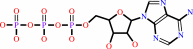 ATP
ATP
|
+
|
H2O
|
+
|
4
×
H(+)(in)
|
=
|
ADP
Bound ligand (Het Group name = )
corresponds exactly
|
+
|
 phosphate
|
+
|
5
×
H(+)(out)
|
|
|
|
|
|
|
|
|
|
Enzyme class 3:
|
|
Chains D, E, F, H, L, M, N, P:
E.C.3.6.3.14
- Transferred entry: 7.1.2.2.
|
|
|
|
|
|
|
Reaction:
|
|
ATP + H2O + H+(In) = ADP + phosphate + H+(Out)
|
|
|
|
|
|
 ATP
ATP
|
+
|
H(2)O
|
+
|
4
×
H(+)(In)
|
=
|
ADP
Bound ligand (Het Group name = )
corresponds exactly
|
+
|
phosphate
|
+
|
5
×
H(+)(Out)
|
|
|
|
|
|
|
|
|
|
|
|
|
Note, where more than one E.C. class is given (as above), each may
correspond to a different protein domain or, in the case of polyprotein
precursors, to a different mature protein.
|
|
|
|
Molecule diagrams generated from .mol files obtained from the
KEGG ftp site
|
|
|
|
|
|
|
|
|
|
|
|
|
|
 |
|
|
|
|
|
|
| |
|
|
| |
|
|
Embo Rep
10:1228-1234
(2009)
|
|
PubMed id:
|
|
|
|
|
|
| |
|
Inter-subunit interaction and quaternary rearrangement defined by the central stalk of prokaryotic V1-ATPase.
|
|
N.Numoto,
Y.Hasegawa,
K.Takeda,
K.Miki.
|
|
|
|
|
| |
ABSTRACT
|
|
|
|
| |
|
|
V-type ATPases (V-ATPases) are categorized as rotary ATP synthase/ATPase
complexes. The V-ATPases are distinct from F-ATPases in terms of their rotation
scheme, architecture and subunit composition. However, there is no detailed
structural information on V-ATPases despite the abundant biochemical and
biophysical research. Here, we report a crystallographic study of V1-ATPase,
from Thermus thermophilus, which is a soluble component consisting of A, B, D
and F subunits. The structure at 4.5 A resolution reveals inter-subunit
interactions and nucleotide binding. In particular, the structure of the central
stalk composed of D and F subunits was shown to be characteristic of V1-ATPases.
Small conformational changes of respective subunits and significant
rearrangement of the quaternary structure observed in the three AB pairs were
related to the interaction with the straight central stalk. The rotation
mechanism is discussed based on a structural comparison between V1-ATPases and
F1-ATPases.
|
|
|
|
|
|
|
|
|
|
|
|
|
|
|
|
|
|
 |
 |
 |
|
Literature references that cite this PDB file's key reference
|
|
|
| |
PubMed id
|
|
Reference
|
|
|
|
|
|
S.Arai,
S.Saijo,
K.Suzuki,
K.Mizutani,
Y.Kakinuma,
Y.Ishizuka-Katsura,
N.Ohsawa,
T.Terada,
M.Shirouzu,
S.Yokoyama,
S.Iwata,
I.Yamato,
and
T.Murata
(2013).
Rotation mechanism of Enterococcus hirae V1-ATPase based on asymmetric crystal structures.
|
| |
Nature,
493,
703-707.
|
|
|
PDB codes:
|
|
|
|
|
|
|
|
S.Benlekbir,
S.A.Bueler,
and
J.L.Rubinstein
(2012).
Structure of the vacuolar-type ATPase from Saccharomyces cerevisiae at 11-Å resolution.
|
| |
Nat Struct Mol Biol,
19,
1356-1362.
|
|
|
|
|
|
|
W.C.Lau,
and
J.L.Rubinstein
(2012).
Subnanometre-resolution structure of the intact Thermus thermophilus H+-driven ATP synthase.
|
| |
Nature,
481,
214-218.
|
|
|
PDB code:
|
|
|
|
|
|
|
|
T.Ibuki,
K.Imada,
T.Minamino,
T.Kato,
T.Miyata,
and
K.Namba
(2011).
Common architecture of the flagellar type III protein export apparatus and F- and V-type ATPases.
|
| |
Nat Struct Mol Biol,
18,
277-282.
|
|
|
PDB code:
|
|
|
|
|
|
|
|
L.K.Lee,
A.G.Stewart,
M.Donohoe,
R.A.Bernal,
and
D.Stock
(2010).
The structure of the peripheral stalk of Thermus thermophilus H+-ATPase/synthase.
|
| |
Nat Struct Mol Biol,
17,
373-378.
|
|
|
PDB code:
|
|
|
|
|
|
|
|
P.Balabaskaran Nina,
N.V.Dudkina,
L.A.Kane,
J.E.van Eyk,
E.J.Boekema,
M.W.Mather,
and
A.B.Vaidya
(2010).
Highly divergent mitochondrial ATP synthase complexes in Tetrahymena thermophila.
|
| |
PLoS Biol,
8,
e1000418.
|
|
|
|
|
|
|
Z.L.Hildenbrand,
S.K.Molugu,
D.Stock,
and
R.A.Bernal
(2010).
The C-H peripheral stalk base: a novel component in V1-ATPase assembly.
|
| |
PLoS One,
5,
e12588.
|
|
|
|
|
|
|
T.Boesen,
and
P.Nissen
(2009).
V for victory--a V1-ATPase structure revealed.
|
| |
EMBO Rep,
10,
1211-1212.
|
|
|
|
|
|
The most recent references are shown first.
Citation data come partly from CiteXplore and partly
from an automated harvesting procedure. Note that this is likely to be
only a partial list as not all journals are covered by
either method. However, we are continually building up the citation data
so more and more references will be included with time.
Where a reference describes a PDB structure, the PDB
codes are
shown on the right.
|

| |


 Links
Links


