
|
|
|
|
|
 |
Contents |
 |
|
|
|
|
|
|
|
|
|
|
|

 431 a.a.
|
|
|
|
|
|
|
|
|
|
|

 352 a.a.
|
|
|
|
|
|
|
|
|
|
|

 385 a.a.
|
|
|
|
|
|
|
|
|
|
|

 246 a.a.
|
|
|
|
|
|
|
|
|
|
|

 185 a.a.
|
|
|
|
|
|
|
|
|
|
|

 74 a.a.
|
|
|
|
|
|
|
|
|
|
|

 125 a.a.
|
|
|
|
|
|
|
|
|
|
|

 93 a.a.
|
|
|
|
|
|
|
|
|
|
|

 55 a.a.
|
|
|
|
|
|
|
|
|
|
|

 127 a.a.
|
|
|
|
|
|
|
|
|
|
|

 107 a.a.
|
|
|
|
|
|
|
|
|
|
|
 112 a.a.
|
|
|
|
|
|
|
|
|
|
|
|
|
|
|
|
|
|
|
|
|
|
|
×2
|
|
|
|
|
|
|
|
|
|
|
×7
|
|
|
|
|
|
|
|
|
|
|
×2
|
|
|
|
|
|
|
|
|
|
|
×2
|
|
|
|
|
|
|
|
|
|
|
×2
|
|
|
|
|
|
|
|
|
|
|
×2
|
|
|
|
|
|
|
|
|
|
|
×2
|
|
|
|
|
|
|
|
|
|
|
×2
|
|
|
|
|
|
|
|
|
|
|
×2
|
|
|
|
|
|
|
|
|
* Residue conservation analysis
|
|
|
|
|
|
PDB id:
|
|
|
|
| Name: |
|
Oxidoreductase
|
|
|
Title:
|
|
Structure of yeast complex iii with isoform-2 cytochromE C bound and definition of a minimal core interface for electron transfer.
|
|
Structure:
|
|
Cytochrome b-c1 complex subunit 1, mitochondrial. Chain: a, l. Synonym: ubiquinol- cytochromE-C reductase complex core protein 1, core protein i, complex iii subunit 1. Cytochrome b-c1 complex subunit 2, mitochondrial. Chain: b, m. Synonym: ubiquinol- cytochromE-C reductase complex core protein 2, core protein ii, complex iii subunit 2. Cytochrome b.
|
|
Source:
|
|
Saccharomyces cerevisiae. Yeast. Mus musculus. House mouse. Organism_taxid: 10090. Expressed in: escherichia coli. Expression_system_taxid: 562. Yeast
|
|
Resolution:
|
|
|
2.50Å
|
R-factor:
|
0.225
|
R-free:
|
0.256
|
|
|
Authors:
|
|
S.R.N.Solmaz,C.Hunte
|
Key ref:

|
|
S.R.Solmaz
and
C.Hunte
(2008).
Structure of complex III with bound cytochrome c in reduced state and definition of a minimal core interface for electron transfer.
J Biol Chem,
283,
17542-17549.
PubMed id:
DOI:

|
|
|
Date:
|
|
|
24-Apr-08
|
Release date:
|
13-May-08
|
|
|
|
|
|
|
PROCHECK
|

|
|
|
|
|
Headers
|
|
|
|
References
|
|
|
|
|
|

|
|
P07256
(QCR1_YEAST) -
Cytochrome b-c1 complex subunit 1, mitochondrial from Saccharomyces cerevisiae (strain ATCC 204508 / S288c)
|
|
|
|
Seq:
Struc:
|
|
|
|
457 a.a.
431 a.a.*
|
|

|

|

|
|
|
|
|
|
|
|
|
|
|
|

|
|
P07257
(QCR2_YEAST) -
Cytochrome b-c1 complex subunit 2, mitochondrial from Saccharomyces cerevisiae (strain ATCC 204508 / S288c)
|
|
|
|
Seq:
Struc:
|
|
|
|
368 a.a.
352 a.a.
|
|
|

|

|
|
|
|
|
|
|
|
|
|
|
|

|
|
P00163
(CYB_YEAST) -
Cytochrome b from Saccharomyces cerevisiae (strain ATCC 204508 / S288c)
|
|
|
|
Seq:
Struc:
|
|
|
|
385 a.a.
385 a.a.
|
|
|

|

|
|
|
|
|
|
|
|
|
|
|
|

|
|
P07143
(CY1_YEAST) -
Cytochrome c1, heme protein, mitochondrial from Saccharomyces cerevisiae (strain ATCC 204508 / S288c)
|
|
|
|
Seq:
Struc:
|
|
|
|
309 a.a.
246 a.a.
|
|
|

|

|
|
|
|
|
|
|
|
|
|
|
|

|
|
P08067
(UCRI_YEAST) -
Cytochrome b-c1 complex subunit Rieske, mitochondrial from Saccharomyces cerevisiae (strain ATCC 204508 / S288c)
|
|
|
|
Seq:
Struc:
|
|
|
|
215 a.a.
185 a.a.
|
|
|

|
|
|
|
|
|
|
|
|
|
|
|
|

|
|
P00127
(QCR6_YEAST) -
Cytochrome b-c1 complex subunit 6, mitochondrial from Saccharomyces cerevisiae (strain ATCC 204508 / S288c)
|
|
|
|
Seq:
Struc:
|
|
|
|
147 a.a.
74 a.a.
|
|
|

|
|
|
|
|
|
|
|
|
|
|
|
|

|
|
P00128
(QCR7_YEAST) -
Cytochrome b-c1 complex subunit 7, mitochondrial from Saccharomyces cerevisiae (strain ATCC 204508 / S288c)
|
|
|
|
Seq:
Struc:
|
|
|
|
127 a.a.
125 a.a.
|
|
|

|
|
|
|
|
|
|
|
|
|
|
|
|

|
|
P08525
(QCR8_YEAST) -
Cytochrome b-c1 complex subunit 8, mitochondrial from Saccharomyces cerevisiae (strain ATCC 204508 / S288c)
|
|
|
|
Seq:
Struc:
|
|
|
|
94 a.a.
93 a.a.
|
|
|

|
|
|
|
|
|
|
|
|
|
|
|
|

|
|
P22289
(QCR9_YEAST) -
Cytochrome b-c1 complex subunit 9, mitochondrial from Saccharomyces cerevisiae (strain ATCC 204508 / S288c)
|
|
|
|
Seq:
Struc:
|
|
|
|
66 a.a.
55 a.a.
|
|
|

|
|
|
|
|
|
|
|
|
|
|
|
|

|
|
No UniProt id for this chain
|
|
|
|
|
|
|
|
|
|
|
|
|
|
|
|
|
|
|
|
|
Enzyme class 2:
|
|
Chains A, B, F, G, H, I, L, M, Q, R, S, T:
E.C.1.10.2.2
- Transferred entry: 7.1.1.8.
|
|
|
|
|
|
|
Reaction:
|
|
Quinol + 2 ferricytochrome c = quinone + 2 ferrocytochrome c + 2 H+
|
|
|
|
|
|
Quinol
|
+
|
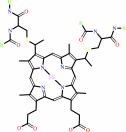 2
×
ferricytochrome c
2
×
ferricytochrome c
|
=
|
quinone
Bound ligand (Het Group name = )
matches with 72.73% similarity
|
+
|
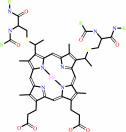 2
×
ferrocytochrome c
2
×
ferrocytochrome c
|
+
|
2
×
H(+)
|
|
|
|
|
|
|
|
|
|
Enzyme class 3:
|
|
Chains C, D, E, N, O, P:
E.C.7.1.1.8
- quinol--cytochrome-c reductase.
|
|
|
|
|
|
|
Reaction:
|
|
a quinol + 2 Fe(III)-[cytochrome c](out) = a quinone + 2 Fe(II)- [cytochrome c](out) + 2 H(+)(out)
|
|
|
|
|
|
quinol
|
+
|
2
×
Fe(III)-[cytochrome c](out)
|
=
|
 quinone
|
+
|
2
×
Fe(II)- [cytochrome c](out)
|
+
|
2
×
H(+)(out)
|
|
|
|
|
|
|
|
|
|
Enzyme class 4:
|
|
Chain W:
E.C.?
|
|
|
|
|
|
|
|
|
|
Note, where more than one E.C. class is given (as above), each may
correspond to a different protein domain or, in the case of polyprotein
precursors, to a different mature protein.
|
|
|
|
Molecule diagrams generated from .mol files obtained from the
KEGG ftp site
|
|
|
|
|
|
|
|
|
|
|
|
|
|
 |
|
|
|
|
|
|
| |
|
|
| |
|
DOI no:
|
J Biol Chem
283:17542-17549
(2008)
|
|
PubMed id:
|
|
|
|
|
|
| |
|
Structure of complex III with bound cytochrome c in reduced state and definition of a minimal core interface for electron transfer.
|
|
S.R.Solmaz,
C.Hunte.
|
|
|
|
|
| |
ABSTRACT
|
|
|
|
| |
|
|
In cellular respiration, cytochrome c transfers electrons from cytochrome bc(1)
complex (complex III) to cytochrome c oxidase by transiently binding to the
membrane proteins. Here, we report the structure of isoform-1 cytochrome c bound
to cytochrome bc(1) complex at 1.9 A resolution in reduced state. The dimer
structure is asymmetric. Monovalent cytochrome c binding is correlated with
conformational changes of the Rieske head domain and subunit QCR6p and with a
higher number of interfacial water molecules bound to cytochrome c(1).
Pronounced hydration and a "mobility mismatch" at the interface with disordered
charged residues on the cytochrome c side are favorable for transient binding.
Within the hydrophobic interface, a minimal core was identified by comparison
with the novel structure of the complex with bound isoform-2 cytochrome c. Four
core interactions encircle the heme cofactors surrounded by variable
interactions. The core interface may be a feature to gain specificity for
formation of the reactive complex.
|
|
|
|
|
|
| |
Selected figure(s)
|
|
|
|
| |
|
|

|
|

|
|
Figure 2.
FIGURE 2. The interface of cyt c (green) and cyt c[1]
(pink) at high resolution. Hemes, black; water molecules, cyan.
A, 2F[o] - F[c] electron density map at the interface, contoured
at 1  and drawn as a blue
mesh. B, stereo view of the core interface. The minimal core
interface (dashed lines) is defined by four residue pairs
(labeled) that were identified in three structures of the
electron transfer complex. The contact of the heme CBC atoms is
shown as a dotted line. and drawn as a blue
mesh. B, stereo view of the core interface. The minimal core
interface (dashed lines) is defined by four residue pairs
(labeled) that were identified in three structures of the
electron transfer complex. The contact of the heme CBC atoms is
shown as a dotted line.
|
|
Figure 3.
FIGURE 3. The building blocks of the interface. The cyt
c[1] (A)-cyt c (B) interface is shown in open book view. The
heme groups (black) are encircled by the core interface (orange
area, interacting atoms as orange spheres). The variable
interface (yellow) surrounds the latter. Residues mediating
long-range electrostatic interactions (pink and blue for
negative and positive charges, respectively) form a semicircle
around the central hydrophobic contact site. C, the
semitransparent surface representation of cyt c[1] (gray) and
cyt c (green) shows the position of these long-range
electrostatic interactions in the high resolution structure
(Table 1) as highlighted in blue-green and pink (positive and
negative charges, respectively). Heme groups are shown in black.
A high number of water molecules (cyan spheres) are bound at the
interface of cyt c[1] (D) but not of cyt c (E). Only two of
these water molecules form hydrogen bonds to both cyt c[1] and
cyt c (green spheres). F, interface water molecules bound to cyt
c[1] colored in cyan and green (as in D) are superimposed with
all surface water molecules that are present at the other cyt
c[1] with the non-occupied cyt c binding site (dark blue
spheres). Surface water molecules up to a distance of 3.5
Å are included.
|
|
|
|
|
|
| |
The above figures are
reprinted
by permission from the ASBMB:
J Biol Chem
(2008,
283,
17542-17549)
copyright 2008.
|
|
| |
Figures were
selected
by the author.
|
|
|
|
|
|
|
|
|
|
|
|
|
|
|
|
 |
 |
 |
|
Literature references that cite this PDB file's key reference
|
|
|
| |
PubMed id
|
|
Reference
|
|
|
|
|
|
I.Bertini,
G.Cavallaro,
and
A.Rosato
(2011).
Principles and patterns in the interaction between mono-heme cytochrome c and its partners in electron transfer processes.
|
| |
Metallomics,
3,
354-362.
|
|
|
|
|
|
|
L.Macchioni,
T.Corazzi,
M.Davidescu,
E.Francescangeli,
R.Roberti,
and
L.Corazzi
(2010).
Cytochrome c redox state influences the binding and release of cytochrome c in model membranes and in brain mitochondria.
|
| |
Mol Cell Biochem,
341,
149-157.
|
|
|
|
|
|
|
M.Bestwick,
M.Y.Jeong,
O.Khalimonchuk,
H.Kim,
and
D.R.Winge
(2010).
Analysis of Leigh syndrome mutations in the yeast SURF1 homolog reveals a new member of the cytochrome oxidase assembly factor family.
|
| |
Mol Cell Biol,
30,
4480-4491.
|
|
|
|
|
|
|
M.Castellani,
R.Covian,
T.Kleinschroth,
O.Anderka,
B.Ludwig,
and
B.L.Trumpower
(2010).
Direct demonstration of half-of-the-sites reactivity in the dimeric cytochrome bc1 complex: enzyme with one inactive monomer is fully active but unable to activate the second ubiquinol oxidation site in response to ligand binding at the ubiquinone reduction site.
|
| |
J Biol Chem,
285,
502-510.
|
|
|
|
|
|
|
D.Baniulis,
E.Yamashita,
J.P.Whitelegge,
A.I.Zatsman,
M.P.Hendrich,
S.S.Hasan,
C.M.Ryan,
and
W.A.Cramer
(2009).
Structure-Function, Stability, and Chemical Modification of the Cyanobacterial Cytochrome b6f Complex from Nostoc sp. PCC 7120.
|
| |
J Biol Chem,
284,
9861-9869.
|
|
|
PDB code:
|
|
|
|
|
|
|
|
J.W.Cooley,
D.W.Lee,
and
F.Daldal
(2009).
Across membrane communication between the Q(o) and Q(i) active sites of cytochrome bc(1).
|
| |
Biochemistry,
48,
1888-1899.
|
|
|
|
|
|
|
M.Nojiri,
H.Koteishi,
T.Nakagami,
K.Kobayashi,
T.Inoue,
K.Yamaguchi,
and
S.Suzuki
(2009).
Structural basis of inter-protein electron transfer for nitrite reduction in denitrification.
|
| |
Nature,
462,
117-120.
|
|
|
PDB code:
|
|
|
|
|
|
|
|
V.Zara,
L.Conte,
and
B.L.Trumpower
(2009).
Evidence that the assembly of the yeast cytochrome bc1 complex involves the formation of a large core structure in the inner mitochondrial membrane.
|
| |
FEBS J,
276,
1900-1914.
|
|
|
|
|
|
|
J.Janzon,
Q.Yuan,
F.Malatesta,
P.Hellwig,
B.Ludwig,
B.Durham,
and
F.Millett
(2008).
Probing the Paracoccus denitrificans cytochrome c(1)-cytochrome c(552) interaction by mutagenesis and fast kinetics.
|
| |
Biochemistry,
47,
12974-12984.
|
|
|
|
|
|
The most recent references are shown first.
Citation data come partly from CiteXplore and partly
from an automated harvesting procedure. Note that this is likely to be
only a partial list as not all journals are covered by
either method. However, we are continually building up the citation data
so more and more references will be included with time.
Where a reference describes a PDB structure, the PDB
code is
shown on the right.
|

| |


 Links
Links


