 |
PDBsum entry 2zoq

|
|
|
|
|
 |
Contents |
 |
|
|
|
|
|
|
|
|
|
|
|
|
|
|
* Residue conservation analysis
|
|
|
|
|
|
PDB id:
|
|
|
|
| Name: |
|
Transferase
|
|
|
Title:
|
|
Structural dissection of human mitogen-activated kinase erk1
|
|
Structure:
|
|
Mitogen-activated protein kinase 3. Chain: a, b. Synonym: extracellular signal-regulated kinase 1, erk-1, insulin- stimulated map2 kinase, map kinase 1, mapk 1, p44-erk1, ert2, p44- mapk, microtubule-associated protein 2 kinase. Engineered: yes
|
|
Source:
|
|
Homo sapiens. Human. Organism_taxid: 9606. Gene: mapk3, erk1, prkm3. Expressed in: escherichia coli. Expression_system_taxid: 562.
|
|
Resolution:
|
|
|
2.39Å
|
R-factor:
|
0.249
|
R-free:
|
0.267
|
|
|
Authors:
|
|
T.Kinoshita,T.Tada,S.Nakae,I.Yoshida
|
|
Key ref:
|
|
T.Kinoshita
et al.
(2008).
Crystal structure of human mono-phosphorylated ERK1 at Tyr204.
Biochem Biophys Res Commun,
377,
1123-1127.
PubMed id:
|
|
|
Date:
|
|
|
01-Jun-08
|
Release date:
|
07-Apr-09
|
|
|
|
|
|
|
PROCHECK
|

|
|
|
|
|
Headers
|
|
|
|
References
|
|
|
|
|
|

|
|
P27361
(MK03_HUMAN) -
Mitogen-activated protein kinase 3 from Homo sapiens
|
|
|
|
Seq:
Struc:
|
|
|
|
379 a.a.
352 a.a.
|
|

|

|

|
|
|
|
|
|
|
|
|
|
|
Key: |
 |
PfamA domain |
|
|
 |
Secondary structure |
|
 |
CATH domain |
|
|
|
|
|
|
|
|
|
|
|
|
|
Enzyme class:
|
|
E.C.2.7.11.24
- mitogen-activated protein kinase.
|
|
|
|
|
|
|
Reaction:
|
|
|
1.
|
L-seryl-[protein] + ATP = O-phospho-L-seryl-[protein] + ADP + H+
|
|
2.
|
L-threonyl-[protein] + ATP = O-phospho-L-threonyl-[protein] + ADP + H+
|
|
|
|
|
|
|
L-seryl-[protein]
|
+
|
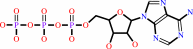 ATP
ATP
|
=
|
O-phospho-L-seryl-[protein]
Bound ligand (Het Group name = )
matches with 62.07% similarity
|
+
|
 ADP
ADP
|
+
|
H(+)
|
|
|
|
|
|
|
L-threonyl-[protein]
|
+
|
ATP
|
=
|
O-phospho-L-threonyl-[protein]
Bound ligand (Het Group name = )
matches with 62.07% similarity
|
+
|
ADP
|
+
|
H(+)
|
|
|
|
|
|
|
|
|
|
|
|
|
Molecule diagrams generated from .mol files obtained from the
KEGG ftp site
|
|
|
|
|
|
|
|
|
|
|
|
|
|
 |
|
|
|
|
|
|
| |
|
|
| |
|
|
Biochem Biophys Res Commun
377:1123-1127
(2008)
|
|
PubMed id:
|
|
|
|
|
|
| |
|
Crystal structure of human mono-phosphorylated ERK1 at Tyr204.
|
|
T.Kinoshita,
I.Yoshida,
S.Nakae,
K.Okita,
M.Gouda,
M.Matsubara,
K.Yokota,
H.Ishiguro,
T.Tada.
|
|
|
|
|
| |
ABSTRACT
|
|
|
|
| |
|
|
Extracellular signal-regulated kinase (ERK) is a member of the MAP kinase
family, and can regulate several cellular responses. The isoforms ERK1 and ERK2
have markedly similar amino acid sequences, but exhibit distinctive
physiological functions. As well as ERK2, ERK1 was auto- and mono-phosphorylated
at Tyr204 in the activation loop during Escherichia coli production, resulting
in basal level activity, approximately 500-fold less compared with fully-active
ERK1 dual-phosphorylated at Thr202 and Tyr204. Crystal structure demonstrated
that the mono-phosphorylated ERK1 kinase possessed a novel conformation
distinguishable from the un-phosphorylated (inactive) and the
dual-phosphorylated (full-active) forms. The characteristic structural features
in both the C-helix and the activation loop likely contribute to the basal
activity of the mono-phosphorylated ERK1. The structural dissection of ERK1
compared to ERK2 suggests that the structural differences in the D-motif binding
site and in the backside binding site are putative targets for development of
selective ERK1/ERK2 inhibitors.
|
|
|
|
|
|
|
|
|
|
|
|
|
|
|
|
|
|
 |
 |
 |
|
Literature references that cite this PDB file's key reference
|
|
|
| |
PubMed id
|
|
Reference
|
|
|
|
|
|
P.Evans,
A.Sacan,
L.Ungar,
and
A.Tozeren
(2010).
Sequence alignment reveals possible MAPK docking motifs on HIV proteins.
|
| |
PLoS One,
5,
e8942.
|
|
|
|
|
|
The most recent references are shown first.
Citation data come partly from CiteXplore and partly
from an automated harvesting procedure. Note that this is likely to be
only a partial list as not all journals are covered by
either method. However, we are continually building up the citation data
so more and more references will be included with time.
|
|


 Links
Links


