 |
PDBsum entry 2zm4

|
|
|
|
|
 |
Contents |
 |
|
|
|
|
|
|
|
|
|
|
|
|
* Residue conservation analysis
|
|
|
|
|
|
|
|
|
|
|
Enzyme class:
|
|
E.C.2.7.10.2
- non-specific protein-tyrosine kinase.
|
|
|
|
|
|
|
Reaction:
|
|
L-tyrosyl-[protein] + ATP = O-phospho-L-tyrosyl-[protein] + ADP + H+
|
|
|
|
|
|
L-tyrosyl-[protein]
|
+
|
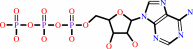 ATP
ATP
|
=
|
O-phospho-L-tyrosyl-[protein]
|
+
|
 ADP
ADP
|
+
|
H(+)
|
|
|
|
|
|
|
|
|
|
|
|
|
Molecule diagrams generated from .mol files obtained from the
KEGG ftp site
|
|
|
|
|
|
|
|
|
|
|
|
|
|
 |
|
|
|
|
|
|
| |
|
|
| |
|
|
Bioorg Med Chem Lett
16:10311-10318
(2008)
|
|
PubMed id:
|
|
|
|
|
|
| |
|
The importance of CH/pi hydrogen bonds in rational drug design: An ab initio fragment molecular orbital study to leukocyte-specific protein tyrosine (LCK) kinase.
|
|
T.Ozawa,
E.Tsuji,
M.Ozawa,
C.Handa,
H.Mukaiyama,
T.Nishimura,
S.Kobayashi,
K.Okazaki.
|
|
|
|
|
| |
ABSTRACT
|
|
|
|
| |
|
|
The interaction energy was calculated, by the ab initio FMO method, for
complexes between LCK protein and four inhibitors (staurosporine, BMS compound
2, and our compounds 3 and 4). In every case a number of CH/pi hydrogen bonds
have been disclosed in the so-called adenine pocket. In complexes of 2, 3, and
4, CH/pi and NH/pi hydrogen bonds have been observed in another pocket. In view
of the above results, the aniline ring of 3 was replaced by 2,6-dimethyl aniline
to increase the potency for LCK kinase. A 10-fold increase in the potency has
been achieved for 4 over 3. We suggest that the concept of weak hydrogen bonds
is useful in the rational design of drugs.
|
|
|
|
|
|
|
|
|
|
|
|
|
|
|
|
|
|
 |
 |
 |
|
Literature references that cite this PDB file's key reference
|
|
|
| |
PubMed id
|
|
Reference
|
|
|
|
|
|
J.P.Yesudas,
F.B.Sayyed,
and
C.H.Suresh
(2011).
Analysis of structural water and CH···π interactions in HIV-1 protease and PTP1B complexes using a hydrogen bond prediction tool, HBPredicT.
|
| |
J Mol Model,
17,
401-413.
|
|
|
|
|
|
|
T.Nagata,
D.G.Fedorov,
K.Kitaura,
and
M.S.Gordon
(2009).
A combined effective fragment potential-fragment molecular orbital method. I. The energy expression and initial applications.
|
| |
J Chem Phys,
131,
024101.
|
|
|
|
|
|
The most recent references are shown first.
Citation data come partly from CiteXplore and partly
from an automated harvesting procedure. Note that this is likely to be
only a partial list as not all journals are covered by
either method. However, we are continually building up the citation data
so more and more references will be included with time.
|
|


 Links
Links


