 |
PDBsum entry 2w5h

|
|
|
|
|
 |
Contents |
 |
|
|
|
|
|
|
|
|
|
|
* Residue conservation analysis
|
|
|
|
|
|
|
|
|
|
|
Enzyme class:
|
|
E.C.2.7.11.1
- non-specific serine/threonine protein kinase.
|
|
|
|
|
|
|
Reaction:
|
|
|
1.
|
L-seryl-[protein] + ATP = O-phospho-L-seryl-[protein] + ADP + H+
|
|
2.
|
L-threonyl-[protein] + ATP = O-phospho-L-threonyl-[protein] + ADP + H+
|
|
|
|
|
|
|
L-seryl-[protein]
|
+
|
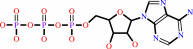 ATP
ATP
|
=
|
O-phospho-L-seryl-[protein]
|
+
|
 ADP
ADP
|
+
|
H(+)
|
|
|
|
|
|
|
L-threonyl-[protein]
|
+
|
ATP
|
=
|
O-phospho-L-threonyl-[protein]
|
+
|
ADP
|
+
|
H(+)
|
|
|
|
|
|
|
|
|
|
|
|
|
Molecule diagrams generated from .mol files obtained from the
KEGG ftp site
|
|
|
|
|
|
|
|
|
|
|
|
|
|
 |
|
|
|
|
|
|
| |
|
|
| |
|
DOI no:
|
J Mol Biol
386:476-485
(2009)
|
|
PubMed id:
|
|
|
|
|
|
| |
|
Insights into the conformational variability and regulation of human Nek2 kinase.
|
|
I.Westwood,
D.M.Cheary,
J.E.Baxter,
M.W.Richards,
R.L.van Montfort,
A.M.Fry,
R.Bayliss.
|
|
|
|
|
| |
ABSTRACT
|
|
|
|
| |
|
|
The Nek family of serine/threonine kinases regulates centrosome and cilia
function; in addition, several of its members are potential targets for drug
discovery. Nek2 is dimeric, is cell cycle regulated and functions in the
separation of centrosomes at G2/M. Here, we report the crystal structures of
wild-type human Nek2 kinase domain bound to ADP at 1.55-A resolution and T175A
mutant in apo form as well as that bound to a non-hydrolyzable ATP analog. These
show that regions of the Nek2 structure around the nucleotide-binding site can
adopt several different but well-defined conformations. None of the
conformations was the same as that observed for the previously reported
inhibitor-bound structure, and the two nucleotides stabilized two conformations.
The structures suggest mechanisms for the auto-inhibition of Nek2 that we have
tested by mutagenesis. Comparison of the structures with Aurora-A and Cdk2 gives
insight into the structural mechanism of Nek2 activation. The production of
specific inhibitors that target individual kinases of the human genome is an
urgent challenge in drug discovery, and Nek2 is especially promising as a cancer
target. We not only identify potential challenges to the task of producing Nek2
inhibitors but also propose that the conformational variability provides an
opportunity for the design of Nek2 selective inhibitors because one of the
conformations may provide a unique target.
|
|
|
|
|
|
| |
Selected figure(s)
|
|
|
|
| |
|
|

|
|

|
|
Figure 1.
Fig. 1. Electron density maps at the DFG and HRD motifs of
Nek2. (a–c) 2mF[o] − DF[c] (gray) and mF[o] − DF[c]
(green, red) SigmaA-weighted electron density maps contoured at
1.0σ, 2.5σ and − 2.5σ around (a) Nek2-T175A^ATPγS, (b)
Nek2^ADP and (c) Nek2-T175A^Apo, respectively. Carbon atoms are
shown in yellow, orange and pale pink in (a), (b) and (c),
respectively. Oxygen atoms are shown in red, whereas nitrogen
atoms are shown in blue. The same color scheme for stick
representation is used in subsequent figures.
|
|
Figure 2.
Fig. 2. The DFG motif and activation loop adopt different
conformations dependent on the bound ligand. (a) Superposition
of Nek2-T175A^ATPγS (yellow), Nek2^ADP (orange) and
Nek2-T175A^SU (green) protein structures shown as a ribbon in
two orientations related by a 90° rotation about the y-axis.
(b) Stereoview of Nek2-T175A^ATPγS (yellow carbon atoms) and
Nek2^ADP (orange carbon atoms) superposition at the DFG motif.
(c) Stereoview of Nek2-T175A^ATPγS (yellow carbon atoms) and
Nek2-T175A^SU (green carbon atoms) superposition at the DFG
motif. (d) Stereoview of Nek2-T175A^ATPγS (yellow carbon atoms)
and Nek2-T175A^Apo (light pink carbon atoms) superposition at
the DFG motif. (e) Schematic of the secondary structures adopted
by the four Nek2 structures and the amino acid sequence
surrounding the DFG motif in Nek2 and Aurora-A. (f)
Superposition of three Nek2 conformations of the DFG motif
together with the likely position adopted in the fully active
conformation based on the Aurora-A/TPX2 structure (magenta). The
orientation is that of panels (b) to (d) viewed from the bottom
left to the top right.
|
|
|
|
|
|
| |
The above figures are
reprinted
from an Open Access publication published by Elsevier:
J Mol Biol
(2009,
386,
476-485)
copyright 2009.
|
|
| |
Figures were
selected
by the author.
|
|
|
|
| |
|
|
|
|
|
|
|
|
|
|
|
|
|
|
|
|
|
|
| |
|
|
|
|
| |
Nek2 is a cell-cycle regulated, serine/threonine protein kinase that regulates the separation of centrosomes in G2/M. We have crystallised the catalytic domain on Nek2 in an apo-form suitable for soaking of ligands, and determined the structure of apo-, ADP-bound and ATP-analogue bound forms. The DFG-motif of Nek2 is able to adopt multiple, ordered conformations dependent on the ligand bound. This presents a challenge to the development of Nek2-selective inhibitors.
|
|
|
|
|
|
|
|
|
|
|
|
|
 |
|
 |
 |
 |
|
|
|
|
|
|
|
|
|
|
|
|
|
|
|
|
|
Literature references that cite this PDB file's key reference
|
|
|
| |
PubMed id
|
|
Reference
|
|
|
|
|
|
G.V.Meirelles,
J.C.Silva,
Y.d.e. .A.Mendonça,
C.H.Ramos,
I.L.Torriani,
and
J.Kobarg
(2011).
Human Nek6 is a monomeric mostly globular kinase with an unfolded short N-terminal domain.
|
| |
BMC Struct Biol,
11,
12.
|
|
|
|
|
|
|
C.A.Dodson,
M.Kosmopoulou,
M.W.Richards,
B.Atrash,
V.Bavetsias,
J.Blagg,
and
R.Bayliss
(2010).
Crystal structure of an Aurora-A mutant that mimics Aurora-B bound to MLN8054: insights into selectivity and drug design.
|
| |
Biochem J,
427,
19-28.
|
|
|
PDB codes:
|
|
|
|
|
|
|
|
C.C.Lee,
Y.Jia,
N.Li,
X.Sun,
K.Ng,
E.Ambing,
M.Y.Gao,
S.Hua,
C.Chen,
S.Kim,
P.Y.Michellys,
S.A.Lesley,
J.L.Harris,
and
G.Spraggon
(2010).
Crystal structure of the ALK (anaplastic lymphoma kinase) catalytic domain.
|
| |
Biochem J,
430,
425-437.
|
|
|
PDB codes:
|
|
|
|
|
|
|
|
D.K.Whelligan,
S.Solanki,
D.Taylor,
D.W.Thomson,
K.M.Cheung,
K.Boxall,
C.Mas-Droux,
C.Barillari,
S.Burns,
C.G.Grummitt,
I.Collins,
R.L.van Montfort,
G.W.Aherne,
R.Bayliss,
and
S.Hoelder
(2010).
Aminopyrazine inhibitors binding to an unusual inactive conformation of the mitotic kinase Nek2: SAR and structural characterization.
|
| |
J Med Chem,
53,
7682-7698.
|
|
|
PDB codes:
|
|
|
|
|
|
|
|
M.W.Richards,
L.O'Regan,
C.Mas-Droux,
J.M.Blot,
J.Cheung,
S.Hoelder,
A.M.Fry,
and
R.Bayliss
(2009).
An autoinhibitory tyrosine motif in the cell-cycle-regulated Nek7 kinase is released through binding of Nek9.
|
| |
Mol Cell,
36,
560-570.
|
|
|
PDB codes:
|
|
|
|
|
|
|
The most recent references are shown first.
Citation data come partly from CiteXplore and partly
from an automated harvesting procedure. Note that this is likely to be
only a partial list as not all journals are covered by
either method. However, we are continually building up the citation data
so more and more references will be included with time.
Where a reference describes a PDB structure, the PDB
codes are
shown on the right.
|
|


 Links
Links


