 |
PDBsum entry 2vwj

|
|
|
|
|
|

|

|

|

|
|

|
|

|
|

|
|

|
|

|
|

|
|
|
 |

|

|
|
|
|
|
|
|
|
|
|
|
|
|
|
|
|
|
|
|
|
|
|
|
|
|
|
|
|
|
|
|
|
|
|
|
DNA replication
|
PDB id
|
|
|
|
2vwj
|
|
|
|
|
|
|
|
|
|
|
|
|
|
|

|

|

|
|
|
|
|
|
|
|
 |
Contents |
 |
|
|
|
|
|
|
|
|
|
|
|
|
|
|
* Residue conservation analysis
|
|
|
|
|
|
|
|
|
|
|
Enzyme class:
|
|
E.C.2.7.7.7
- DNA-directed Dna polymerase.
|
|
|
|
|
|
|
Reaction:
|
|
DNA(n) + a 2'-deoxyribonucleoside 5'-triphosphate = DNA(n+1) + diphosphate
|
|
|
|
|
|
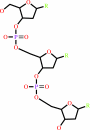 DNA(n)
|
+
|
2'-deoxyribonucleoside 5'-triphosphate
|
=
|
DNA(n+1)
|
+
|
 diphosphate
|
|
|
|
|
|
|
|
|
|
|
|
|
Molecule diagrams generated from .mol files obtained from the
KEGG ftp site
|
|
|
|
|
|
|
|
|
|
|
|
|
|
 |
|
|
|
|
|
|
| |
|
|
| |
|
DOI no:
|
J Mol Biol
381:529-539
(2008)
|
|
PubMed id:
|
|
|
|
|
|
| |
|
Uracil recognition in archaeal DNA polymerases captured by X-ray crystallography.
|
|
S.J.Firbank,
J.Wardle,
P.Heslop,
R.J.Lewis,
B.A.Connolly.
|
|
|
|
|
| |
ABSTRACT
|
|
|
|
| |
|
|
Archaeal family B DNA polymerases bind tightly to template-strand uracil and
stall replication on encountering the pro-mutagenic base. This article describes
an X-ray crystal structure, at 2.8 A resolution, of Thermococcus gorgonarius
polymerase in complex with a DNA primer-template containing uracil in the
single-stranded region. The DNA backbone is distorted to position the uracil
deeply within a pocket, located in the amino-terminal domain of the polymerase.
Specificity arises from a combination of hydrogen bonds between the protein
backbone and uracil, with the pocket shaped to prevent the stable binding of the
four standard DNA bases. Strong interactions are seen with the two phosphates
that flank the uracil and the structure gives clues concerning the coupling of
uracil binding to the halting of replication. The importance of key amino acids,
identified by the analysis of the structure and their conservation between
archaeal polymerases, was confirmed by site-directed mutagenesis. The crystal
structure of V93Q, a polymerase variant that no longer recognises uracil, is
also reported, explaining the V93Q phenotype by the steric exclusion of uracil
from the pocket.
|
|
|
|
|
|
| |
Selected figure(s)
|
|
|
|
| |
|
|

|
|

|
|
Figure 1.
Fig. 1. Structure of Tgo-Pol:DNA complex. (a) The sequence of
the primer–template mimic used in this study. Sixteen bases
are palindromic and form an 8-bp duplex with four consecutive
thymines forming the hairpin. The uracil is + 4 from the
duplex–single-stranded junction. (b) Overall fold of Tgo-Pol
in complex with uracil-containing DNA. The N-terminal domain
(1–130 and 327–368) is coloured yellow, the exonuclease
domain (131–326) lilac, the palm (369–449 and 500–585)
magenta, the fingers (450–499) cyan, and the thumb (586–773)
green. The DNA is red. (c) Overlay of Tgo-Pol:DNA with apo
Tgo-Pol. For Tgo-Pol:DNA the protein is yellow with red DNA, apo
Tgo-Pol (PDB 1TGO) is teal. Although the majority of the
proteins superimpose well (left), the thumb exhibits a rotation
upon DNA binding (right). The two images are approximately
90° apart by rotation around the vertical axis. (d) The
movement of the thumb domain, relative to the rest of the
polymerase, as a consequence of duplex DNA binding. The view is
approximately 90° away from that shown in (b) in a clockwise
direction around a horizontal axis. Apo Tgo-Pol (PDB 1TGO) is
the left image, the structure with DNA the right. The
interaction with DNA causes repositioning of the thumb, greatly
reducing the contact area between the thumb and exonuclease
domains. The domains are coloured as in (b).
|
|
Figure 2.
Fig. 2. DNA and the contacts it makes to Tgo-Pol. (a) Final
2F[obs] − F[calc] electron density map (gold) contoured at 1σ
for the primer–template region of the DNA (red) illustrating
the quality of the maps for the majority of the DNA component of
the structure. (b) Contacts observed between Tgo-Pol and DNA.
The same colour scheme as in Fig. 1 is used to identify
individual domains. Most of the contacts (dotted lines) are
polar in nature, the exception being the hydrophobic stacking
between V93 and the uracil base (continuous line). The specific
interactions with uracil are shown in more detail in Fig. 4.
|
|
|
|
|
|
| |
The above figures are
reprinted
by permission from Elsevier:
J Mol Biol
(2008,
381,
529-539)
copyright 2008.
|
|
| |
Figures were
selected
by an automated process.
|
|
|
|
|
|
|
|
|
|
|
|
|
|
|
|
 |
 |
 |
|
Literature references that cite this PDB file's key reference
|
|
|
| |
PubMed id
|
|
Reference
|
|
|
|
|
|
K.Mayanagi,
S.Kiyonari,
H.Nishida,
M.Saito,
D.Kohda,
Y.Ishino,
T.Shirai,
and
K.Morikawa
(2011).
Architecture of the DNA polymerase B-proliferating cell nuclear antigen (PCNA)-DNA ternary complex.
|
| |
Proc Natl Acad Sci U S A,
108,
1845-1849.
|
|
|
|
|
|
|
S.K.Jozwiakowski,
and
B.A.Connolly
(2011).
A modified family-B archaeal DNA polymerase with reverse transcriptase activity.
|
| |
Chembiochem,
12,
35-37.
|
|
|
|
|
|
|
A.Tubeleviciute,
and
R.Skirgaila
(2010).
Compartmentalized self-replication (CSR) selection of Thermococcus litoralis Sh1B DNA polymerase for diminished uracil binding.
|
| |
Protein Eng Des Sel,
23,
589-597.
|
|
|
|
|
|
|
E.Johansson,
and
S.A.Macneill
(2010).
The eukaryotic replicative DNA polymerases take shape.
|
| |
Trends Biochem Sci,
35,
339-347.
|
|
|
|
|
|
|
H.J.Russell,
T.T.Richardson,
K.Emptage,
and
B.A.Connolly
(2009).
The 3'-5' proofreading exonuclease of archaeal family-B DNA polymerase hinders the copying of template strand deaminated bases.
|
| |
Nucleic Acids Res,
37,
7603-7611.
|
|
|
|
|
|
|
K.Emami,
E.Topakas,
T.Nagy,
J.Henshaw,
K.A.Jackson,
K.E.Nelson,
E.F.Mongodin,
J.W.Murray,
R.J.Lewis,
and
H.J.Gilbert
(2009).
Regulation of the Xylan-degrading Apparatus of Cellvibrio japonicus by a Novel Two-component System.
|
| |
J Biol Chem,
284,
1086-1096.
|
|
|
PDB code:
|
|
|
|
|
|
|
|
S.K.Jozwiakowski,
and
B.A.Connolly
(2009).
Plasmid-based lacZalpha assay for DNA polymerase fidelity: application to archaeal family-B DNA polymerase.
|
| |
Nucleic Acids Res,
37,
e102.
|
|
|
|
|
|
|
S.Klinge,
R.Núñez-Ramírez,
O.Llorca,
and
L.Pellegrini
(2009).
3D architecture of DNA Pol alpha reveals the functional core of multi-subunit replicative polymerases.
|
| |
EMBO J,
28,
1978-1987.
|
|
|
PDB code:
|
|
|
|
|
|
|
|
T.H.Tahirov,
K.S.Makarova,
I.B.Rogozin,
Y.I.Pavlov,
and
E.V.Koonin
(2009).
Evolution of DNA polymerases: an inactivated polymerase-exonuclease module in Pol epsilon and a chimeric origin of eukaryotic polymerases from two classes of archaeal ancestors.
|
| |
Biol Direct,
4,
11.
|
|
|
|
|
|
The most recent references are shown first.
Citation data come partly from CiteXplore and partly
from an automated harvesting procedure. Note that this is likely to be
only a partial list as not all journals are covered by
either method. However, we are continually building up the citation data
so more and more references will be included with time.
Where a reference describes a PDB structure, the PDB
code is
shown on the right.
|
|


 Links
Links


