 |
PDBsum entry 2vrw

|
|
|
|
|
|

|

|

|

|
|

|
|

|
|

|
|

|
|

|
|

|
|
|
 |

|

|
|
|
|
|
|
|
|
|
|
|
|
|
|
|
|
|
|
|
|
|
|
|
|
|
|
|
|
|
|
|
|
|
|
|
Signaling protein
|
PDB id
|
|
|
|
2vrw
|
|
|
|
|
|
|
|
|
|
|
|
|
|
|

|

|

|
|
|
|
|
|
|
|
 |
Contents |
 |
|
|
|
|
|
|
|
|
|
|
|
|
* Residue conservation analysis
|
|
|
|
|
|
|
|
|
|
Enzyme class 1:
|
|
Chain A:
E.C.3.6.5.2
- small monomeric GTPase.
|
|
|
|
|
|
|
Reaction:
|
|
GTP + H2O = GDP + phosphate + H+
|
|
|
|
|
|
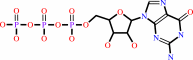 GTP
GTP
|
+
|
H2O
|
=
|
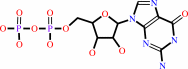 GDP
GDP
|
+
|
 phosphate
|
+
|
H(+)
|
|
|
|
|
|
|
|
|
|
Enzyme class 2:
|
|
Chain B:
E.C.?
|
|
|
|
|
|
|
|
|
|
Note, where more than one E.C. class is given (as above), each may
correspond to a different protein domain or, in the case of polyprotein
precursors, to a different mature protein.
|
|
|
|
Molecule diagrams generated from .mol files obtained from the
KEGG ftp site
|
|
|
|
|
|
|
|
|
|
|
|
|
|
 |
|
|
|
|
|
|
| |
|
|
| |
|
DOI no:
|
Embo Rep
9:655-661
(2008)
|
|
PubMed id:
|
|
|
|
|
|
| |
|
Crucial structural role for the PH and C1 domains of the Vav1 exchange factor.
|
|
J.Rapley,
V.L.Tybulewicz,
K.Rittinger.
|
|
|
|
|
| |
ABSTRACT
|
|
|
|
| |
|
|
The Vav family of proteins are guanine nucleotide exchange factors (GEFs) for
the Rho family of GTPases, which regulate various cellular functions, including
T-cell activation. They contain a catalytic Dbl homology (DH) domain that is
invariably followed by a pleckstrin homology (PH) domain, which is often
required for catalytic activity. Vav proteins are the first GEFs for which an
additional C1 domain is required for full biological activity. Here, we present
the structure of a Vav1 fragment comprising the DH-PH-C1 domains bound to Rac1.
This structure shows that the PH and C1 domains form a single structural unit
that packs against the carboxy-terminal helix of the DH domain to stabilize its
conformation and to promote nucleotide exchange. In contrast to previous
reports, this structure shows that there are no direct contacts between the
GTPase and C1 domain but instead suggests new mechanisms for the regulation of
Vav1 activity.
|
|
|
|
|
|
|
|
|
|
|
|
|
|
|
|
|
|
 |
 |
 |
|
Literature references that cite this PDB file's key reference
|
|
|
| |
PubMed id
|
|
Reference
|
|
|
|
|
|
B.Yu,
I.R.Martins,
P.Li,
G.K.Amarasinghe,
J.Umetani,
M.E.Fernandez-Zapico,
D.D.Billadeau,
M.Machius,
D.R.Tomchick,
and
M.K.Rosen
(2010).
Structural and energetic mechanisms of cooperative autoinhibition and activation of Vav1.
|
| |
Cell,
140,
246-256.
|
|
|
PDB code:
|
|
|
|
|
|
|
|
S.Rosales-Corral,
R.J.Reiter,
D.X.Tan,
G.G.Ortiz,
and
G.Lopez-Armas
(2010).
Functional aspects of redox control during neuroinflammation.
|
| |
Antioxid Redox Signal,
13,
193-247.
|
|
|
|
|
|
|
S.Katzav
(2009).
Vav1: a hematopoietic signal transduction molecule involved in human malignancies.
|
| |
Int J Biochem Cell Biol,
41,
1245-1248.
|
|
|
|
|
|
|
T.Cierpicki,
J.Bielnicki,
M.Zheng,
J.Gruszczyk,
M.Kasterka,
M.Petoukhov,
A.Zhang,
E.J.Fernandez,
D.I.Svergun,
U.Derewenda,
J.H.Bushweller,
and
Z.S.Derewenda
(2009).
The solution structure and dynamics of the DH-PH module of PDZRhoGEF in isolation and in complex with nucleotide-free RhoA.
|
| |
Protein Sci,
18,
2067-2079.
|
|
|
|
|
|
|
T.T.Zhang,
H.Li,
S.M.Cheung,
J.L.Costantini,
S.Hou,
M.Al-Alwan,
and
A.J.Marshall
(2009).
Phosphoinositide 3-kinase-regulated adapters in lymphocyte activation.
|
| |
Immunol Rev,
232,
255-272.
|
|
|
|
|
|
|
C.Ambrogio,
C.Voena,
A.D.Manazza,
C.Martinengo,
C.Costa,
T.Kirchhausen,
E.Hirsch,
G.Inghirami,
and
R.Chiarle
(2008).
The anaplastic lymphoma kinase controls cell shape and growth of anaplastic large cell lymphoma through Cdc42 activation.
|
| |
Cancer Res,
68,
8899-8907.
|
|
|
|
|
|
The most recent references are shown first.
Citation data come partly from CiteXplore and partly
from an automated harvesting procedure. Note that this is likely to be
only a partial list as not all journals are covered by
either method. However, we are continually building up the citation data
so more and more references will be included with time.
Where a reference describes a PDB structure, the PDB
code is
shown on the right.
|
|
|


 Links
Links


