
|
|
|
|
|
 |
Contents |
 |
|
|
|
|
|
|
|
|
|
|
* Residue conservation analysis
|
|
|
|
|
|
PDB id:
|
|
|
|
| Name: |
|
Transferase
|
|
|
Title:
|
|
Crystal structure of wild-type plk-1 kinase domain in complex with a selective darpin
|
|
Structure:
|
|
Serine/threonine-protein kinase plk1. Chain: a, b. Fragment: kinase domain, residues 33-345. Synonym: plk-1, serine/threonine-protein kinase 13, stpk13, polo-like kinase 1, human polo-like kinase 1. Engineered: yes. Other_details: construct 4. Design ankyrin repeat protein. Chain: c, d.
|
|
Source:
|
|
Homo sapiens. Human. Organism_taxid: 9606. Expressed in: spodoptera frugiperda. Expression_system_taxid: 7108. Synthetic construct. Organism_taxid: 32630. Expressed in: escherichia coli. Expression_system_taxid: 562.
|
|
Resolution:
|
|
|
2.30Å
|
R-factor:
|
0.184
|
R-free:
|
0.224
|
|
|
Authors:
|
|
T.M.Bandeiras,R.C.Hillig,P.M.Matias,U.Eberspaecher,J.Fanghaenel, M.Thomaz,S.Miranda,K.Crusius,V.Puetter,P.Amstutz,M.Gulotti- Georgieva,H.K.Binz,C.Holz,A.A.P.Schmitz,C.Lang,P.Donner,U.Egner, M.A.Carrondo,B.Mueller-Tiemann
|
Key ref:

|
|
T.M.Bandeiras
et al.
(2008).
Structure of wild-type Plk-1 kinase domain in complex with a selective DARPin.
Acta Crystallogr D Biol Crystallogr,
64,
339-353.
PubMed id:
DOI:

|
|
|
Date:
|
|
|
08-Jul-07
|
Release date:
|
01-Apr-08
|
|
|
|
|
|
|
PROCHECK
|

|
|
|
|
|
Headers
|
|
|
|
References
|
|
|
|
|
|
|
|
|
|
|
|
Enzyme class:
|
|
Chains A, B:
E.C.2.7.11.21
- polo kinase.
|
|
|
|
|
|
|
Reaction:
|
|
|
1.
|
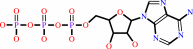
L-seryl-[protein] + ATP = O-phospho-L-seryl-[protein] + ADP + H+
|
|
2.
|
L-threonyl-[protein] + ATP = O-phospho-L-threonyl-[protein] + ADP + H+
|
|
|
|
|
|
|
L-seryl-[protein]
|
+
|
 ATP
ATP
|
=
|
O-phospho-L-seryl-[protein]
|
+
|
 ADP
ADP
|
+
|
H(+)
|
|
|
|
|
|
|
L-threonyl-[protein]
|
+
|
ATP
|
=
|
O-phospho-L-threonyl-[protein]
|
+
|
ADP
|
+
|
H(+)
|
|
|
|
|
|
|
|
|
|
|
|
|
Molecule diagrams generated from .mol files obtained from the
KEGG ftp site
|
|
|
|
|
|
|
|
|
|
|
|
|
|
 |
|
|
|
|
|
|
| |
|
|
| |
|
DOI no:
|
Acta Crystallogr D Biol Crystallogr
64:339-353
(2008)
|
|
PubMed id:
|
|
|
|
|
|
| |
|
Structure of wild-type Plk-1 kinase domain in complex with a selective DARPin.
|
|
T.M.Bandeiras,
R.C.Hillig,
P.M.Matias,
U.Eberspaecher,
J.Fanghänel,
M.Thomaz,
S.Miranda,
K.Crusius,
V.Pütter,
P.Amstutz,
M.Gulotti-Georgieva,
H.K.Binz,
C.Holz,
A.A.Schmitz,
C.Lang,
P.Donner,
U.Egner,
M.A.Carrondo,
B.Müller-Tiemann.
|
|
|
|
|
| |
ABSTRACT
|
|
|
|
| |
|
|
As a key regulator of mitosis, the Ser/Thr protein polo-like kinase-1 (Plk-1) is
a well validated drug target in cancer therapy. In order to enable
structure-guided drug design, determination of the crystal structure of the
kinase domain of Plk-1 was attempted. Using a multi-parallel cloning and
expression approach, a set of length variants were identified which could be
expressed in large amounts from insect cells and which could be purified to high
purity. However, all attempts to crystallize these constructs failed. Crystals
were ultimately obtained by generating designed ankyrin-repeat proteins
(DARPins) selective for Plk-1 and using them for cocrystallization. Here, the
first crystal structure of the kinase domain of wild-type apo Plk-1, in complex
with DARPin 3H10, is presented, underlining the power of selective DARPins as
crystallization tools. The structure was refined to 2.3 A resolution and shows
the active conformation of Plk-1. It broadens the basis for modelling and
cocrystallization studies for drug design. The binding epitope of 3H10 is rich
in arginine, glutamine and lysine residues, suggesting that the DARPin enabled
crystallization by masking a surface patch which is unfavourable for crystal
contact formation. Based on the packing observed in the crystal, a truncated
DARPin variant was designed which showed improved binding characteristics.
|
|
|
|
|
|
| |
Selected figure(s)
|
|
|
|
| |
|
|

|
|

|
|
Figure 1.
Figure 1 Plk-1 construct design and examples of multi-parallel
expression tests. The domain structure of human Plk-1 is shown,
with P indicating the phosphorylation site Thr210. Below, an
initial construct and a set of 20 length variants (#1-#20) is
shown. Residue numbers for the N- and C-terminal amino acids are
indicated.
|
|
Figure 7.
Figure 7 Comparison of Plk-1-3H10 with further
kinase-ankyrin-repeat (AR) protein complexes. (a)-(c) Tube
diagrams showing the overall folds of kinases in complex with AR
proteins: (a) Plk-1-DARPin 3H10; (b) Cdk6-P19INK4D inhibitor
complex (Russo et al., 1998[Russo, A. A., Tong, L., Lee, J. O.,
Jeffrey, P. D. & Pavletich, N. P. (1998). Nature (London), 395,
237-243.]; chains A and B from PDB entry 1bi8 ); (c) APH-AR
inhibitor complex (Kohl et al., 2005[Kohl, A., Amstutz, P.,
Parizek, P., Binz, H. K., Briand, C., Capitani, G., Forrer, P.,
Plückthun, A. & Grütter, M. G. (2005). Structure, 13,
1131-1141.]; chains A and B from PDB entry 2bkk ). In all panels
the kinase is coloured gold and the AR protein is coloured cyan.
The ADP in APH is shown in ball-and-stick representation (C, N,
O and P atoms are coloured grey, blue, red and green,
respectively) and is a reference for the ATP site. This figure
was prepared with DINO (Philippsen, 2002[Philippsen, A. (2002).
DINO. http://www.dino3d.org .]).
|
|
|
|
|
|
| |
The above figures are
reprinted
by permission from the IUCr:
Acta Crystallogr D Biol Crystallogr
(2008,
64,
339-353)
copyright 2008.
|
|
| |
Figures were
selected
by an automated process.
|
|
|
|
|
|
|
|
|
|
|
|
|
|
|
|
 |
 |
 |
|
Literature references that cite this PDB file's key reference
|
|
|
| |
PubMed id
|
|
Reference
|
|
|
|
|
|
N.Monroe,
G.Sennhauser,
M.A.Seeger,
C.Briand,
and
M.G.Grütter
(2011).
Designed ankyrin repeat protein binders for the crystallization of AcrB: plasticity of the dominant interface.
|
| |
J Struct Biol,
174,
269-281.
|
|
|
PDB codes:
|
|
|
|
|
|
|
|
K.Strebhardt
(2010).
Multifaceted polo-like kinases: drug targets and antitargets for cancer therapy.
|
| |
Nat Rev Drug Discov,
9,
643-660.
|
|
|
|
|
|
|
Z.S.Derewenda
(2010).
Application of protein engineering to enhance crystallizability and improve crystal properties.
|
| |
Acta Crystallogr D Biol Crystallogr,
66,
604-615.
|
|
|
|
|
|
|
D.Veesler,
B.Dreier,
S.Blangy,
J.Lichière,
D.Tremblay,
S.Moineau,
S.Spinelli,
M.Tegoni,
A.Plückthun,
V.Campanacci,
and
C.Cambillau
(2009).
Crystal structure and function of a DARPin neutralizing inhibitor of lactococcal phage TP901-1: comparison of DARPin and camelid VHH binding mode.
|
| |
J Biol Chem,
284,
30718-30726.
|
|
|
PDB code:
|
|
|
|
|
|
|
|
M.Gebauer,
and
A.Skerra
(2009).
Engineered protein scaffolds as next-generation antibody therapeutics.
|
| |
Curr Opin Chem Biol,
13,
245-255.
|
|
|
|
|
|
|
S.Koide
(2009).
Engineering of recombinant crystallization chaperones.
|
| |
Curr Opin Struct Biol,
19,
449-457.
|
|
|
|
|
|
|
S.Tong,
H.Zhou,
Y.Gao,
Z.Zhu,
X.Zhang,
M.Teng,
and
L.Niu
(2009).
Crystal structure of human osteoclast stimulating factor.
|
| |
Proteins,
75,
245-251.
|
|
|
PDB codes:
|
|
|
|
|
|
|
The most recent references are shown first.
Citation data come partly from CiteXplore and partly
from an automated harvesting procedure. Note that this is likely to be
only a partial list as not all journals are covered by
either method. However, we are continually building up the citation data
so more and more references will be included with time.
Where a reference describes a PDB structure, the PDB
codes are
shown on the right.
|
 |


 Links
Links


