
|
|
|
|
|
 |
Contents |
 |
|
|
|
|
|
|
|
|
|
|
|
|
* Residue conservation analysis
|
|
|
|
|
|
|
|
|
|
Enzyme class 1:
|
|
Chains A, B:
E.C.?
|
|
|
|
|
|
|
Enzyme class 2:
|
|
Chains C, D:
E.C.3.6.5.4
- signal-recognition-particle GTPase.
|
|
|
|
|
|
|
Reaction:
|
|
GTP + H2O = GDP + phosphate + H+
|
|
|
|
|
|
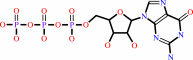 GTP
GTP
|
+
|
H2O
|
=
|
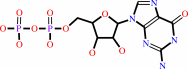 GDP
GDP
|
+
|
 phosphate
|
+
|
H(+)
|
|
|
|
|
|
|
|
|
|
|
|
|
Note, where more than one E.C. class is given (as above), each may
correspond to a different protein domain or, in the case of polyprotein
precursors, to a different mature protein.
|
|
|
|
Molecule diagrams generated from .mol files obtained from the
KEGG ftp site
|
|
|
|
|
|
|
|
|
|
|
|
|
|
 |
|
|
|
|
|
|
| |
|
|
| |
|
DOI no:
|
Proc Natl Acad Sci U S A
104:14911-14916
(2007)
|
|
PubMed id:
|
|
|
|
|
|
| |
|
Interaction of signal-recognition particle 54 GTPase domain and signal-recognition particle RNA in the free signal-recognition particle.
|
|
T.Hainzl,
S.Huang,
A.E.Sauer-Eriksson.
|
|
|
|
|
| |
ABSTRACT
|
|
|
|
| |
|
|
The signal-recognition particle (SRP) is a ubiquitous protein-RNA complex that
targets proteins to cellular membranes for insertion or secretion. A key player
in SRP-mediated protein targeting is the evolutionarily conserved core
consisting of the SRP RNA and the multidomain protein SRP54. Communication
between the SRP54 domains is critical for SRP function, where signal sequence
binding at the M domain directs receptor binding at the GTPase domain (NG
domain). These SRP activities are linked to domain rearrangements, for which the
role of SRP RNA is not clear. In free SRP, a direct interaction of the GTPase
domain with SRP RNA has been proposed but has never been structurally verified.
In this study, we present the crystal structure at 2.5-A resolution of the
SRP54-SRP19-SRP RNA complex of Methanococcus jannaschii SRP. The structure
reveals an RNA-bound conformation of the SRP54 GTPase domain, in which the
domain is spatially well separated from the signal peptide binding site. The
association of both the N and G domains with SRP RNA in free SRP provides
further structural evidence for the pivotal role of SRP RNA in the regulation of
the SRP54 activity.
|
|
|
|
|
|
| |
Selected figure(s)
|
|
|
|
| |
|
|

|
|

|
|
Figure 3.
Fig. 3. SRP54 NG domain–RNA interactions. (A) The
molecular surface of the SRP54 NG domain (Left) and 7S.S RNA
(Right) are shaded to indicate the different accessibilities of
the surface areas at each residue (Left) and nucleotide (Right)
between the free and complexed forms. The red areas define
protein–RNA contacts. The molecule to the right is rotated by
180° with respect to the molecule to the left. (B)
Interaction between the G domain loop connecting  G1 and G1 and
 G2
and the RNA minor groove of helix 5. The side chains of Arg-122
and Lys-126 bind to the phosphate oxygen of A186 and the 2'-OH
atom of C187 in the RNA strand that switches from helix 6 to 8.
The main-chain oxygen of Lys-126 is hydrogen-bonded to the 2'-OH
of C188, and forms a water-mediated contact with the guanine
base of G231, the base partner of C187 in the G–C pair
immediately above the three-way junction. Furthermore, the side
chain of Lys-130 interacts with the phosphate group of C233. RNA
is colored in red, protein residues are colored in blue, and
hydrogen bonds are colored in green. G2
and the RNA minor groove of helix 5. The side chains of Arg-122
and Lys-126 bind to the phosphate oxygen of A186 and the 2'-OH
atom of C187 in the RNA strand that switches from helix 6 to 8.
The main-chain oxygen of Lys-126 is hydrogen-bonded to the 2'-OH
of C188, and forms a water-mediated contact with the guanine
base of G231, the base partner of C187 in the G–C pair
immediately above the three-way junction. Furthermore, the side
chain of Lys-130 interacts with the phosphate group of C233. RNA
is colored in red, protein residues are colored in blue, and
hydrogen bonds are colored in green.
|
|
Figure 4.
Fig. 4. Ribbon representation of the GM-linker structure.
In S domain A, Ser-301 forms a hydrogen bond with the 2'-OH
group of C221 in helix 8, and Leu-302, Ala-306, and Met-309 make
hydrophobic interactions with Gly-67 and Leu-68 situated in the
apical loop between N3 and N4 in
the N domain. The NG domain is shown in blue, the RNA is shown
in red, the M domain is shown in green, and the GM-linker is
shown in orange. The GM-linker in S domain B is shown in gray.
The side chain of Asp-311 in B is also shown. The overlay is
based on the SRP54 M domains.
|
|
|
|
| |
Figures were
selected
by an automated process.
|
|
|
|
|
|
|
|
|
|
|
|
|
|
|
|
 |
 |
 |
|
Literature references that cite this PDB file's key reference
|
|
|
| |
PubMed id
|
|
Reference
|
|
|
|
|
|
I.Saraogi,
and
S.O.Shan
(2011).
Molecular mechanism of co-translational protein targeting by the signal recognition particle.
|
| |
Traffic,
12,
535-542.
|
|
|
|
|
|
|
T.Hainzl,
S.Huang,
G.Meriläinen,
K.Brännström,
and
A.E.Sauer-Eriksson
(2011).
Structural basis of signal-sequence recognition by the signal recognition particle.
|
| |
Nat Struct Mol Biol,
18,
389-391.
|
|
|
PDB code:
|
|
|
|
|
|
|
|
C.Zwieb,
and
S.Bhuiyan
(2010).
Archaea signal recognition particle shows the way.
|
| |
Archaea,
2010,
485051.
|
|
|
|
|
|
|
K.Wild,
G.Bange,
G.Bozkurt,
B.Segnitz,
A.Hendricks,
and
I.Sinning
(2010).
Structural insights into the assembly of the human and archaeal signal recognition particles.
|
| |
Acta Crystallogr D Biol Crystallogr,
66,
295-303.
|
|
|
PDB codes:
|
|
|
|
|
|
|
|
M.Yang,
X.Zhang,
and
K.Han
(2010).
Molecular dynamics simulation of SRP GTPases: towards an understanding of the complex formation from equilibrium fluctuations.
|
| |
Proteins,
78,
2222-2237.
|
|
|
|
|
|
|
N.B.Ulyanov,
and
T.L.James
(2010).
RNA structural motifs that entail hydrogen bonds involving sugar-phosphate backbone atoms of RNA.
|
| |
New J Chem,
34,
910-917.
|
|
|
|
|
|
|
E.M.Clérico,
A.Szymańska,
and
L.M.Gierasch
(2009).
Exploring the interactions between signal sequences and E. coli SRP by two distinct and complementary crosslinking methods.
|
| |
Biopolymers,
92,
201-211.
|
|
|
|
|
|
|
I.A.Buskiewicz,
J.Jöckel,
M.V.Rodnina,
and
W.Wintermeyer
(2009).
Conformation of the signal recognition particle in ribosomal targeting complexes.
|
| |
RNA,
15,
44-54.
|
|
|
|
|
|
|
I.Sinning,
K.Wild,
and
G.Bange
(2009).
Signal sequences get active.
|
| |
Nat Chem Biol,
5,
146-147.
|
|
|
|
|
|
|
P.Grudnik,
G.Bange,
and
I.Sinning
(2009).
Protein targeting by the signal recognition particle.
|
| |
Biol Chem,
390,
775-782.
|
|
|
|
|
|
|
E.M.Clérico,
J.L.Maki,
and
L.M.Gierasch
(2008).
Use of synthetic signal sequences to explore the protein export machinery.
|
| |
Biopolymers,
90,
307-319.
|
|
|
|
|
|
|
P.F.Egea,
H.Tsuruta,
G.P.de Leon,
J.Napetschnig,
P.Walter,
and
R.M.Stroud
(2008).
Structures of the signal recognition particle receptor from the archaeon Pyrococcus furiosus: implications for the targeting step at the membrane.
|
| |
PLoS ONE,
3,
e3619.
|
|
|
PDB codes:
|
|
|
|
|
|
|
|
P.F.Egea,
J.Napetschnig,
P.Walter,
and
R.M.Stroud
(2008).
Structures of SRP54 and SRP19, the two proteins that organize the ribonucleic core of the signal recognition particle from Pyrococcus furiosus.
|
| |
PLoS ONE,
3,
e3528.
|
|
|
PDB codes:
|
|
|
|
|
|
|
|
X.Zhang,
S.Kung,
and
S.O.Shan
(2008).
Demonstration of a multistep mechanism for assembly of the SRP x SRP receptor complex: implications for the catalytic role of SRP RNA.
|
| |
J Mol Biol,
381,
581-593.
|
|
|
|
|
|
The most recent references are shown first.
Citation data come partly from CiteXplore and partly
from an automated harvesting procedure. Note that this is likely to be
only a partial list as not all journals are covered by
either method. However, we are continually building up the citation data
so more and more references will be included with time.
Where a reference describes a PDB structure, the PDB
code is
shown on the right.
|
 |


 Links
Links


