 |
PDBsum entry 2rik

|
|
|
|
|
|

|

|

|

|
|

|
|

|
|
|
 |

|

|
|
|
|
|
|
|
|
|
|
|
|
|
|
|
|
|
|
|
|
|
|
|
|
|
|
|
|
|
|
|
Structural protein
|
PDB id
|
|
|
|
2rik
|
|
|
|
|
|
|
|
|
|
|
|
|
|
|

|

|

|
|
|
|
|
|
|
|
 |
Contents |
 |
|
|
|
|
|
|
|
|
|
|
* Residue conservation analysis
|
|
|
|
|
|
|
|
|
|
|
Enzyme class:
|
|
E.C.2.7.11.1
- non-specific serine/threonine protein kinase.
|
|
|
|
|
|
|
Reaction:
|
|
|
1.
|
L-seryl-[protein] + ATP = O-phospho-L-seryl-[protein] + ADP + H+
|
|
2.
|
L-threonyl-[protein] + ATP = O-phospho-L-threonyl-[protein] + ADP + H+
|
|
|
|
|
|
|
L-seryl-[protein]
|
+
|
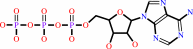 ATP
ATP
|
=
|
O-phospho-L-seryl-[protein]
|
+
|
 ADP
ADP
|
+
|
H(+)
|
|
|
|
|
|
|
L-threonyl-[protein]
|
+
|
ATP
|
=
|
O-phospho-L-threonyl-[protein]
|
+
|
ADP
|
+
|
H(+)
|
|
|
|
|
|
|
|
|
|
|
|
|
Molecule diagrams generated from .mol files obtained from the
KEGG ftp site
|
|
|
|
|
|
|
|
|
|
|
|
|
|
 |
|
|
|
|
|
|
| |
|
|
| |
|
DOI no:
|
Proc Natl Acad Sci U S A
105:1186-1191
(2008)
|
|
PubMed id:
|
|
|
|
|
|
| |
|
A regular pattern of Ig super-motifs defines segmental flexibility as the elastic mechanism of the titin chain.
|
|
E.von Castelmur,
M.Marino,
D.I.Svergun,
L.Kreplak,
Z.Ucurum-Fotiadis,
P.V.Konarev,
A.Urzhumtsev,
D.Labeit,
S.Labeit,
O.Mayans.
|
|
|
|
|
| |
ABSTRACT
|
|
|
|
| |
|
|
Myofibril elasticity, critical to muscle function, is dictated by the
intrasarcomeric filament titin, which acts as a molecular spring. To date, the
molecular events underlying the mechanics of the folded titin chain remain
largely unknown. We have elucidated the crystal structure of the 6-Ig fragment
I65-I70 from the elastic I-band fraction of titin and validated its conformation
in solution using small angle x-ray scattering. The long-range properties of the
chain have been visualized by electron microscopy on a 19-Ig fragment and
modeled for the full skeletal tandem. Results show that conserved Ig-Ig
transition motifs generate high-order in the structure of the filament, where
conformationally stiff segments interspersed with pliant hinges form a regular
pattern of dynamic super-motifs leading to segmental flexibility in the chain.
Pliant hinges support molecular shape rearrangements that dominate chain
behavior at moderate stretch, whereas stiffer segments predictably oppose high
stretch forces upon full chain extension. There, librational entropy can be
expected to act as an energy barrier to prevent Ig unfolding while, instead,
triggering the unraveling of flanking springs formed by proline, glutamate,
valine, and lysine (PEVK) sequences. We propose a mechanistic model based on
freely jointed rigid segments that rationalizes the response to stretch of titin
Ig-tandems according to molecular features.
|
|
|
|
|
|
| |
Selected figure(s)
|
|
|
|
| |
|
|

|
|

|
|
Figure 1.
Structural order in the poly-Ig from I-band titin. (A)
Crystal structure of I65–I70. β-sheets are color coded to
emphasize domain torsions. The FG β-hairpin, which claps
against the Ig–Ig transition motif EPP, is colored black. (B)
Modular composition of the I-band of soleus titin from rabbit
(N2A and N2B elements are omitted). Ig domains are represented
as boxes, where orange indicates Ig tightly connected and blue
represents Ig containing a C-terminal three-residue linker.
Annotations refer to conserved features at the Ig–Ig
interfaces, where (i) an FG β-hairpin containing an NxxG
sequence is marked by red asterisks, (ii) interdomain EPP motifs
in green are listed vertically under each domain (Ig exhibiting
a natural E-to-A mutation in this motif are colored salmon), and
(iii) the conserved S/T residue in the BC loop is shown in red.
These features are characteristic of the skeletal but not of the
constitutive Ig tandems. Super-repeats of 6 or 10 Ig are
indicated by capped bars. Domains with previously known
structure are marked with a thick bar. (C) Frontal (Left) and
lateral (Right) views of a predicted model of the complete
skeletal Ig-tandem in one of its putative slack conformations in
solution as calculated from linker arrangements in I65–I70.
(D) Model in extended conformation (C and D are color coded as
in B). (E) EM images (70 × 70 nm^2) of
glycerol-sprayed/rotary shadowed I39–I57 accompanied by its
corresponding model. The model (fragment indicated by arrows in
C) has been oriented to match the micrographs, but no other
manipulation has been applied (the 3D conformation of the
I39–I57 model can be visualized in SI Movie 2).
|
|
Figure 2.
Molecular features of I65–I70. (A) Structure-based sequence
alignment where orange and yellow represent >90% and >70%
sequence identity, respectively, across all Ig of the skeletal
tandem. Green indicates conserved hydrophobic positions. The EPP
motif, NxxG sequence in β-hairpin FG, and the BC loop are boxed
in black. To ease comparison, the E group in tight linkers is
given as the last residue of the preceding domain. A conserved
set of residues (KD at the CC′ region and Y at β-strand F)
responsible for the conformation of the CC′D loop
characteristic of this Ig type is boxed in blue. (B) Molecular
surface of I65–I70 colored according to sequence conservation
as in A. (C) I65–I66 long linker interface. The three inserted
residues are in dark gray. The conserved E is now an integral
part of the linker, whereas L, the last of the inserted
residues, has replaced it at the N terminus of the following Ig.
(D) I68–I69 interface representative of tight connections. The
transition motif EPP, an integral part of the N terminus of
I69, is in green. The conserved N residue from β-hairpin FG and
the T group from the BC loop are in yellow; their interactions
are conserved in all Ig constituents of I65–I70. Hydrogen
bonds are shown as dashed lines (experimental electron density
for both linkers is shown in SI Fig 6).
|
|
|
|
| |
Figures were
selected
by an automated process.
|
|
|
|
|
|
|
|
|
|
|
|
|
|
|
|
 |
 |
 |
|
Literature references that cite this PDB file's key reference
|
|
|
| |
PubMed id
|
|
Reference
|
|
|
|
|
|
J.Hsin,
J.Strümpfer,
E.H.Lee,
and
K.Schulten
(2011).
Molecular origin of the hierarchical elasticity of titin: simulation, experiment, and theory.
|
| |
Annu Rev Biophys,
40,
187-203.
|
|
|
|
|
|
|
N.M.Burton,
and
L.J.Bruce
(2011).
Modelling the structure of the red cell membrane.
|
| |
Biochem Cell Biol,
89,
200-215.
|
|
|
|
|
|
|
T.Inobe,
S.Fishbain,
S.Prakash,
and
A.Matouschek
(2011).
Defining the geometry of the two-component proteasome degron.
|
| |
Nat Chem Biol,
7,
161-167.
|
|
|
|
|
|
|
E.H.Lee,
J.Hsin,
E.von Castelmur,
O.Mayans,
and
K.Schulten
(2010).
Tertiary and secondary structure elasticity of a six-Ig titin chain.
|
| |
Biophys J,
98,
1085-1095.
|
|
|
|
|
|
|
L.Tskhovrebova,
and
J.Trinick
(2010).
Roles of titin in the structure and elasticity of the sarcomere.
|
| |
J Biomed Biotechnol,
2010,
612482.
|
|
|
|
|
|
|
P.Bernadó
(2010).
Effect of interdomain dynamics on the structure determination of modular proteins by small-angle scattering.
|
| |
Eur Biophys J,
39,
769-780.
|
|
|
|
|
|
|
A.Kontrogianni-Konstantopoulos,
M.A.Ackermann,
A.L.Bowman,
S.V.Yap,
and
R.J.Bloch
(2009).
Muscle giants: molecular scaffolds in sarcomerogenesis.
|
| |
Physiol Rev,
89,
1217-1267.
|
|
|
|
|
|
|
C.A.Otey,
R.Dixon,
C.Stack,
and
S.M.Goicoechea
(2009).
Cytoplasmic Ig-domain proteins: cytoskeletal regulators with a role in human disease.
|
| |
Cell Motil Cytoskeleton,
66,
618-634.
|
|
|
|
|
|
|
N.Pinotsis,
P.Abrusci,
K.Djinović-Carugo,
and
M.Wilmanns
(2009).
Terminal assembly of sarcomeric filaments by intermolecular beta-sheet formation.
|
| |
Trends Biochem Sci,
34,
33-39.
|
|
|
|
|
|
|
T.I.Garcia,
A.F.Oberhauser,
and
W.Braun
(2009).
Mechanical stability and differentially conserved physical-chemical properties of titin Ig-domains.
|
| |
Proteins,
75,
706-718.
|
|
|
|
|
|
|
W.Stacklies,
M.C.Vega,
M.Wilmanns,
and
F.Gräter
(2009).
Mechanical network in titin immunoglobulin from force distribution analysis.
|
| |
PLoS Comput Biol,
5,
e1000306.
|
|
|
PDB code:
|
|
|
|
|
|
|
|
A.Urzhumtsev,
E.von Castelmur,
and
O.Mayans
(2008).
Ultralow-resolution ab initio phasing of filamentous proteins: crystals from a six-Ig fragment of titin as a case study.
|
| |
Acta Crystallogr D Biol Crystallogr,
64,
478-486.
|
|
|
|
|
|
The most recent references are shown first.
Citation data come partly from CiteXplore and partly
from an automated harvesting procedure. Note that this is likely to be
only a partial list as not all journals are covered by
either method. However, we are continually building up the citation data
so more and more references will be included with time.
Where a reference describes a PDB structure, the PDB
code is
shown on the right.
|
|


 Links
Links


