 |
PDBsum entry 2r4b

|
|
|
|
|
 |
Contents |
 |
|
|
|
|
|
|
|
|
|
|
|
|
* Residue conservation analysis
|
|
|
|
|
|
|
|
|
|
|
Enzyme class:
|
|
E.C.2.7.10.1
- receptor protein-tyrosine kinase.
|
|
|
|
|
|
|
Reaction:
|
|
L-tyrosyl-[protein] + ATP = O-phospho-L-tyrosyl-[protein] + ADP + H+
|
|
|
|
|
|
L-tyrosyl-[protein]
|
+
|
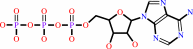 ATP
ATP
|
=
|
O-phospho-L-tyrosyl-[protein]
|
+
|
 ADP
ADP
|
+
|
H(+)
|
|
|
|
|
|
|
|
|
|
|
|
|
Molecule diagrams generated from .mol files obtained from the
KEGG ftp site
|
|
|
|
|
|
|
|
|
|
|
|
|
|
 |
|
|
|
|
|
|
| |
|
|
| |
|
DOI no:
|
Proc Natl Acad Sci U S A
105:2773-2778
(2008)
|
|
PubMed id:
|
|
|
|
|
|
| |
|
6-Ethynylthieno[3,2-d]- and 6-ethynylthieno[2,3-d]pyrimidin-4-anilines as tunable covalent modifiers of ErbB kinases.
|
|
E.R.Wood,
L.M.Shewchuk,
B.Ellis,
P.Brignola,
R.L.Brashear,
T.R.Caferro,
S.H.Dickerson,
H.D.Dickson,
K.H.Donaldson,
M.Gaul,
R.J.Griffin,
A.M.Hassell,
B.Keith,
R.Mullin,
K.G.Petrov,
M.J.Reno,
D.W.Rusnak,
S.M.Tadepalli,
J.C.Ulrich,
C.D.Wagner,
D.E.Vanderwall,
A.G.Waterson,
J.D.Williams,
W.L.White,
D.E.Uehling.
|
|
|
|
|
| |
ABSTRACT
|
|
|
|
| |
|
|
Analysis of the x-ray crystal structure of mono-substituted acetylenic
thienopyrimidine 6 complexed with the ErbB family enzyme ErbB-4 revealed a
covalent bond between the terminal carbon of the acetylene moiety and the
sulfhydryl group of Cys-803 at the solvent interface. The identification of this
covalent adduct suggested that acetylenic thienopyrimidine 6 and related analogs
might also be capable of forming an analogous covalent adduct with EGFR, which
has a conserved cysteine (797) near the ATP binding pocket. To test this
hypothesis, we treated a truncated, catalytically competent form of EGFR
(678-1020) with a structurally related propargylic amine (8). An investigation
of the resulting complex by mass spectrometry revealed the formation of a
covalent complex of thienopyrimidine 8 with Cys-797 of EGFR. This finding
enabled us to readily assess the irreversibility of various inhibitors and also
facilitated a structure-activity relationship understanding of the covalent
modifying potential and biological activity of a series of acetylenic
thienopyrimidine compounds with potent antitumor activity. Several ErbB family
enzyme and cell potent 6-ethynyl thienopyrimidine kinase inhibitors were found
to form covalent adducts with EGFR.
|
|
|
|
|
|
| |
Selected figure(s)
|
|
|
|
| |
|
|

|
|

|
|
Figure 3.
X-ray crystal structure of thienopyrimidine 6 in ErbB-4. (A)
Overlay of the ErbB-4 complexed with 6 (green) and EGFR
complexed with lapatinib (yellow). (B) Overlay of the active
sites of ErbB-4 (green) and EGFR (yellow). The covalent bond
between ErbB-4 and 6 is shown as a dotted green line. The
location of a hydrogen bond between the pyrimidine N1 of 6 and
the hinge region of ErbB-4 is shown by a dashed line. (C) Omit
map density for the ErbB-4 inhibitor complex contoured at 1
sigma.
|
|
Figure 4.
Proposed mechanism of covalent modification of pyrrolidine 8
with EGFR.
|
|
|
|
| |
Figures were
selected
by an automated process.
|
|
|
|
|
|
|
|
|
|
|
|
|
|
|
|
 |
 |
 |
|
Literature references that cite this PDB file's key reference
|
|
|
| |
PubMed id
|
|
Reference
|
|
|
|
|
|
M.Mustafa,
A.Mirza,
and
N.Kannan
(2011).
Conformational regulation of the EGFR kinase core by the juxtamembrane and C-terminal tail: a molecular dynamics study.
|
| |
Proteins,
79,
99.
|
|
|
|
|
|
|
N.Jura,
X.Zhang,
N.F.Endres,
M.A.Seeliger,
T.Schindler,
and
J.Kuriyan
(2011).
Catalytic control in the EGF receptor and its connection to general kinase regulatory mechanisms.
|
| |
Mol Cell,
42,
9.
|
|
|
|
|
|
|
F.Cymer,
and
D.Schneider
(2010).
Transmembrane helix-helix interactions involved in ErbB receptor signaling.
|
| |
Cell Adh Migr,
4,
299-312.
|
|
|
|
|
|
|
J.Monsey,
W.Shen,
P.Schlesinger,
and
R.Bose
(2010).
Her4 and Her2/neu tyrosine kinase domains dimerize and activate in a reconstituted in vitro system.
|
| |
J Biol Chem,
285,
7035-7044.
|
|
|
|
|
|
|
S.Klüter,
J.R.Simard,
H.B.Rode,
C.Grütter,
V.Pawar,
H.C.Raaijmakers,
T.A.Barf,
M.Rabiller,
W.A.van Otterlo,
and
D.Rauh
(2010).
Characterization of irreversible kinase inhibitors by directly detecting covalent bond formation: a tool for dissecting kinase drug resistance.
|
| |
Chembiochem,
11,
2557-2566.
|
|
|
PDB code:
|
|
|
|
|
|
|
|
M.Red Brewer,
S.H.Choi,
D.Alvarado,
K.Moravcevic,
A.Pozzi,
M.A.Lemmon,
and
G.Carpenter
(2009).
The juxtamembrane region of the EGF receptor functions as an activation domain.
|
| |
Mol Cell,
34,
641-651.
|
|
|
PDB code:
|
|
|
|
|
|
|
|
N.Jura,
N.F.Endres,
K.Engel,
S.Deindl,
R.Das,
M.H.Lamers,
D.E.Wemmer,
X.Zhang,
and
J.Kuriyan
(2009).
Mechanism for activation of the EGF receptor catalytic domain by the juxtamembrane segment.
|
| |
Cell,
137,
1293-1307.
|
|
|
PDB code:
|
|
|
|
|
|
|
|
R.Bose,
and
X.Zhang
(2009).
The ErbB kinase domain: structural perspectives into kinase activation and inhibition.
|
| |
Exp Cell Res,
315,
649-658.
|
|
|
|
|
|
The most recent references are shown first.
Citation data come partly from CiteXplore and partly
from an automated harvesting procedure. Note that this is likely to be
only a partial list as not all journals are covered by
either method. However, we are continually building up the citation data
so more and more references will be included with time.
Where a reference describes a PDB structure, the PDB
code is
shown on the right.
|
|


 Links
Links


