 |
PDBsum entry 2qr7

|
|
|
|
|
 |
Contents |
 |
|
|
|
|
|
|
|
|
|
|
|
|
* Residue conservation analysis
|
|
|
|
|
|
PDB id:
|
|
|
|
| Name: |
|
Transferase
|
|
|
Title:
|
|
2.0a x-ray structure of c-terminal kinase domain of p90 ribosomal s6 kinase 2: se-met derivative
|
|
Structure:
|
|
Ribosomal protein s6 kinase alpha-3. Chain: a. Synonym: s6k-alpha 3, 90 kda ribosomal protein s6 kinase 3, p90-rsk 3, ribosomal s6 kinase 2, rsk-2, pp90rsk2, map kinase-activated protein kinase 1b, mapkapk1b. Engineered: yes. Mutation: yes
|
|
Source:
|
|
Mus musculus. House mouse. Organism_taxid: 10090. Gene: rps6ka3, rps6ka-rs1, rsk2. Expressed in: escherichia coli. Expression_system_taxid: 562.
|
|
Resolution:
|
|
|
2.00Å
|
R-factor:
|
0.205
|
R-free:
|
0.238
|
|
|
Authors:
|
|
M.Malakhova,V.Tereshko,Z.Dong
|
Key ref:

|
|
M.Malakhova
et al.
(2008).
Structural basis for activation of the autoinhibitory C-terminal kinase domain of p90 RSK2.
Nat Struct Mol Biol,
15,
112-113.
PubMed id:
DOI:

|
|
|
Date:
|
|
|
27-Jul-07
|
Release date:
|
11-Dec-07
|
|
|
|
|
|
|
PROCHECK
|

|
|
|
|
|
Headers
|
|
|
|
References
|
|
|
|
|
|

|
|
P18654
(KS6A3_MOUSE) -
Ribosomal protein S6 kinase alpha-3 from Mus musculus
|
|
|
|
Seq:
Struc:
|
|
|
|
740 a.a.
298 a.a.*
|
|

|

|
|
|
|
|
|
|
|
|
|
|
|
Key: |
 |
PfamA domain |
|
|
 |
Secondary structure |
|
 |
CATH domain |
|
|
*
PDB and UniProt seqs differ
at 1 residue position (black
cross)
|
|
|
|
|
|
|
|
|
|
|
|
|
Enzyme class:
|
|
E.C.2.7.11.1
- non-specific serine/threonine protein kinase.
|
|
|
|
|
|
|
Reaction:
|
|
|
1.
|
L-seryl-[protein] + ATP = O-phospho-L-seryl-[protein] + ADP + H+
|
|
2.
|
L-threonyl-[protein] + ATP = O-phospho-L-threonyl-[protein] + ADP + H+
|
|
|
|
|
|
|
L-seryl-[protein]
|
+
|
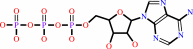 ATP
ATP
|
=
|
O-phospho-L-seryl-[protein]
|
+
|
 ADP
ADP
|
+
|
H(+)
|
|
|
|
|
|
|
L-threonyl-[protein]
|
+
|
ATP
|
=
|
O-phospho-L-threonyl-[protein]
|
+
|
ADP
|
+
|
H(+)
|
|
|
|
|
|
|
|
|
|
|
|
|
Molecule diagrams generated from .mol files obtained from the
KEGG ftp site
|
|
|
|
|
|
|
|
|
|
|
|
|
|
 |
|
|
|
|
|
|
| |
|
|
| |
|
DOI no:
|
Nat Struct Mol Biol
15:112-113
(2008)
|
|
PubMed id:
|
|
|
|
|
|
| |
|
Structural basis for activation of the autoinhibitory C-terminal kinase domain of p90 RSK2.
|
|
M.Malakhova,
V.Tereshko,
S.Y.Lee,
K.Yao,
Y.Y.Cho,
A.Bode,
Z.Dong.
|
|
|
|
|
| |
ABSTRACT
|
|
|
|
| |
|
|
The X-ray structure at 2.0-A resolution of the p90 ribosomal S6 kinase 2
C-terminal kinase domain revealed a C-terminal autoinhibitory alphaL-helix that
was embedded in the kinase scaffold and determines the inactive kinase
conformation. We suggest a mechanism of activation through displacement of the
alphaL-helix and rearrangement of the conserved residue Glu500, as well as the
reorganization of the T-loop into the active conformation.
|
|
|
|
|
|
| |
Selected figure(s)
|
|
|
|
| |
|
|

|
|

|
|
Figure 1.
The autoinhibitory C-terminal  L-helix
is shown in yellow. (a) The folding diagram. Disordered residues
715–740 are indicated in gray. (b) The 'cradle' position of
the L-helix
on the potential surface (positive in blue, negative in red).
See Supplementary Methods and Supplementary Table 1 online for
details of the structure determination and crystallographic
statistics, respectively. The sequence alignment is shown in
Supplementary Figure 4 online. L-helix
is shown in yellow. (a) The folding diagram. Disordered residues
715–740 are indicated in gray. (b) The 'cradle' position of
the L-helix
on the potential surface (positive in blue, negative in red).
See Supplementary Methods and Supplementary Table 1 online for
details of the structure determination and crystallographic
statistics, respectively. The sequence alignment is shown in
Supplementary Figure 4 online.
|
|
Figure 2.
(a) The CTD superimposed on active PKA (chain A from PDB
1CDK) illustrates the different positions of the D-helix.
Boxed region corresponds to boxed region in c. The ligand
(inhibitory peptide, purple ribbon) and an ATP analog (AMP-PNP;
blue van der Waals surface representation) bound to PKA are
included. (b) The CTD RSK2 superimposed on the autoinhibited
Ca^2+/calmodulin-dependent protein kinase I (PDB 1A06). (c) A
comparison of the active sites of CTD and PKA. Selected RSK2 CTD
residues are shown. Only residue Glu127 (analogous to Glu500 in
the CTD structure), which differs in the two structures, is
shown for PKA. The ATP analog and Mg^2+ ions (balls) are shown
in blue.
|
|
|
|
|
|
| |
The above figures are
reprinted
by permission from Macmillan Publishers Ltd:
Nat Struct Mol Biol
(2008,
15,
112-113)
copyright 2008.
|
|
|
|
|
|
|
|
|
|
|
|
|
|
 |
 |
 |
|
Literature references that cite this PDB file's key reference
|
|
|
| |
PubMed id
|
|
Reference
|
|
|
|
|
|
S.Ferreira-Cerca,
V.Sagar,
T.Schäfer,
M.Diop,
A.M.Wesseling,
H.Lu,
E.Chai,
E.Hurt,
and
N.Laronde-Leblanc
(2012).
ATPase-dependent role of the atypical kinase Rio2 on the evolving pre-40S ribosomal subunit.
|
| |
Nat Struct Mol Biol,
19,
1316-1323.
|
|
|
PDB codes:
|
|
|
|
|
|
|
|
J.R.St-Germain,
P.Taylor,
J.Tong,
L.L.Jin,
A.Nikolic,
I.I.Stewart,
R.M.Ewing,
M.Dharsee,
Z.Li,
S.Trudel,
and
M.F.Moran
(2009).
Multiple myeloma phosphotyrosine proteomic profile associated with FGFR3 expression, ligand activation, and drug inhibition.
|
| |
Proc Natl Acad Sci U S A,
106,
20127-20132.
|
|
|
|
|
|
|
M.Malakhova,
I.Kurinov,
K.Liu,
D.Zheng,
I.D'Angelo,
J.H.Shim,
V.Steinman,
A.M.Bode,
and
Z.Dong
(2009).
Structural diversity of the active N-terminal kinase domain of p90 ribosomal S6 kinase 2.
|
| |
PLoS One,
4,
e8044.
|
|
|
PDB code:
|
|
|
|
|
|
|
|
S.Kang,
S.Elf,
S.Dong,
T.Hitosugi,
K.Lythgoe,
A.Guo,
H.Ruan,
S.Lonial,
H.J.Khoury,
I.R.Williams,
B.H.Lee,
J.L.Roesel,
G.Karsenty,
A.Hanauer,
J.Taunton,
T.J.Boggon,
T.L.Gu,
and
J.Chen
(2009).
Fibroblast growth factor receptor 3 associates with and tyrosine phosphorylates p90 RSK2, leading to RSK2 activation that mediates hematopoietic transformation.
|
| |
Mol Cell Biol,
29,
2105-2117.
|
|
|
|
|
|
|
X.Gao,
and
T.B.Patel
(2009).
Regulation of protein kinase A activity by p90 ribosomal S6 kinase 1.
|
| |
J Biol Chem,
284,
33070-33078.
|
|
|
|
|
|
The most recent references are shown first.
Citation data come partly from CiteXplore and partly
from an automated harvesting procedure. Note that this is likely to be
only a partial list as not all journals are covered by
either method. However, we are continually building up the citation data
so more and more references will be included with time.
Where a reference describes a PDB structure, the PDB
codes are
shown on the right.
|
|


 Links
Links


