 |
PDBsum entry 2pl0

|
|
|
|
|
 |
Contents |
 |
|
|
|
|
|
|
|
|
|
|
|
|
* Residue conservation analysis
|
|
|
|
|
|
|
|
|
|
|
Enzyme class:
|
|
E.C.2.7.10.2
- non-specific protein-tyrosine kinase.
|
|
|
|
|
|
|
Reaction:
|
|
L-tyrosyl-[protein] + ATP = O-phospho-L-tyrosyl-[protein] + ADP + H+
|
|
|
|
|
|
L-tyrosyl-[protein]
|
+
|
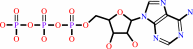 ATP
ATP
|
=
|
O-phospho-L-tyrosyl-[protein]
|
+
|
 ADP
ADP
|
+
|
H(+)
|
|
|
|
|
|
|
|
|
|
|
|
|
Molecule diagrams generated from .mol files obtained from the
KEGG ftp site
|
|
|
|
|
|
|
|
|
|
|
|
|
|
 |
|
|
|
|
|
|
| |
|
|
| |
|
DOI no:
|
Proteins
70:1451-1460
(2008)
|
|
PubMed id:
|
|
|
|
|
|
| |
|
Classifying protein kinase structures guides use of ligand-selectivity profiles to predict inactive conformations: structure of lck/imatinib complex.
|
|
M.D.Jacobs,
P.R.Caron,
B.J.Hare.
|
|
|
|
|
| |
ABSTRACT
|
|
|
|
| |
|
|
We report a clustering of public human protein kinase structures based on the
conformations of two structural elements, the activation segment and the
C-helix, revealing three discrete clusters. One cluster includes kinases in
catalytically active conformations. Each of the other clusters contains a
distinct inactive conformation. Typically, kinases adopt at most one of the
inactive conformations in available X-ray structures, implying that one of the
conformations is preferred for many kinases. The classification is consistent
with selectivity profiles of several well-characterized kinase inhibitors. We
show further that inhibitor selectivity profiles guide kinase classification.
For example, selective inhibition of lck among src-family kinases by imatinib
(Gleevec) suggests that the relative stabilities of inactive conformations of
lck are different from other src-family kinases. We report the X-ray structure
of the lck/imatinib complex, confirming that the conformation adopted by lck is
distinct from other structurally-characterized src-family kinases and instead
resembles kinases abl1 and kit in complex with imatinib. Our classification
creates new paths for designing small-molecule inhibitors.
|
|
|
|
|
|
| |
Selected figure(s)
|
|
|
|
| |
|
|

|
|

|
|
Figure 5.
Figure 5. Lck/imatinib complex. Comparison of X-ray structures
of lck/imatinib (green) and abl/imatinib (gray) complexes. The
side chains of the Asp and Phe residues in the conserved DFG
motif are shown.
|
|
Figure 6.
Figure 6. Overlay of lck/imatinib complex (green) with src
(C-helix-out conformation) (gray) (PDB ID: 2SRC).[13] Side
chains of key residues are shown as sticks. Hydrogen bond
between lck residues W238/E237 and src residues W260/Q312 are
shown as dotted line. Also shown are side chains of src A259 and
lck N290. These residues are at the same position as lck residue
E237 and src residue Q312, respectively.
|
|
|
|
|
|
| |
The above figures are
reprinted
by permission from John Wiley & Sons, Inc.:
Proteins
(2008,
70,
1451-1460)
copyright 2008.
|
|
| |
Figures were
selected
by the author.
|
|
|
|
|
|
|
|
|
|
|
|
|
|
|
|
 |
 |
 |
|
Literature references that cite this PDB file's key reference
|
|
|
| |
PubMed id
|
|
Reference
|
|
|
|
|
|
A.Kuglstatter,
A.Wong,
S.Tsing,
S.W.Lee,
Y.Lou,
A.G.Villaseñor,
J.M.Bradshaw,
D.Shaw,
J.W.Barnett,
and
M.F.Browner
(2011).
Insights into the conformational flexibility of Bruton's tyrosine kinase from multiple ligand complex structures.
|
| |
Protein Sci,
20,
428-436.
|
|
|
PDB codes:
|
|
|
|
|
|
|
|
J.Martin,
K.Anamika,
and
N.Srinivasan
(2010).
Classification of protein kinases on the basis of both kinase and non-kinase regions.
|
| |
PLoS One,
5,
e12460.
|
|
|
|
|
|
|
N.Brooijmans,
Y.W.Chang,
D.Mobilio,
R.A.Denny,
and
C.Humblet
(2010).
An enriched structural kinase database to enable kinome-wide structure-based analyses and drug discovery.
|
| |
Protein Sci,
19,
763-774.
|
|
|
|
|
|
|
P.Ranjitkar,
A.M.Brock,
and
D.J.Maly
(2010).
Affinity reagents that target a specific inactive form of protein kinases.
|
| |
Chem Biol,
17,
195-206.
|
|
|
|
|
|
|
J.A.Winger,
O.Hantschel,
G.Superti-Furga,
and
J.Kuriyan
(2009).
The structure of the leukemia drug imatinib bound to human quinone reductase 2 (NQO2).
|
| |
BMC Struct Biol,
9,
7.
|
|
|
PDB code:
|
|
|
|
|
|
|
|
J.R.Simard,
S.Klüter,
C.Grütter,
M.Getlik,
M.Rabiller,
H.B.Rode,
and
D.Rauh
(2009).
A new screening assay for allosteric inhibitors of cSrc.
|
| |
Nat Chem Biol,
5,
394-396.
|
|
|
PDB codes:
|
|
|
|
|
|
|
|
M.A.Seeliger,
P.Ranjitkar,
C.Kasap,
Y.Shan,
D.E.Shaw,
N.P.Shah,
J.Kuriyan,
and
D.J.Maly
(2009).
Equally potent inhibition of c-Src and Abl by compounds that recognize inactive kinase conformations.
|
| |
Cancer Res,
69,
2384-2392.
|
|
|
PDB codes:
|
|
|
|
|
|
|
|
M.Malakhova,
I.Kurinov,
K.Liu,
D.Zheng,
I.D'Angelo,
J.H.Shim,
V.Steinman,
A.M.Bode,
and
Z.Dong
(2009).
Structural diversity of the active N-terminal kinase domain of p90 ribosomal S6 kinase 2.
|
| |
PLoS One,
4,
e8044.
|
|
|
PDB code:
|
|
|
|
|
|
|
|
Y.Asses,
V.Leroux,
S.Tairi-Kellou,
R.Dono,
F.Maina,
and
B.Maigret
(2009).
Analysis of c-Met kinase domain complexes: a new specific catalytic site receptor model for defining binding modes of ATP-competitive ligands.
|
| |
Chem Biol Drug Des,
74,
560-570.
|
|
|
|
|
|
The most recent references are shown first.
Citation data come partly from CiteXplore and partly
from an automated harvesting procedure. Note that this is likely to be
only a partial list as not all journals are covered by
either method. However, we are continually building up the citation data
so more and more references will be included with time.
Where a reference describes a PDB structure, the PDB
codes are
shown on the right.
|
|


 Links
Links


