 |
PDBsum entry 2p2h

|
|
|
|
|
 |
Contents |
 |
|
|
|
|
|
|
|
|
|
|
|
|
* Residue conservation analysis
|
|
|
|
|
|
PDB id:
|
|
|
|
| Name: |
|
Transferase
|
|
|
Title:
|
|
Crystal structure of the vegfr2 kinase domain in complex with a pyridinyl-triazine inhibitor
|
|
Structure:
|
|
Vascular endothelial growth factor receptor 2. Chain: a. Fragment: kinase domain. Synonym: vegfr-2, kinase insert domain receptor, protein-tyrosine kinase receptor flk-1, cd309 antigen. Engineered: yes. Mutation: yes
|
|
Source:
|
|
Homo sapiens. Human. Organism_taxid: 9606. Gene: kdr, flk1. Expressed in: trichoplusia ni. Expression_system_taxid: 7111.
|
|
Resolution:
|
|
|
1.95Å
|
R-factor:
|
0.205
|
R-free:
|
0.229
|
|
|
Authors:
|
|
D.A.Whittington,J.L.Kim,A.M.Long,P.Rose,Y.Gu,H.Zhao
|
|
Key ref:
|
|
B.L.Hodous
et al.
(2007).
Evolution of a highly selective and potent 2-(pyridin-2-yl)-1,3,5-triazine Tie-2 kinase inhibitor.
J Med Chem,
50,
611-626.
PubMed id:
DOI:
|
|
|
Date:
|
|
|
07-Mar-07
|
Release date:
|
20-Mar-07
|
|
|
|
|
|
|
PROCHECK
|

|
|
|
|
|
Headers
|
|
|
|
References
|
|
|
|
|
|

|
|
P35968
(VGFR2_HUMAN) -
Vascular endothelial growth factor receptor 2 from Homo sapiens
|
|
|
|
Seq:
Struc:
|
|
|
|
1356 a.a.
292 a.a.*
|
|

|

|

|
|
|
|
|
|
|
|
|
|
|
Key: |
 |
PfamA domain |
|
|
 |
Secondary structure |
|
 |
CATH domain |
|
|
*
PDB and UniProt seqs differ
at 7 residue positions (black
crosses)
|
|
|
|
|
|
|
|
|
|
|
|
|
Enzyme class:
|
|
E.C.2.7.10.1
- receptor protein-tyrosine kinase.
|
|
|
|
|
|
|
Reaction:
|
|
L-tyrosyl-[protein] + ATP = O-phospho-L-tyrosyl-[protein] + ADP + H+
|
|
|
|
|
|
L-tyrosyl-[protein]
|
+
|
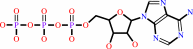 ATP
ATP
|
=
|
O-phospho-L-tyrosyl-[protein]
|
+
|
 ADP
ADP
|
+
|
H(+)
|
|
|
|
|
|
|
|
|
|
|
|
|
Molecule diagrams generated from .mol files obtained from the
KEGG ftp site
|
|
|
|
|
|
|
|
|
|
|
|
|
|
 |
|
|
|
|
|
|
| |
|
|
| |
|
DOI no:
|
J Med Chem
50:611-626
(2007)
|
|
PubMed id:
|
|
|
|
|
|
| |
|
Evolution of a highly selective and potent 2-(pyridin-2-yl)-1,3,5-triazine Tie-2 kinase inhibitor.
|
|
B.L.Hodous,
S.D.Geuns-Meyer,
P.E.Hughes,
B.K.Albrecht,
S.Bellon,
J.Bready,
S.Caenepeel,
V.J.Cee,
S.C.Chaffee,
A.Coxon,
M.Emery,
J.Fretland,
P.Gallant,
Y.Gu,
D.Hoffman,
R.E.Johnson,
R.Kendall,
J.L.Kim,
A.M.Long,
M.Morrison,
P.R.Olivieri,
V.F.Patel,
A.Polverino,
P.Rose,
P.Tempest,
L.Wang,
D.A.Whittington,
H.Zhao.
|
|
|
|
|
| |
ABSTRACT
|
|
|
|
| |
|
|
Inhibition of angiogenesis is a promising and clinically validated approach for
limiting tumor growth and survival. The receptor tyrosine kinase Tie-2 is
expressed almost exclusively in the vascular endothelium and is required for
developmental angiogenesis and vessel maturation. However, the significance of
Tie-2 signaling in tumor angiogenesis is not well understood. In order to
evaluate the therapeutic utility of inhibiting Tie-2 signaling, we developed a
series of potent and orally bioavailable small molecule Tie-2 kinase inhibitors
with selectivity over other kinases, especially those that are believed to be
important for tumor angiogenesis. Our earlier work provided pyridinyl pyrimidine
6 as a potent, nonselective Tie-2 inhibitor that was designed on the basis of
X-ray cocrystal structures of KDR inhibitors 34 (triazine) and 35
(nicotinamide). Lead optimization resulted in pyridinyl triazine 63, which
exhibited >30-fold selectivity over a panel of kinases, good oral exposure,
and in vivo inhibition of Tie-2 phosphorylation.
|
|
|
|
|
|
|
|
|
|
|
|
|
|
|
|
|
|
 |
 |
 |
|
Literature references that cite this PDB file's key reference
|
|
|
| |
PubMed id
|
|
Reference
|
|
|
|
|
|
A.Papakyriakou,
M.E.Katsarou,
M.Belimezi,
M.Karpusas,
and
D.Vourloumis
(2010).
Discovery of potent vascular endothelial growth factor receptor-2 inhibitors.
|
| |
ChemMedChem,
5,
118-129.
|
|
|
|
|
|
|
P.Ranjitkar,
A.M.Brock,
and
D.J.Maly
(2010).
Affinity reagents that target a specific inactive form of protein kinases.
|
| |
Chem Biol,
17,
195-206.
|
|
|
|
|
|
|
H.G.Augustin,
G.Young Koh,
G.Thurston,
and
K.Alitalo
(2009).
Control of vascular morphogenesis and homeostasis through the angiopoietin-Tie system.
|
| |
Nat Rev Mol Cell Biol,
10,
165-177.
|
|
|
|
|
|
|
M.A.Seeliger,
P.Ranjitkar,
C.Kasap,
Y.Shan,
D.E.Shaw,
N.P.Shah,
J.Kuriyan,
and
D.J.Maly
(2009).
Equally potent inhibition of c-Src and Abl by compounds that recognize inactive kinase conformations.
|
| |
Cancer Res,
69,
2384-2392.
|
|
|
PDB codes:
|
|
|
|
|
|
|
|
M.H.Seifert
(2009).
Robust optimization of scoring functions for a target class.
|
| |
J Comput Aided Mol Des,
23,
633-644.
|
|
|
|
|
|
|
M.Thomas,
and
H.G.Augustin
(2009).
The role of the Angiopoietins in vascular morphogenesis.
|
| |
Angiogenesis,
12,
125-137.
|
|
|
|
|
|
|
I.J.Enyedy,
and
W.J.Egan
(2008).
Can we use docking and scoring for hit-to-lead optimization?
|
| |
J Comput Aided Mol Des,
22,
161-168.
|
|
|
|
|
|
|
S.F.Bellon,
P.Kaplan-Lefko,
Y.Yang,
Y.Zhang,
J.Moriguchi,
K.Rex,
C.W.Johnson,
P.E.Rose,
A.M.Long,
A.B.O'Connor,
Y.Gu,
A.Coxon,
T.S.Kim,
A.Tasker,
T.L.Burgess,
and
I.Dussault
(2008).
c-Met Inhibitors with Novel Binding Mode Show Activity against Several Hereditary Papillary Renal Cell Carcinoma-related Mutations.
|
| |
J Biol Chem,
283,
2675-2683.
|
|
|
PDB codes:
|
|
|
|
|
|
|
|
T.Makinde,
and
D.K.Agrawal
(2008).
Intra and extravascular transmembrane signalling of angiopoietin-1-Tie2 receptor in health and disease.
|
| |
J Cell Mol Med,
12,
810-828.
|
|
|
|
|
|
The most recent references are shown first.
Citation data come partly from CiteXplore and partly
from an automated harvesting procedure. Note that this is likely to be
only a partial list as not all journals are covered by
either method. However, we are continually building up the citation data
so more and more references will be included with time.
Where a reference describes a PDB structure, the PDB
codes are
shown on the right.
|
|


 Links
Links


