 |
PDBsum entry 2ofu

|
|
|
|
|
 |
Contents |
 |
|
|
|
|
|
|
|
|
|
|
|
|
* Residue conservation analysis
|
|
|
|
|
|
|
|
|
|
|
Enzyme class:
|
|
E.C.2.7.10.2
- non-specific protein-tyrosine kinase.
|
|
|
|
|
|
|
Reaction:
|
|
L-tyrosyl-[protein] + ATP = O-phospho-L-tyrosyl-[protein] + ADP + H+
|
|
|
|
|
|
L-tyrosyl-[protein]
|
+
|
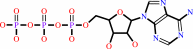 ATP
ATP
|
=
|
O-phospho-L-tyrosyl-[protein]
|
+
|
 ADP
ADP
|
+
|
H(+)
|
|
|
|
|
|
|
|
|
|
|
|
|
Molecule diagrams generated from .mol files obtained from the
KEGG ftp site
|
|
|
|
|
|
|
|
|
|
|
|
|
|
 |
|
|
|
|
|
|
| |
|
|
| |
|
DOI no:
|
J Med Chem
49:4981-4991
(2006)
|
|
PubMed id:
|
|
|
|
|
|
| |
|
Novel 2-aminopyrimidine carbamates as potent and orally active inhibitors of Lck: synthesis, SAR, and in vivo antiinflammatory activity.
|
|
M.W.Martin,
J.Newcomb,
J.J.Nunes,
D.C.McGowan,
D.M.Armistead,
C.Boucher,
J.L.Buchanan,
W.Buckner,
L.Chai,
D.Elbaum,
L.F.Epstein,
T.Faust,
S.Flynn,
P.Gallant,
A.Gore,
Y.Gu,
F.Hsieh,
X.Huang,
J.H.Lee,
D.Metz,
S.Middleton,
D.Mohn,
K.Morgenstern,
M.J.Morrison,
P.M.Novak,
A.Oliveira-dos-Santos,
D.Powers,
P.Rose,
S.Schneider,
S.Sell,
Y.Tudor,
S.M.Turci,
A.A.Welcher,
R.D.White,
D.Zack,
H.Zhao,
L.Zhu,
X.Zhu,
C.Ghiron,
P.Amouzegh,
M.Ermann,
J.Jenkins,
D.Johnston,
S.Napier,
E.Power.
|
|
|
|
|
| |
ABSTRACT
|
|
|
|
| |
|
|
The lymphocyte-specific kinase (Lck) is a cytoplasmic tyrosine kinase of the Src
family expressed in T cells and NK cells. Genetic evidence in both mice and
humans demonstrates that Lck kinase activity is critical for signaling mediated
by the T cell receptor (TCR), which leads to normal T cell development and
activation. A small molecule inhibitor of Lck is expected to be useful in the
treatment of T cell-mediated autoimmune and inflammatory disorders and/or organ
transplant rejection. In this paper, we describe the synthesis,
structure-activity relationships, and pharmacological characterization of
2-aminopyrimidine carbamates, a new class of compounds with potent and selective
inhibition of Lck. The most promising compound of this series,
2,6-dimethylphenyl
2-((3,5-bis(methyloxy)-4-((3-(4-methyl-1-piperazinyl)propyl)oxy)phenyl)amino)-4-pyrimidinyl(2,4-bis(methyloxy)phenyl)carbamate
(43) exhibits good activity when evaluated in in vitro assays and in an in vivo
model of T cell activation.
|
|
|
|
|
|
|
|
|
|
|
|
|
|
|
|
|
|
 |
 |
 |
|
Literature references that cite this PDB file's key reference
|
|
|
| |
PubMed id
|
|
Reference
|
|
|
|
|
|
R.S.Armen,
J.Chen,
and
C.L.Brooks
(2009).
An Evaluation of Explicit Receptor Flexibility in Molecular Docking Using Molecular Dynamics and Torsion Angle Molecular Dynamics.
|
| |
J Chem Theory Comput,
5,
2909-2923.
|
|
|
|
|
|
The most recent references are shown first.
Citation data come partly from CiteXplore and partly
from an automated harvesting procedure. Note that this is likely to be
only a partial list as not all journals are covered by
either method. However, we are continually building up the citation data
so more and more references will be included with time.
|
|


 Links
Links


