 |
PDBsum entry 2oca

|
|
|
|
|
 |
Contents |
 |
|
|
|
|
|
|
|
|
|
|
* Residue conservation analysis
|
|
|
|
|
|
|
|
|
|
|
Enzyme class:
|
|
E.C.3.6.4.12
- Dna helicase.
|
|
|
|
|
|
|
Reaction:
|
|
ATP + H2O = ADP + phosphate + H+
|
|
|
|
|
|
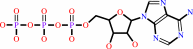 ATP
ATP
|
+
|
H2O
|
=
|
 ADP
ADP
|
+
|
 phosphate
|
+
|
H(+)
|
|
|
|
|
|
|
|
|
|
|
|
|
Molecule diagrams generated from .mol files obtained from the
KEGG ftp site
|
|
|
|
|
|
|
|
|
|
|
|
|
|
 |
|
|
|
|
|
|
| |
|
|
| |
|
DOI no:
|
J Biol Chem
282:34392-34400
(2007)
|
|
PubMed id:
|
|
|
|
|
|
| |
|
Crystallographic and NMR analyses of UvsW and UvsW.1 from bacteriophage T4.
|
|
I.D.Kerr,
S.Sivakolundu,
Z.Li,
J.C.Buchsbaum,
L.A.Knox,
R.Kriwacki,
S.W.White.
|
|
|
|
|
| |
ABSTRACT
|
|
|
|
| |
|
|
The uvsWXY system is implicated in the replication and repair of the
bacteriophage T4 genome. Whereas the roles of the recombinase (UvsX) and the
recombination mediator protein (UvsY) are known, the precise role of UvsW is
unclear. Sequence analysis identifies UvsW as a member of the monomeric SF2
helicase superfamily that translocates nucleic acid substrates via the action of
two RecA-like motor domains. Functional homologies to Escherichia coli RecG and
biochemical analyses have shown that UvsW interacts with branched nucleic acid
substrates, suggesting roles in recombination and the rescue of stalled
replication forks. A sequencing error at the 3'-end of the uvsW gene has
revealed a second, short open reading frame that encodes a protein of unknown
function called UvsW.1. We have determined the crystal structure of UvsW to 2.7A
and the NMR solution structure of UvsW.1. UvsW has a four-domain architecture
with structural homology to the eukaryotic SF2 helicase, Rad54. A model of the
UvsW-ssDNA complex identifies structural elements and conserved residues that
may interact with nucleic acid substrates. The NMR solution structure of UvsW.1
reveals a dynamic four-helix bundle with homology to the structure-specific
nucleic acid binding module of RecQ helicases.
|
|
|
|
|
|
| |
Selected figure(s)
|
|
|
|
| |
|
|

|
|

|
|
Figure 3.
Structure of full-length UvsW.A, actual crystal structure
showing the molecule in the open conformation. B, structure in
the modeled closed conformation in which domains 2A and 2B have
been rotated according to the structure of NS3-ssDNA. Each
domain is labeled. Key conserved residues within the helicase
motifs and the two flexible loops are shown, and these are
colored blue and pink to reflect interactions with DNA and
nucleotide, respectively. Note that in the closed conformation,
the helicase motifs congregate at the domain interface and the
two flexible loops are at the top of the molecule. The figures
were produced using MOLSCRIPT (57) and rendered with RASTER3D
(58).
|
|
Figure 5.
Primary sequence of UvsW.1. The sequence is shown in the
one-letter code, and the secondary structure elements are
indicated by the shaded segments.
|
|
|
|
|
|
| |
The above figures are
reprinted
by permission from the ASBMB:
J Biol Chem
(2007,
282,
34392-34400)
copyright 2007.
|
|
| |
Figures were
selected
by an automated process.
|
|
|
|
|
|
|
|
|
|
|
|
|
|
|
|
 |
 |
 |
|
Literature references that cite this PDB file's key reference
|
|
|
| |
PubMed id
|
|
Reference
|
|
|
|
|
|
D.T.Long,
and
K.N.Kreuzer
(2009).
Fork regression is an active helicase-driven pathway in bacteriophage T4.
|
| |
EMBO Rep,
10,
394-399.
|
|
|
|
|
|
|
J.Atkinson,
and
P.McGlynn
(2009).
Replication fork reversal and the maintenance of genome stability.
|
| |
Nucleic Acids Res,
37,
3475-3492.
|
|
|
|
|
|
|
S.W.Nelson,
S.K.Perumal,
and
S.J.Benkovic
(2009).
Processive and unidirectional translocation of monomeric UvsW helicase on single-stranded DNA.
|
| |
Biochemistry,
48,
1036-1046.
|
|
|
|
|
|
The most recent references are shown first.
Citation data come partly from CiteXplore and partly
from an automated harvesting procedure. Note that this is likely to be
only a partial list as not all journals are covered by
either method. However, we are continually building up the citation data
so more and more references will be included with time.
|
|


 Links
Links


