 |
PDBsum entry 2npq

|
|
|
|
|
 |
Contents |
 |
|
|
|
|
|
|
|
|
|
|
|
|
* Residue conservation analysis
|
|
|
|
|
|
PDB id:
|
|
|
|
| Name: |
|
Transferase
|
|
|
Title:
|
|
A novel lipid binding site in the p38 alpha map kinase
|
|
Structure:
|
|
Mitogen-activated protein kinase 14. Chain: a. Synonym: mitogen-activated protein kinase p38 alpha, map kinase p38 alpha, cytokine suppressive anti-inflammatory drug-binding protein, csaid-binding protein, csbp, max-interacting protein 2, map kinase mxi2, sapk2a. Engineered: yes
|
|
Source:
|
|
Homo sapiens. Human. Organism_taxid: 9606. Expressed in: escherichia coli. Expression_system_taxid: 562.
|
|
Resolution:
|
|
|
1.80Å
|
R-factor:
|
0.205
|
R-free:
|
0.245
|
|
|
Authors:
|
|
R.Diskin,D.Engelberg,O.Livnah
|
Key ref:

|
|
R.Diskin
et al.
(2008).
A novel lipid binding site formed by the MAP kinase insert in p38 alpha.
J Mol Biol,
375,
70-79.
PubMed id:
DOI:

|
|
|
Date:
|
|
|
29-Oct-06
|
Release date:
|
16-Oct-07
|
|
|
|
|
|
|
PROCHECK
|

|
|
|
|
|
Headers
|
|
|
|
References
|
|
|
|
|
|

|
|
Q16539
(MK14_HUMAN) -
Mitogen-activated protein kinase 14 from Homo sapiens
|
|
|
|
Seq:
Struc:
|
|
|
|
360 a.a.
326 a.a.
|
|

|

|

|
|
|
|
|
|
|
|
|
|
|
Key: |
 |
PfamA domain |
|
|
 |
Secondary structure |
|
 |
CATH domain |
|
|
|
|
|
|
|
|
|
|
|
|
|
Enzyme class:
|
|
E.C.2.7.11.24
- mitogen-activated protein kinase.
|
|
|
|
|
|
|
Reaction:
|
|
|
1.
|
L-seryl-[protein] + ATP = O-phospho-L-seryl-[protein] + ADP + H+
|
|
2.
|
L-threonyl-[protein] + ATP = O-phospho-L-threonyl-[protein] + ADP + H+
|
|
|
|
|
|
|
L-seryl-[protein]
|
+
|
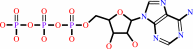 ATP
ATP
|
=
|
O-phospho-L-seryl-[protein]
|
+
|
 ADP
ADP
|
+
|
H(+)
|
|
|
|
|
|
|
L-threonyl-[protein]
|
+
|
ATP
|
=
|
O-phospho-L-threonyl-[protein]
|
+
|
ADP
|
+
|
H(+)
|
|
|
|
|
|
|
|
|
|
|
|
|
Molecule diagrams generated from .mol files obtained from the
KEGG ftp site
|
|
|
|
|
|
|
|
|
|
|
|
|
|
 |
|
|
|
|
|
|
| |
|
|
| |
|
DOI no:
|
J Mol Biol
375:70-79
(2008)
|
|
PubMed id:
|
|
|
|
|
|
| |
|
A novel lipid binding site formed by the MAP kinase insert in p38 alpha.
|
|
R.Diskin,
D.Engelberg,
O.Livnah.
|
|
|
|
|
| |
ABSTRACT
|
|
|
|
| |
|
|
The p38 mitogen-activated protein (MAP) kinases function as signaling molecules
essential for many cellular processes, particularly mediating stress response.
The activity of p38 MAP kinases is meticulously regulated to reach the desired
cellular phenotype. Several alternative activation and attenuation mechanisms
have been characterized recently which include new phosphorylation sites. Here
we present the crystal structure of p38 alpha MAP kinase in complex with
n-octyl-beta-glucopyranoside detergent. The complex unveils a novel
lipid-binding site formed by a local conformational change of the MAP kinase
insert. This binding is the first attribution for a possible role of the MAP
kinase insert in p38. The binding site can accommodate a large selection of
lipidic molecules. In addition, we also show via biophysical methods that
arachidonic acid and its derivatives bind p38 alpha in vitro. Based on our
analysis we propose that the binding of lipids could fine-tune p38 alpha
catalytic activity towards a preferred phenotype.
|
|
|
|
|
|
| |
Selected figure(s)
|
|
|
|
| |
|
|

|
|

|
|
Figure 1.
Figure 1. Overall structure. (a) Structural alignment of the
p38α – β-OG complex (green) and native p38α (gray) using
the coordinate of PDB ID 1P38.^19 The phosphorylation lip of the
native p38 as well as the N′ and C′ lobes are indicated. The
phosphorylation lip of the β-OG complex is not shown due to
local disorder. The overall kinase topology is maintained
although a minor change in the inter-lobe orientation is
apparent. All molecular graphics shown here were rendered using
PyMol [http://pymol.sourceforge.net/]. (b) Ribbon representation
of the p38α – β-OG complex with the two β-OG molecules
shown as spheres. The MAP kinase insert is shown in gray. The
β-OG 1 (carbon atoms shown in orange) is characterized by the
relatively lower B-factor whereas β-OG 2 (carbon atoms shown in
magenta) by higher values (see Table 1). (c) Difference electron
density map (F[obs]–F[calc]) calculated at a 2.0σ cutoff at
the resolution range of 32.7 Å−1.8 Å after the
initial cycle of refinement without β-OG in the model,
superimposed with the final coordinates of the p38α – β-OG
complex. The map clearly indicates the presence of β-OG in site
1.
|
|
Figure 3.
Figure 3. Structural characteristics of β-OG binding to
p38α. (a) Superimposition of the p38α – β-OG complex
(green) and native p38α (gray) in the vicinity of the MAP
kinase insert. The β-OG molecules are represented as spheres in
orange and magenta for β-OG 1 and 2, respectively. Trp197 and
Met198 from the αEF/αF loop of native p38α and the p38α –
β-OG complex are shown as sticks. The MAP kinase insert goes
through a conformational change and opens up to accommodate the
β-OG molecule. In addition the αEF/αF loop including Trp197
and Met198 goes through a substantial conformational change. In
this context, Trp197 forms a hydrophobic interaction with the
aliphatic segment of the detergent molecule. (b) Surface
representation of p38α displaying the shape of the lipid
binding site that accommodates β-OG 1 (orange) and β-OG 2
(magenta). β-OG 1 is extensively buried in the binding site
whereas only the lipid tail of β-OG 2 interacts with the
protein. The MAP kinase insert is highlighted in a darker
surface colour.
|
|
|
|
|
|
| |
The above figures are
reprinted
by permission from Elsevier:
J Mol Biol
(2008,
375,
70-79)
copyright 2008.
|
|
| |
Figures were
selected
by an automated process.
|
|
|
|
|
|
|
|
|
|
|
|
|
|
|
|
 |
 |
 |
|
Literature references that cite this PDB file's key reference
|
|
|
| |
PubMed id
|
|
Reference
|
|
|
|
|
|
R.Eglen,
and
T.Reisine
(2011).
Drug discovery and the human kinome: recent trends.
|
| |
Pharmacol Ther,
130,
144-156.
|
|
|
|
|
|
|
M.Rabiller,
M.Getlik,
S.Klüter,
A.Richters,
S.Tückmantel,
J.R.Simard,
and
D.Rauh
(2010).
Proteus in the world of proteins: conformational changes in protein kinases.
|
| |
Arch Pharm (Weinheim),
343,
193-206.
|
|
|
|
|
|
|
R.L.Rich,
and
D.G.Myszka
(2010).
Grading the commercial optical biosensor literature-Class of 2008: 'The Mighty Binders'.
|
| |
J Mol Recognit,
23,
1.
|
|
|
|
|
|
|
J.J.Perry,
R.M.Harris,
D.Moiani,
A.J.Olson,
and
J.A.Tainer
(2009).
p38alpha MAP kinase C-terminal domain binding pocket characterized by crystallographic and computational analyses.
|
| |
J Mol Biol,
391,
1.
|
|
|
PDB code:
|
|
|
|
|
|
|
|
Y.Choi,
M.A.Seeliger,
S.B.Panjarian,
H.Kim,
X.Deng,
T.Sim,
B.Couch,
A.J.Koleske,
T.E.Smithgall,
and
N.S.Gray
(2009).
N-myristoylated c-Abl tyrosine kinase localizes to the endoplasmic reticulum upon binding to an allosteric inhibitor.
|
| |
J Biol Chem,
284,
29005-29014.
|
|
|
|
|
|
The most recent references are shown first.
Citation data come partly from CiteXplore and partly
from an automated harvesting procedure. Note that this is likely to be
only a partial list as not all journals are covered by
either method. However, we are continually building up the citation data
so more and more references will be included with time.
Where a reference describes a PDB structure, the PDB
code is
shown on the right.
|
|


 Links
Links


