 |
PDBsum entry 2ng1

|
|
|
|
|
|

|

|

|

|
|

|
|

|
|

|
|

|
|

|
|
|
 |

|

|
|
|
|
|
|
|
|
|
|
|
|
|
|
|
|
|
|
|
|
|
|
|
|
|
|
|
|
|
|
|
|
|
|
Signal recognition
|
PDB id
|
|
|
|
2ng1
|
|
|
|
|
|
|
|
|
|
|
|
|
|
|

|

|

|
|
|
|
|
|
|
|
 |
Contents |
 |
|
|
|
|
|
|
|
|
|
|
|
|
* Residue conservation analysis
|
|
|
|
|
|
|
|
|
|
|
Enzyme class:
|
|
E.C.3.6.5.4
- signal-recognition-particle GTPase.
|
|
|
|
|
|
|
Reaction:
|
|
GTP + H2O = GDP + phosphate + H+
|
|
|
|
|
|
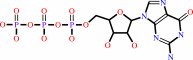 GTP
GTP
|
+
|
H2O
|
=
|
GDP
Bound ligand (Het Group name = )
corresponds exactly
|
+
|
 phosphate
|
+
|
H(+)
|
|
|
|
|
|
|
|
|
|
|
|
|
Molecule diagrams generated from .mol files obtained from the
KEGG ftp site
|
|
|
|
|
|
|
|
|
|
|
|
|
|
 |
|
|
|
|
|
|
| |
|
|
| |
|
DOI no:
|
Nat Struct Biol
6:793-801
(1999)
|
|
PubMed id:
|
|
|
|
|
|
| |
|
Functional changes in the structure of the SRP GTPase on binding GDP and Mg2+GDP.
|
|
D.M.Freymann,
R.J.Keenan,
R.M.Stroud,
P.Walter.
|
|
|
|
|
| |
ABSTRACT
|
|
|
|
| |
|
|
Ffh is a component of a bacterial ribonucleoprotein complex homologous to the
signal recognition particle (SRP) of eukaryotes. It comprises three domains that
mediate both binding to the hydrophobic signal sequence of the nascent
polypeptide and the GTP-dependent interaction of Ffh with a structurally
homologous GTPase of the SRP receptor. The X-ray structures of the two-domain
'NG' GTPase of Ffh in complex with Mg2+GDP and GDP have been determined at 2.0 A
resolution. The structures explain the low nucleotide affinity of Ffh and locate
two regions of structural mobility at opposite sides of the nucleotide-binding
site. One of these regions includes highly conserved sequence motifs that
presumably contribute to the structural trigger signaling the GTP-bound state.
The other includes the highly conserved interface between the N and G domains,
and supports the hypothesis that the N domain regulates or signals the
nucleotide occupancy of the G domain.
|
|
|
|
|
|
| |
Selected figure(s)
|
|
|
|
| |
|
|

|
|

|
|
Figure 3.
Figure 3. Comparison of the GDP-binding interactions in Ffh (G2)
with those in Ras (4q21). a, In Ffh, the 'closing loop' wraps
around Lys 117 and forms van der Waals contacts with the guanine
base. Lys 117 and Thr 114 are bridged by a buried water molecule
that forms the floor of the binding site and provides a hydrogen
bond to the guanine N7. Motifs I and IV are coupled by
interactions of Lys 246 and Thr 245 with carbonyl oxygens of the
motif I backbone. b, In Ras, Asn 116 bridges the binding site by
hydrogen-bonding the carbonyl oxygen of motif I Val 14 and the
hydroxyl of Thr 144 of the G-5 loop. The G-5 loop provides a
hydrogen bond from Ala 146 to the guanine O6; similar O6
hydrogen bonding is present in other GTPases, but is absent in
Ffh. The hydrophobic character of the floor of the binding site
is also typical of most other GTPases (but not the Rho subfamily
of GTPases, which includes buried water molecules^46, ^47). A
packing interaction structurally analogous to the 'closing loop'
in Ffh is provided by Phe 28 from the  1-helix
in Ras; in other GTPases, it is provided by elements of the 1-helix
in Ras; in other GTPases, it is provided by elements of the  4
loop. 4
loop.
|
|
Figure 5.
Figure 5. Cartoon summarizing the structural consequences of
binding of Mg^2+GDP and GDP to NG. The three structures
suggest a pathway for stepwise release of Mg^2+ and GDP. GTPase
sequence motifs I, II and III interact with the magnesium and
phosphate groups. On release of Mg^2+ (or perhaps Mg^2+P[i])
they can form a network of hydrogen bonding interactions that
stabilizes the nucleotide-free protein. Gln 144 is adjacent to
the active site and can hydrogen bond the  -phosphate
of the product GDP, thereby opening up the active site for
product release. The closing loop, depicted at the bottom of the
active site, packs against the bound nucleotide but on
nucleotide release moves away and becomes disordered. The
position of motif IV, which provides recognition of the guanine
base, is coupled to the position of the N domain. The concerted
action of the four elements presumably allows regulation of
binding and release, and can explain the low nucleotide affinity
of the SRP GTPase. -phosphate
of the product GDP, thereby opening up the active site for
product release. The closing loop, depicted at the bottom of the
active site, packs against the bound nucleotide but on
nucleotide release moves away and becomes disordered. The
position of motif IV, which provides recognition of the guanine
base, is coupled to the position of the N domain. The concerted
action of the four elements presumably allows regulation of
binding and release, and can explain the low nucleotide affinity
of the SRP GTPase.
|
|
|
|
|
|
| |
The above figures are
reprinted
by permission from Macmillan Publishers Ltd:
Nat Struct Biol
(1999,
6,
793-801)
copyright 1999.
|
|
| |
Figures were
selected
by an automated process.
|
|
|
|
|
|
|
|
|
|
|
|
|
|
|
|
 |
 |
 |
|
Literature references that cite this PDB file's key reference
|
|
|
| |
PubMed id
|
|
Reference
|
|
|
|
|
|
M.Yang,
X.Zhang,
and
K.Han
(2010).
Molecular dynamics simulation of SRP GTPases: towards an understanding of the complex formation from equilibrium fluctuations.
|
| |
Proteins,
78,
2222-2237.
|
|
|
|
|
|
|
S.O.Shan,
S.L.Schmid,
and
X.Zhang
(2009).
Signal recognition particle (SRP) and SRP receptor: a new paradigm for multistate regulatory GTPases.
|
| |
Biochemistry,
48,
6696-6704.
|
|
|
|
|
|
|
X.Zhang,
C.Schaffitzel,
N.Ban,
and
S.O.Shan
(2009).
Multiple conformational switches in a GTPase complex control co-translational protein targeting.
|
| |
Proc Natl Acad Sci U S A,
106,
1754-1759.
|
|
|
|
|
|
|
P.F.Egea,
J.Napetschnig,
P.Walter,
and
R.M.Stroud
(2008).
Structures of SRP54 and SRP19, the two proteins that organize the ribonucleic core of the signal recognition particle from Pyrococcus furiosus.
|
| |
PLoS ONE,
3,
e3528.
|
|
|
PDB codes:
|
|
|
|
|
|
|
|
U.D.Ramirez,
P.J.Focia,
and
D.M.Freymann
(2008).
Nucleotide-binding flexibility in ultrahigh-resolution structures of the SRP GTPase Ffh.
|
| |
Acta Crystallogr D Biol Crystallogr,
64,
1043-1053.
|
|
|
PDB codes:
|
|
|
|
|
|
|
|
Y.Agari,
S.Sato,
T.Wakamatsu,
Y.Bessho,
A.Ebihara,
S.Yokoyama,
S.Kuramitsu,
and
A.Shinkai
(2008).
X-ray crystal structure of a hypothetical Sua5 protein from Sulfolobus tokodaii strain 7.
|
| |
Proteins,
70,
1108-1111.
|
|
|
PDB code:
|
|
|
|
|
|
|
|
C.G.Noble,
B.Beuth,
and
I.A.Taylor
(2007).
Structure of a nucleotide-bound Clp1-Pcf11 polyadenylation factor.
|
| |
Nucleic Acids Res,
35,
87-99.
|
|
|
PDB code:
|
|
|
|
|
|
|
|
C.L.Reyes,
E.Rutenber,
P.Walter,
and
R.M.Stroud
(2007).
X-ray structures of the signal recognition particle receptor reveal targeting cycle intermediates.
|
| |
PLoS ONE,
2,
e607.
|
|
|
PDB codes:
|
|
|
|
|
|
|
|
J.Gawronski-Salerno,
J.S.Coon,
P.J.Focia,
and
D.M.Freymann
(2007).
X-ray structure of the T. aquaticus FtsY:GDP complex suggests functional roles for the C-terminal helix of the SRP GTPases.
|
| |
Proteins,
66,
984-995.
|
|
|
PDB code:
|
|
|
|
|
|
|
|
P.Jaru-Ampornpan,
S.Chandrasekar,
and
S.O.Shan
(2007).
Efficient interaction between two GTPases allows the chloroplast SRP pathway to bypass the requirement for an SRP RNA.
|
| |
Mol Biol Cell,
18,
2636-2645.
|
|
|
|
|
|
|
S.O.Shan,
S.Chandrasekar,
and
P.Walter
(2007).
Conformational changes in the GTPase modules of the signal reception particle and its receptor drive initiation of protein translocation.
|
| |
J Cell Biol,
178,
611-620.
|
|
|
|
|
|
|
I.L.Mainprize,
D.R.Beniac,
E.Falkovskaia,
R.M.Cleverley,
L.M.Gierasch,
F.P.Ottensmeyer,
and
D.W.Andrews
(2006).
The structure of Escherichia coli signal recognition particle revealed by scanning transmission electron microscopy.
|
| |
Mol Biol Cell,
17,
5063-5074.
|
|
|
|
|
|
|
U.D.Ramirez,
and
D.M.Freymann
(2006).
Analysis of protein hydration in ultrahigh-resolution structures of the SRP GTPase Ffh.
|
| |
Acta Crystallogr D Biol Crystallogr,
62,
1520-1534.
|
|
|
PDB codes:
|
|
|
|
|
|
|
|
E.C.Mandon,
and
R.Gilmore
(2004).
GTPase twins in the SRP family.
|
| |
Nat Struct Mol Biol,
11,
115-116.
|
|
|
|
|
|
|
E.H.Williams,
X.Perez-Martinez,
and
T.D.Fox
(2004).
MrpL36p, a highly diverged L31 ribosomal protein homolog with additional functional domains in Saccharomyces cerevisiae mitochondria.
|
| |
Genetics,
167,
65-75.
|
|
|
|
|
|
|
F.Chu,
S.O.Shan,
D.T.Moustakas,
F.Alber,
P.F.Egea,
R.M.Stroud,
P.Walter,
and
A.L.Burlingame
(2004).
Unraveling the interface of signal recognition particle and its receptor by using chemical cross-linking and tandem mass spectrometry.
|
| |
Proc Natl Acad Sci U S A,
101,
16454-16459.
|
|
|
|
|
|
|
J.A.Doudna,
and
R.T.Batey
(2004).
Structural insights into the signal recognition particle.
|
| |
Annu Rev Biochem,
73,
539-557.
|
|
|
|
|
|
|
K.Wild,
M.Halic,
I.Sinning,
and
R.Beckmann
(2004).
SRP meets the ribosome.
|
| |
Nat Struct Mol Biol,
11,
1049-1053.
|
|
|
|
|
|
|
P.J.Focia,
H.Alam,
T.Lu,
U.D.Ramirez,
and
D.M.Freymann
(2004).
Novel protein and Mg2+ configurations in the Mg2+GDP complex of the SRP GTPase ffh.
|
| |
Proteins,
54,
222-230.
|
|
|
PDB code:
|
|
|
|
|
|
|
|
P.J.Focia,
I.V.Shepotinovskaya,
J.A.Seidler,
and
D.M.Freymann
(2004).
Heterodimeric GTPase core of the SRP targeting complex.
|
| |
Science,
303,
373-377.
|
|
|
PDB code:
|
|
|
|
|
|
|
|
K.Nagai,
C.Oubridge,
A.Kuglstatter,
E.Menichelli,
C.Isel,
and
L.Jovine
(2003).
Structure, function and evolution of the signal recognition particle.
|
| |
EMBO J,
22,
3479-3485.
|
|
|
|
|
|
|
K.R.Rosendal,
K.Wild,
G.Montoya,
and
I.Sinning
(2003).
Crystal structure of the complete core of archaeal signal recognition particle and implications for interdomain communication.
|
| |
Proc Natl Acad Sci U S A,
100,
14701-14706.
|
|
|
PDB codes:
|
|
|
|
|
|
|
|
S.O.Shan,
and
P.Walter
(2003).
Induced nucleotide specificity in a GTPase.
|
| |
Proc Natl Acad Sci U S A,
100,
4480-4485.
|
|
|
|
|
|
|
S.Q.Gu,
F.Peske,
H.J.Wieden,
M.V.Rodnina,
and
W.Wintermeyer
(2003).
The signal recognition particle binds to protein L23 at the peptide exit of the Escherichia coli ribosome.
|
| |
RNA,
9,
566-573.
|
|
|
|
|
|
|
R.M.Cleverley,
and
L.M.Gierasch
(2002).
Mapping the signal sequence-binding site on SRP reveals a significant role for the NG domain.
|
| |
J Biol Chem,
277,
46763-46768.
|
|
|
|
|
|
|
J.R.Jagath,
N.B.Matassova,
E.de Leeuw,
J.M.Warnecke,
G.Lentzen,
M.V.Rodnina,
J.Luirink,
and
W.Wintermeyer
(2001).
Important role of the tetraloop region of 4.5S RNA in SRP binding to its receptor FtsY.
|
| |
RNA,
7,
293-301.
|
|
|
|
|
|
|
R.J.Keenan,
D.M.Freymann,
R.M.Stroud,
and
P.Walter
(2001).
The signal recognition particle.
|
| |
Annu Rev Biochem,
70,
755-775.
|
|
|
|
|
|
|
S.Padmanabhan,
and
D.M.Freymann
(2001).
The conformation of bound GMPPNP suggests a mechanism for gating the active site of the SRP GTPase.
|
| |
Structure,
9,
859-867.
|
|
|
PDB codes:
|
|
|
|
|
|
|
|
Y.Lu,
H.Y.Qi,
J.B.Hyndman,
N.D.Ulbrandt,
A.Teplyakov,
N.Tomasevic,
and
H.D.Bernstein
(2001).
Evidence for a novel GTPase priming step in the SRP protein targeting pathway.
|
| |
EMBO J,
20,
6724-6734.
|
|
|
|
|
|
|
A.A.Herskovits,
E.S.Bochkareva,
and
E.Bibi
(2000).
New prospects in studying the bacterial signal recognition particle pathway.
|
| |
Mol Microbiol,
38,
927-939.
|
|
|
|
|
|
|
B.Prakash,
L.Renault,
G.J.Praefcke,
C.Herrmann,
and
A.Wittinghofer
(2000).
Triphosphate structure of guanylate-binding protein 1 and implications for nucleotide binding and GTPase mechanism.
|
| |
EMBO J,
19,
4555-4564.
|
|
|
PDB code:
|
|
|
|
|
|
|
|
G.Montoya,
K.Kaat,
R.Moll,
G.Schäfer,
and
I.Sinning
(2000).
The crystal structure of the conserved GTPase of SRP54 from the archaeon Acidianus ambivalens and its comparison with related structures suggests a model for the SRP-SRP receptor complex.
|
| |
Structure,
8,
515-525.
|
|
|
PDB codes:
|
|
|
|
|
|
|
|
R.M.Stroud,
and
P.Walter
(1999).
Signal sequence recognition and protein targeting.
|
| |
Curr Opin Struct Biol,
9,
754-759.
|
|
|
|
|
|
The most recent references are shown first.
Citation data come partly from CiteXplore and partly
from an automated harvesting procedure. Note that this is likely to be
only a partial list as not all journals are covered by
either method. However, we are continually building up the citation data
so more and more references will be included with time.
Where a reference describes a PDB structure, the PDB
codes are
shown on the right.
|
|


 Links
Links


