Mode of interaction between beta2gpi and lipoprotein receptors suggests mutually exclusive binding of beta2gpi to the receptors and anionic phospholipids.
Lipoprotein receptors of the LDLR family serve as clearance receptors for
beta2GPI and as signaling receptors for the beta2GPI/antibody complexes in
antiphospholipid syndrome. We compared four ligand-binding LA modules from LDLR
and ApoER2 for their ability to bind domain V of beta2GPI (beta2GPI-DV). We
found that the LA modules capable of binding beta2GPI-DV interact with the same
region on beta2GPI-DV using residues at their calcium-coordination site. The
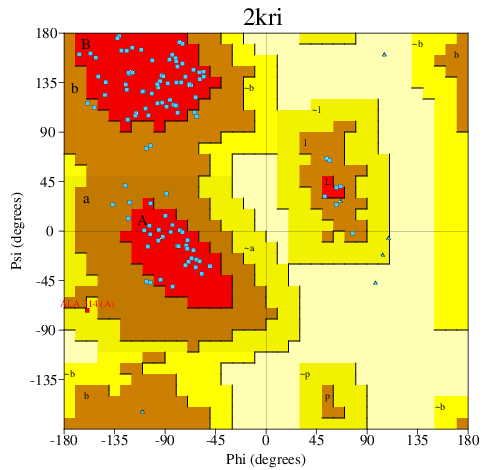
structure of a complex between beta2GPI-DV and LA4 of LDLR, solved by molecular
docking guided by NMR-derived restraints and extensively validated, represents
the general mode of interaction between beta2GPI and lipoprotein receptors. We
have shown that beta2GPI-DV cannot simultaneously bind to lipoprotein receptors
and anionic phospholipids, suggesting that the association of
beta2GPI/anti-beta2GPI antibody complexes with anionic phospholipids will
interfere with lipoprotein receptors' signaling in APS.