|
|
|
|
|
 |
Contents |
 |
|
|
|
|
|
|
|
|
|
|
|
 225 a.a.
|
|
|
|
|
|
|
|
|
|
|
 75 a.a.
|
|
|
|
|
|
|
|
|
|
|
 156 a.a.
|
|
|
|
|
|
|
|
|
* Residue conservation analysis
|
|
|
|
|
|
PDB id:
|
|
|
|
| Name: |
|
Protein binding, hydrolase
|
|
|
Title:
|
|
Crystal structure of human senp2 in complex with rangap1-sumo-1
|
|
Structure:
|
|
Sentrin-specific protease 2. Chain: a. Fragment: catalytic domain. Synonym: sentrin/sumo-specific protease senp2, smt3-specific isopeptidase 2, smt3ip2, axam2. Engineered: yes. Mutation: yes. Small ubiquitin-related modifier 1. Chain: b.
|
|
Source:
|
|
Homo sapiens. Human. Organism_taxid: 9606. Gene: senp2, kiaa1331. Expressed in: escherichia coli. Expression_system_taxid: 562. Gene: sumo1, smt3c, smt3h3, ubl1. Gene: rangap1.
|
|
Biol. unit:
|
|
 Dodecamer (from PDB file)
|
|
Resolution:
|
|
|
2.90Å
|
R-factor:
|
0.268
|
R-free:
|
0.301
|
|
|
Authors:
|
|
D.Reverter,C.D.Lima
|
Key ref:

|
|
D.Reverter
and
C.D.Lima
(2006).
Structural basis for SENP2 protease interactions with SUMO precursors and conjugated substrates.
Nat Struct Mol Biol,
13,
1060-1068.
PubMed id:
DOI:

|
|
|
Date:
|
|
|
09-Oct-06
|
Release date:
|
21-Nov-06
|
|
|
|
|
|
|
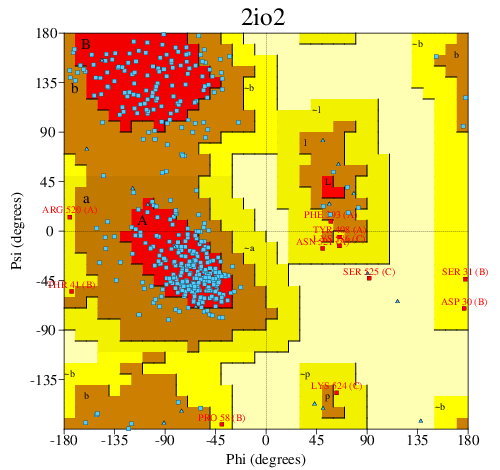
PROCHECK
|
|
|
|
|
|
Headers
|
|
|
|
References
|
|
|
|
|
|

|
|
Q9HC62
(SENP2_HUMAN) -
Sentrin-specific protease 2 from Homo sapiens
|
|
|
|
Seq:
Struc:
|
|
|
|
589 a.a.
225 a.a.*
|
|

|

|
|
|
|
|
|
|
|
|
|
|
|
|
|
|
|
|
|
|
|
|
|
 |
|
|
|
|
|
|
| |
|
DOI no:
|
Nat Struct Mol Biol
13:1060-1068
(2006)
|
|
PubMed id:
|
|
|
|
|
|
| |
|
Structural basis for SENP2 protease interactions with SUMO precursors and conjugated substrates.
|
|
D.Reverter,
C.D.Lima.
|
|
|
|
|
| |
ABSTRACT
|
|
|
|
| |
|
|
SUMO processing and deconjugation are essential proteolytic activities for
nuclear metabolism and cell-cycle progression in yeast and higher eukaryotes. To
elucidate the mechanisms used during substrate lysine deconjugation, SUMO
isoform processing and SUMO isoform interactions, X-ray structures were
determined for a catalytically inert SENP2 protease domain in complex with
conjugated RanGAP1-SUMO-1 or RanGAP1-SUMO-2, or in complex with SUMO-2 or SUMO-3
precursors. Common features within the active site include a 90 degrees kink
proximal to the scissile bond that forces C-terminal amino acid residues or the
lysine side chain toward a protease surface that appears optimized for lysine
deconjugation. Analysis of this surface reveals SENP2 residues, particularly
Met497, that mediate, and in some instances reverse, in vitro substrate
specificity. Mutational analysis and biochemistry provide a mechanism for SENP2
substrate preferences that explains why SENP2 catalyzes SUMO deconjugation more
efficiently than processing.
|
|
|
|
|
|
| |
Selected figure(s)
|
|
|
|
| |
|
|

|
|

|
|
Figure 1.
Figure 1. Structures of SENP2 deconjugation complexes with
RanGAP1–SUMO-1 and RanGAP1–SUMO-2. (a) Two nearly
orthogonal views of the human SENP2 catalytic domain in complex
with the C-terminal domain of RanGAP1 conjugated to either
SUMO-2 (left) or SUMO-1 (right), shown as ribbons. SENP2
catalytic residues are shown in bond representation, as is the
isopeptide bond between lysine and the SUMO diglycine motif. (b)
Stereo representation of the interaction between the SUMO-1
C-terminal tail (yellow), SENP2 (blue) and the consensus
residues of RanGAP1 (magenta), with interacting residues labeled
and shown in bond representation. Red dashed lines denote
putative hydrogen bonds. (c) Surface representation of SENP2 in
complex with the consensus residues of RanGAP1 conjugated to the
SUMO-1 diglycine motif. SUMO-1 C-terminal residues (yellow) and
RanGAP1 consensus motif (magenta) are shown as sticks. (d)
Stereo view of Ubc9 (SUMO E2, yellow) active site in complex
with RanGAP1–SUMO-1 (PDB 1Z5S)^29, depicted as in b. (e)
Simulated annealing omit map contoured at 1.2  ,
covering the isopeptide bond and selected active site residues
in the SENP2–RanGAP1–SUMO-1 structure. Graphics prepared
with PyMOL^41 (http://pymol.sourceforge.net). ,
covering the isopeptide bond and selected active site residues
in the SENP2–RanGAP1–SUMO-1 structure. Graphics prepared
with PyMOL^41 (http://pymol.sourceforge.net).
|
|
Figure 5.
Figure 5. Comparison of the hydrogen bond coordination of the
 and and
 peptide
bonds in the deconjugation and processing complexes. (a)
Stick representation of isopeptide bond between RanGAP1 Lys524
and SUMO Gly97. Blue, SENP2; yellow, SUMO; magenta, RanGAP1; red
dashed lines, hydrogen bonds. (b) Stick representation of
scissile peptide bond between Gly92 and Val93 from pre-SUMO-3,
in similar orientation as in a. peptide
bonds in the deconjugation and processing complexes. (a)
Stick representation of isopeptide bond between RanGAP1 Lys524
and SUMO Gly97. Blue, SENP2; yellow, SUMO; magenta, RanGAP1; red
dashed lines, hydrogen bonds. (b) Stick representation of
scissile peptide bond between Gly92 and Val93 from pre-SUMO-3,
in similar orientation as in a.
|
|
|
|
|
|
| |
The above figures are
reprinted
by permission from Macmillan Publishers Ltd:
Nat Struct Mol Biol
(2006,
13,
1060-1068)
copyright 2006.
|
|
| |
Figures were
selected
by the author.
|
|
|
|
|
|
|
|
|
|
|
|
|
|
|
|
 |
 |
 |
|
Literature references that cite this PDB file's key reference
|
|
|
| |
PubMed id
|
|
Reference
|
|
|
|
|
|
E.Van Damme,
K.Laukens,
T.H.Dang,
and
X.Van Ostade
(2010).
A manually curated network of the PML nuclear body interactome reveals an important role for PML-NBs in SUMOylation dynamics.
|
| |
Int J Biol Sci,
6,
51-67.
|
|
|
|
|
|
|
G.Fernández-Miranda,
I.Pérez de Castro,
M.Carmena,
C.Aguirre-Portolés,
S.Ruchaud,
X.Fant,
G.Montoya,
W.C.Earnshaw,
and
M.Malumbres
(2010).
SUMOylation modulates the function of Aurora-B kinase.
|
| |
J Cell Sci,
123,
2823-2833.
|
|
|
|
|
|
|
J.R.Gareau,
and
C.D.Lima
(2010).
The SUMO pathway: emerging mechanisms that shape specificity, conjugation and recognition.
|
| |
Nat Rev Mol Cell Biol,
11,
861-871.
|
|
|
|
|
|
|
N.Kolli,
J.Mikolajczyk,
M.Drag,
D.Mukhopadhyay,
N.Moffatt,
M.Dasso,
G.Salvesen,
and
K.D.Wilkinson
(2010).
Distribution and paralogue specificity of mammalian deSUMOylating enzymes.
|
| |
Biochem J,
430,
335-344.
|
|
|
|
|
|
|
E.T.Yeh
(2009).
SUMOylation and De-SUMOylation: Wrestling with Life's Processes.
|
| |
J Biol Chem,
284,
8223-8227.
|
|
|
|
|
|
|
K.Satoo,
N.N.Noda,
H.Kumeta,
Y.Fujioka,
N.Mizushima,
Y.Ohsumi,
and
F.Inagaki
(2009).
The structure of Atg4B-LC3 complex reveals the mechanism of LC3 processing and delipidation during autophagy.
|
| |
EMBO J,
28,
1341-1350.
|
|
|
PDB codes:
|
|
|
|
|
|
|
|
S.Zhu,
J.Goeres,
K.M.Sixt,
M.Békés,
X.D.Zhang,
G.S.Salvesen,
and
M.J.Matunis
(2009).
Protection from isopeptidase-mediated deconjugation regulates paralog-selective sumoylation of RanGAP1.
|
| |
Mol Cell,
33,
570-580.
|
|
|
|
|
|
|
W.A.Hofmann,
A.Arduini,
S.M.Nicol,
C.J.Camacho,
J.L.Lessard,
F.V.Fuller-Pace,
and
P.de Lanerolle
(2009).
SUMOylation of nuclear actin.
|
| |
J Cell Biol,
186,
193-200.
|
|
|
|
|
|
|
Y.Wang,
and
M.Dasso
(2009).
SUMOylation and deSUMOylation at a glance.
|
| |
J Cell Sci,
122,
4249-4252.
|
|
|
|
|
|
|
Z.Xu,
H.Y.Chan,
W.L.Lam,
K.H.Lam,
L.S.Lam,
T.B.Ng,
and
S.W.Au
(2009).
SUMO proteases: redox regulation and biological consequences.
|
| |
Antioxid Redox Signal,
11,
1453-1484.
|
|
|
|
|
|
|
C.D.Lima,
and
D.Reverter
(2008).
Structure of the Human SENP7 Catalytic Domain and Poly-SUMO Deconjugation Activities for SENP6 and SENP7.
|
| |
J Biol Chem,
283,
32045-32055.
|
|
|
PDB code:
|
|
|
|
|
|
|
|
L.A.Campbell,
E.J.Faivre,
M.D.Show,
J.G.Ingraham,
J.Flinders,
J.D.Gross,
and
H.A.Ingraham
(2008).
Decreased recognition of SUMO-sensitive target genes following modification of SF-1 (NR5A1).
|
| |
Mol Cell Biol,
28,
7476-7486.
|
|
|
|
|
|
|
M.Drag,
and
G.S.Salvesen
(2008).
DeSUMOylating enzymes--SENPs.
|
| |
IUBMB Life,
60,
734-742.
|
|
|
|
|
|
|
A.Catic,
S.Misaghi,
G.A.Korbel,
and
H.L.Ploegh
(2007).
ElaD, a Deubiquitinating protease expressed by E. coli.
|
| |
PLoS ONE,
2,
e381.
|
|
|
|
|
|
|
A.D.Capili,
and
C.D.Lima
(2007).
Structure and analysis of a complex between SUMO and Ubc9 illustrates features of a conserved E2-Ubl interaction.
|
| |
J Mol Biol,
369,
608-618.
|
|
|
PDB code:
|
|
|
|
|
|
|
|
A.D.Capili,
and
C.D.Lima
(2007).
Taking it step by step: mechanistic insights from structural studies of ubiquitin/ubiquitin-like protein modification pathways.
|
| |
Curr Opin Struct Biol,
17,
726-735.
|
|
|
|
|
|
|
D.M.Duda,
R.C.van Waardenburg,
L.A.Borg,
S.McGarity,
A.Nourse,
M.B.Waddell,
M.A.Bjornsti,
and
B.A.Schulman
(2007).
Structure of a SUMO-binding-motif mimic bound to Smt3p-Ubc9p: conservation of a non-covalent ubiquitin-like protein-E2 complex as a platform for selective interactions within a SUMO pathway.
|
| |
J Mol Biol,
369,
619-630.
|
|
|
PDB code:
|
|
|
|
|
|
|
|
D.Mukhopadhyay,
and
M.Dasso
(2007).
Modification in reverse: the SUMO proteases.
|
| |
Trends Biochem Sci,
32,
286-295.
|
|
|
|
|
|
|
J.Mikolajczyk,
M.Drag,
M.Békés,
J.T.Cao,
Z.Ronai,
and
G.S.Salvesen
(2007).
Small ubiquitin-related modifier (SUMO)-specific proteases: profiling the specificities and activities of human SENPs.
|
| |
J Biol Chem,
282,
26217-26224.
|
|
|
|
|
|
|
D.T.Huang,
and
B.A.Schulman
(2006).
Breaking up with a kinky SUMO.
|
| |
Nat Struct Mol Biol,
13,
1045-1047.
|
|
|
|
|
|
The most recent references are shown first.
Citation data come partly from CiteXplore and partly
from an automated harvesting procedure. Note that this is likely to be
only a partial list as not all journals are covered by
either method. However, we are continually building up the citation data
so more and more references will be included with time.
Where a reference describes a PDB structure, the PDB
codes are
shown on the right.
|
 |
|


 Links
Links