
|
|
|
|
|
 |
Contents |
 |
|
|
|
|
|
|
|
|
|
|
* Residue conservation analysis
|
|
|
|
|
|
|
|
|
|
Enzyme class:
|
|
Chain B:
E.C.2.7.11.14
- rhodopsin kinase.
|
|
|
|
|
|
|
Reaction:
|
|
|
1.
|
L-seryl-[rhodopsin] + ATP = O-phospho-L-seryl-[rhodopsin] + ADP + H+
|
|
2.
|
L-threonyl-[rhodopsin] + ATP = O-phospho-L-threonyl-[rhodopsin] + ADP + H+
|
|
|
|
|
|
|
L-seryl-[rhodopsin]
|
+
|
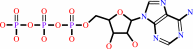 ATP
ATP
|
=
|
O-phospho-L-seryl-[rhodopsin]
|
+
|
 ADP
ADP
|
+
|
H(+)
|
|
|
|
|
|
|
L-threonyl-[rhodopsin]
|
+
|
ATP
|
=
|
O-phospho-L-threonyl-[rhodopsin]
|
+
|
ADP
|
+
|
H(+)
|
|
|
|
|
|
|
|
|
|
|
|
|
Molecule diagrams generated from .mol files obtained from the
KEGG ftp site
|
|
|
|
|
|
|
|
|
|
|
|
|
|
 |
|
|
|
|
|
|
| |
|
|
| |
|
DOI no:
|
J Biol Chem
281:37237-37245
(2006)
|
|
PubMed id:
|
|
|
|
|
|
| |
|
Structural basis for calcium-induced inhibition of rhodopsin kinase by recoverin.
|
|
J.B.Ames,
K.Levay,
J.N.Wingard,
J.D.Lusin,
V.Z.Slepak.
|
|
|
|
|
| |
ABSTRACT
|
|
|
|
| |
|
|
Recoverin, a member of the neuronal calcium sensor branch of the EF-hand
superfamily, serves as a calcium sensor that regulates rhodopsin kinase (RK)
activity in retinal rod cells. We report here the NMR structure of Ca(2+)-bound
recoverin bound to a functional N-terminal fragment of rhodopsin kinase
(residues 1-25, called RK25). The overall main-chain structure of recoverin in
the complex is similar to structures of Ca(2+)-bound recoverin in the absence of
target (<1.8A root-mean-square deviation). The first eight residues of
recoverin at the N terminus are solvent-exposed, enabling the N-terminal
myristoyl group to interact with target membranes, and Ca(2+) is bound at the
second and third EF-hands of the protein. RK25 in the complex forms an
amphipathic helix (residues 4-16). The hydrophobic face of the RK25 helix
(Val-9, Val-10, Ala-11, Ala-14, and Phe-15) interacts with an exposed
hydrophobic groove on the surface of recoverin lined by side-chain atoms of
Trp-31, Phe-35, Phe-49, Ile-52, Tyr-53, Phe-56, Phe-57, Tyr-86, and Leu-90.
Residues of recoverin that contact RK25 are highly conserved, suggesting a
similar target binding site structure in all neuronal calcium sensor proteins.
Site-specific mutagenesis and deletion analysis confirm that the hydrophobic
residues at the interface are necessary and sufficient for binding. The
recoverin-RK25 complex exhibits Ca(2+)-induced binding to rhodopsin immobilized
on concanavalin-A resin. We propose that Ca(2+)-bound recoverin is bound between
rhodopsin and RK in a ternary complex on rod outer segment disk membranes,
thereby blocking RK interaction with rhodopsin at high Ca(2+).
|
|
|
|
|
|
| |
Selected figure(s)
|
|
|
|
| |
|
|

|
|

|
|
Figure 5.
FIGURE 5. Intermolecular interactions between recoverin and
RK25. Side-chain atoms in the hydrophobic groove of recoverin
(yellow) interact with side-chain atoms from the hydrophobic
surface of RK25 helix (magenta).
|
|
Figure 7.
FIGURE 7. Schematic model of Ca^2+-induced inhibition of
rhodopsin kinase. Myristoylation (red) targets Ca^2+-bound
recoverin to the membrane surface, where it interacts with
rhodopsin. Recoverin also interacts with the N-terminal helix of
rhodopsin kinase (magenta), forming a ternary complex on the
membrane surface that blocks phosphorylation of rhodopsin. Light
activation leads to a lowering of cytosolic Ca^2+, causing
conformational changes in recoverin that sequester the
covalently attached myristoyl group and disrupt the interaction
with rhodopsin kinase. Ca^2+-free recoverin then dissociates
from the membrane surface, allowing RK to phosphorylate the
C-terminal tail of light-excited rhodopsin.
|
|
|
|
|
|
| |
The above figures are
reprinted
by permission from the ASBMB:
J Biol Chem
(2006,
281,
37237-37245)
copyright 2006.
|
|
| |
Figures were
selected
by an automated process.
|
|
|
|
|
|
|
|
|
|
|
|
|
|
|
|
 |
 |
 |
|
Literature references that cite this PDB file's key reference
|
|
|
| |
PubMed id
|
|
Reference
|
|
|
|
|
|
I.I.Senin,
N.K.Tikhomirova,
V.A.Churumova,
I.I.Grigoriev,
T.A.Kolpakova,
D.V.Zinchenko,
P.P.Philippov,
and
E.Y.Zernii
(2011).
Amino Acid sequences of two immune-dominant epitopes of recoverin are involved in ca2+/recoverin-dependent inhibition of phosphorylation of rhodopsin.
|
| |
Biochemistry (Mosc),
76,
332-338.
|
|
|
|
|
|
|
X.Xu,
R.Ishima,
and
J.B.Ames
(2011).
Conformational dynamics of recoverin's Ca(2+) -myristoyl switch probed by (15) N NMR relaxation dispersion and chemical shift analysis.
|
| |
Proteins,
79,
1910-1922.
|
|
|
|
|
|
|
C.K.Chen,
M.L.Woodruff,
F.S.Chen,
D.Chen,
and
G.L.Fain
(2010).
Background light produces a recoverin-dependent modulation of activated-rhodopsin lifetime in mouse rods.
|
| |
J Neurosci,
30,
1213-1220.
|
|
|
|
|
|
|
D.Arinobu,
S.Tachibanaki,
and
S.Kawamura
(2010).
Larger inhibition of visual pigment kinase in cones than in rods.
|
| |
J Neurochem,
115,
259-268.
|
|
|
|
|
|
|
C.S.Pao,
B.L.Barker,
and
J.L.Benovic
(2009).
Role of the amino terminus of G protein-coupled receptor kinase 2 in receptor phosphorylation.
|
| |
Biochemistry,
48,
7325-7333.
|
|
|
|
|
|
|
J.L.Li,
C.Y.Geng,
Y.Bu,
X.R.Huang,
and
C.C.Sun
(2009).
Conformational transition pathway in the allosteric process of calcium-induced recoverin: molecular dynamics simulations.
|
| |
J Comput Chem,
30,
1135-1145.
|
|
|
|
|
|
|
K.E.Komolov,
I.I.Senin,
N.A.Kovaleva,
M.P.Christoph,
V.A.Churumova,
I.I.Grigoriev,
M.Akhtar,
P.P.Philippov,
and
K.W.Koch
(2009).
Mechanism of rhodopsin kinase regulation by recoverin.
|
| |
J Neurochem,
110,
72-79.
|
|
|
|
|
|
|
A.Torisawa,
D.Arinobu,
S.Tachibanaki,
and
S.Kawamura
(2008).
Amino acid residues in GRK1/GRK7 responsible for interaction with S-modulin/recoverin.
|
| |
Photochem Photobiol,
84,
823-830.
|
|
|
|
|
|
|
O.Okhrimenko,
and
I.Jelesarov
(2008).
A survey of the year 2006 literature on applications of isothermal titration calorimetry.
|
| |
J Mol Recognit,
21,
1.
|
|
|
|
|
|
|
P.Singh,
B.Wang,
T.Maeda,
K.Palczewski,
and
J.J.Tesmer
(2008).
Structures of rhodopsin kinase in different ligand states reveal key elements involved in G protein-coupled receptor kinase activation.
|
| |
J Biol Chem,
283,
14053-14062.
|
|
|
PDB codes:
|
|
|
|
|
|
|
|
S.M.Boaz,
K.Dominguez,
J.A.Shaman,
and
W.S.Ward
(2008).
Mouse spermatozoa contain a nuclease that is activated by pretreatment with EGTA and subsequent calcium incubation.
|
| |
J Cell Biochem,
103,
1636-1645.
|
|
|
|
|
|
|
I.V.Peshenko,
and
A.M.Dizhoor
(2007).
Activation and inhibition of photoreceptor guanylyl cyclase by guanylyl cyclase activating protein 1 (GCAP-1): the functional role of Mg2+/Ca2+ exchange in EF-hand domains.
|
| |
J Biol Chem,
282,
21645-21652.
|
|
|
|
|
|
|
R.D.Burgoyne
(2007).
Neuronal calcium sensor proteins: generating diversity in neuronal Ca2+ signalling.
|
| |
Nat Rev Neurosci,
8,
182-193.
|
|
|
|
|
|
The most recent references are shown first.
Citation data come partly from CiteXplore and partly
from an automated harvesting procedure. Note that this is likely to be
only a partial list as not all journals are covered by
either method. However, we are continually building up the citation data
so more and more references will be included with time.
Where a reference describes a PDB structure, the PDB
codes are
shown on the right.
|
 |


 Links
Links


