
|
|
|
|
|
 |
Contents |
 |
|
|
|
|
|
|
|
|
|
|
|
|
|
|
* Residue conservation analysis
|
|
|
|
|
|
|
|
|
|
Enzyme class:
|
|
Chains A, B:
E.C.2.7.11.24
- mitogen-activated protein kinase.
|
|
|
|
|
|
|
Reaction:
|
|
|
1.
|
L-seryl-[protein] + ATP = O-phospho-L-seryl-[protein] + ADP + H+
|
|
2.
|
L-threonyl-[protein] + ATP = O-phospho-L-threonyl-[protein] + ADP + H+
|
|
|
|
|
|
|
L-seryl-[protein]
|
+
|
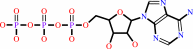 ATP
ATP
|
=
|
O-phospho-L-seryl-[protein]
|
+
|
 ADP
ADP
|
+
|
H(+)
|
|
|
|
|
|
|
L-threonyl-[protein]
|
+
|
ATP
|
=
|
O-phospho-L-threonyl-[protein]
|
+
|
ADP
|
+
|
H(+)
|
|
|
|
|
|
|
|
|
|
|
|
|
Molecule diagrams generated from .mol files obtained from the
KEGG ftp site
|
|
|
|
|
|
|
|
|
|
|
|
|
|
 |
|
|
|
|
|
|
| |
|
|
| |
|
DOI no:
|
Science
311:822-826
(2006)
|
|
PubMed id:
|
|
|
|
|
|
| |
|
The Ste5 scaffold allosterically modulates signaling output of the yeast mating pathway.
|
|
R.P.Bhattacharyya,
A.Reményi,
M.C.Good,
C.J.Bashor,
A.M.Falick,
W.A.Lim.
|
|
|
|
|
| |
ABSTRACT
|
|
|
|
| |
|
|
Scaffold proteins organize signaling proteins into pathways and are often viewed
as passive assembly platforms. We found that the Ste5 scaffold has a more active
role in the yeast mating pathway: A fragment of Ste5 allosterically activated
autophosphorylation of the mitogen-activated protein kinase Fus3. The resulting
form of Fus3 is partially active-it is phosphorylated on only one of two key
residues in the activation loop. Unexpectedly, at a systems level, autoactivated
Fus3 appears to have a negative regulatory role, promoting Ste5 phosphorylation
and a decrease in pathway transcriptional output. Thus, scaffolds not only
direct basic pathway connectivity but can precisely tune quantitative pathway
input-output properties.
|
|
|
|
|
|
| |
Selected figure(s)
|
|
|
|
| |
|
|

|
|

|
|
Figure 1.
Fig. 1. Fus3 recruitment to the pheromone response MAPK
complex. (A) Schematic of pheromone response MAPK complex. The
MAPK Fus3 interacts with the scaffold protein Ste5 (4–6) and
the MAPKK Ste7 (6, 40). (B) Maps of the interaction domains in
the MAPKK Ste7 and the scaffold Ste5. Minimal Fus3 binding
peptides are shown in color [dark blue, Ste7_pep1 (12, 16);
light blue, Ste7_pep2 (16)]. Black bars above the Ste5 schematic
indicate protein-interaction domains identified in yeast
two-hybrid assays (4, 37). The Fus3 binding peptide (Ste5_pep)
is shown in red (fig. S1).
|
|
Figure 2.
Fig. 2. Structure of Fus3-Ste5 complex and comparison to
canonical docking complexes. (A) Crystal structure of
Fus3/Ste5_pep complex. Ste5 (red) binds to Fus3 in a bipartite
manner. Close-up views of site A and site B on the right are
shown with simulated annealed electron density omit maps
(contoured at 1  ) for the Ste5
peptide. (B) Structure of Fus3 in complex with a canonical
docking motif from Ste7 (Ste7_pep1) (16). (C) Protein-protein
interactions at site A. The N-terminal half of Ste5_pep adopts a
ß-strand conformation and initiates the formation of a new
ß strand at the N terminus of Fus3 (ß0). This strand
forms eight backbone-backbone H bonds with the Fus3 N-terminal
region (H bonds are indicated with red dashed lines). The side
chain of Q^292 is H bonded to the backbone of ß1, the
hydrophobic side chain of I^294 interacts with a groove on the
top of the kinase, and Y^295 makes an H bond with the side chain
of R^4 from Fus3. Schematic illustration of secondary structural
elements of the N-terminal kinase lobe in the unliganded and
Ste5_pep liganded complex is shown on the right. (D) Comparison
of protein-protein interactions at the canonical MAPK docking
groove (site B) between the Fus3/Ste5_pep and the Fus3/Far1_pep
complexes (16). ) for the Ste5
peptide. (B) Structure of Fus3 in complex with a canonical
docking motif from Ste7 (Ste7_pep1) (16). (C) Protein-protein
interactions at site A. The N-terminal half of Ste5_pep adopts a
ß-strand conformation and initiates the formation of a new
ß strand at the N terminus of Fus3 (ß0). This strand
forms eight backbone-backbone H bonds with the Fus3 N-terminal
region (H bonds are indicated with red dashed lines). The side
chain of Q^292 is H bonded to the backbone of ß1, the
hydrophobic side chain of I^294 interacts with a groove on the
top of the kinase, and Y^295 makes an H bond with the side chain
of R^4 from Fus3. Schematic illustration of secondary structural
elements of the N-terminal kinase lobe in the unliganded and
Ste5_pep liganded complex is shown on the right. (D) Comparison
of protein-protein interactions at the canonical MAPK docking
groove (site B) between the Fus3/Ste5_pep and the Fus3/Far1_pep
complexes (16).
|
|
|
|
|
|
| |
The above figures are
reprinted
by permission from the AAAs:
Science
(2006,
311,
822-826)
copyright 2006.
|
|
| |
Figures were
selected
by an automated process.
|
|
|
|
|
|
|
|
|
|
|
|
|
|
|
|
 |
 |
 |
|
Literature references that cite this PDB file's key reference
|
|
|
| |
PubMed id
|
|
Reference
|
|
|
|
|
|
B.H.Várkuti,
Z.Yang,
B.Kintses,
P.Erdélyi,
I.Bárdos-Nagy,
A.L.Kovács,
P.Hári,
M.Kellermayer,
T.Vellai,
and
A.Málnási-Csizmadia
(2012).
A novel actin binding site of myosin required for effective muscle contraction.
|
| |
Nat Struct Mol Biol,
19,
299-306.
|
|
|
|
|
|
|
M.C.Good,
J.G.Zalatan,
and
W.A.Lim
(2011).
Scaffold proteins: hubs for controlling the flow of cellular information.
|
| |
Science,
332,
680-686.
|
|
|
|
|
|
|
R.Alam,
and
M.M.Gorska
(2011).
Mitogen-activated protein kinase signalling and ERK1/2 bistability in asthma.
|
| |
Clin Exp Allergy,
41,
149-159.
|
|
|
|
|
|
|
A.Alexa,
J.Varga,
and
A.Reményi
(2010).
Scaffolds are 'active' regulators of signaling modules.
|
| |
FEBS J,
277,
4376-4382.
|
|
|
|
|
|
|
A.Málnási-Csizmadia,
and
M.Kovács
(2010).
Emerging complex pathways of the actomyosin powerstroke.
|
| |
Trends Biochem Sci,
35,
684-690.
|
|
|
|
|
|
|
B.N.Kholodenko,
J.F.Hancock,
and
W.Kolch
(2010).
Signalling ballet in space and time.
|
| |
Nat Rev Mol Cell Biol,
11,
414-426.
|
|
|
|
|
|
|
E.Zeqiraj,
and
D.M.van Aalten
(2010).
Pseudokinases-remnants of evolution or key allosteric regulators?
|
| |
Curr Opin Struct Biol,
20,
772-781.
|
|
|
|
|
|
|
H.Saito
(2010).
Regulation of cross-talk in yeast MAPK signaling pathways.
|
| |
Curr Opin Microbiol,
13,
677-683.
|
|
|
|
|
|
|
I.Correia,
R.Alonso-Monge,
and
J.Pla
(2010).
MAPK cell-cycle regulation in Saccharomyces cerevisiae and Candida albicans.
|
| |
Future Microbiol,
5,
1125-1141.
|
|
|
|
|
|
|
M.C.Rodriguez,
M.Petersen,
and
J.Mundy
(2010).
Mitogen-activated protein kinase signaling in plants.
|
| |
Annu Rev Plant Biol,
61,
621-649.
|
|
|
|
|
|
|
M.K.Malleshaiah,
V.Shahrezaei,
P.S.Swain,
and
S.W.Michnick
(2010).
The scaffold protein Ste5 directly controls a switch-like mating decision in yeast.
|
| |
Nature,
465,
101-105.
|
|
|
|
|
|
|
M.Molina,
V.J.Cid,
and
H.Martín
(2010).
Fine regulation of Saccharomyces cerevisiae MAPK pathways by post-translational modifications.
|
| |
Yeast,
27,
503-511.
|
|
|
|
|
|
|
S.Ritterhoff,
C.M.Farah,
J.Grabitzki,
G.Lochnit,
A.V.Skurat,
and
M.L.Schmitz
(2010).
The WD40-repeat protein Han11 functions as a scaffold protein to control HIPK2 and MEKK1 kinase functions.
|
| |
EMBO J,
29,
3750-3761.
|
|
|
|
|
|
|
A.Balázs,
V.Csizmok,
L.Buday,
M.Rakács,
R.Kiss,
M.Bokor,
R.Udupa,
K.Tompa,
and
P.Tompa
(2009).
High levels of structural disorder in scaffold proteins as exemplified by a novel neuronal protein, CASK-interactive protein1.
|
| |
FEBS J,
276,
3744-3756.
|
|
|
|
|
|
|
A.Mody,
J.Weiner,
and
S.Ramanathan
(2009).
Modularity of MAP kinases allows deformation of their signalling pathways.
|
| |
Nat Cell Biol,
11,
484-491.
|
|
|
|
|
|
|
A.Stein,
R.A.Pache,
P.Bernadó,
M.Pons,
and
P.Aloy
(2009).
Dynamic interactions of proteins in complex networks: a more structured view.
|
| |
FEBS J,
276,
5390-5405.
|
|
|
|
|
|
|
A.Zeke,
M.Lukács,
W.A.Lim,
and
A.Reményi
(2009).
Scaffolds: interaction platforms for cellular signalling circuits.
|
| |
Trends Cell Biol,
19,
364-374.
|
|
|
|
|
|
|
J.S.Bader
(2009).
New connections, new components, real dynamics.
|
| |
Sci Signal,
2,
pe48.
|
|
|
|
|
|
|
L.S.Garrenton,
A.Braunwarth,
S.Irniger,
E.Hurt,
M.Künzler,
and
J.Thorner
(2009).
Nucleus-specific and cell cycle-regulated degradation of mitogen-activated protein kinase scaffold protein Ste5 contributes to the control of signaling competence.
|
| |
Mol Cell Biol,
29,
582-601.
|
|
|
|
|
|
|
M.Good,
G.Tang,
J.Singleton,
A.Reményi,
and
W.A.Lim
(2009).
The Ste5 scaffold directs mating signaling by catalytically unlocking the Fus3 MAP kinase for activation.
|
| |
Cell,
136,
1085-1097.
|
|
|
PDB code:
|
|
|
|
|
|
|
|
S.A.Chapman,
and
A.R.Asthagiri
(2009).
Quantitative effect of scaffold abundance on signal propagation.
|
| |
Mol Syst Biol,
5,
313.
|
|
|
|
|
|
|
S.J.Deminoff,
V.Ramachandran,
and
P.K.Herman
(2009).
Distal recognition sites in substrates are required for efficient phosphorylation by the cAMP-dependent protein kinase.
|
| |
Genetics,
182,
529-539.
|
|
|
|
|
|
|
B.D.Atkins,
S.Yoshida,
and
D.Pellman
(2008).
Symmetry breaking: scaffold plays matchmaker for polarity signaling proteins.
|
| |
Curr Biol,
18,
R1130-R1132.
|
|
|
|
|
|
|
C.J.Bashor,
N.C.Helman,
S.Yan,
and
W.A.Lim
(2008).
Using engineered scaffold interactions to reshape MAP kinase pathway signaling dynamics.
|
| |
Science,
319,
1539-1543.
|
|
|
|
|
|
|
D.L.Sheridan,
Y.Kong,
S.A.Parker,
K.N.Dalby,
and
B.E.Turk
(2008).
Substrate discrimination among mitogen-activated protein kinases through distinct docking sequence motifs.
|
| |
J Biol Chem,
283,
19511-19520.
|
|
|
|
|
|
|
E.Kothe
(2008).
Sexual attraction: on the role of fungal pheromone/receptor systems (A review).
|
| |
Acta Microbiol Immunol Hung,
55,
125-143.
|
|
|
|
|
|
|
E.Pieroni,
S.de la Fuente van Bentem,
G.Mancosu,
E.Capobianco,
H.Hirt,
and
A.de la Fuente
(2008).
Protein networking: insights into global functional organization of proteomes.
|
| |
Proteomics,
8,
799-816.
|
|
|
|
|
|
|
J.W.Locasale,
and
A.K.Chakraborty
(2008).
Regulation of signal duration and the statistical dynamics of kinase activation by scaffold proteins.
|
| |
PLoS Comput Biol,
4,
e1000099.
|
|
|
|
|
|
|
J.W.Locasale
(2008).
Three-state kinetic mechanism for scaffold-mediated signal transduction.
|
| |
Phys Rev E Stat Nonlin Soft Matter Phys,
78,
051921.
|
|
|
|
|
|
|
L.Yu,
M.Qi,
M.A.Sheff,
and
E.A.Elion
(2008).
Counteractive Control of Polarized Morphogenesis during Mating by Mitogen-activated Protein Kinase Fus3 and G1 Cyclin-dependent Kinase.
|
| |
Mol Biol Cell,
19,
1739-1752.
|
|
|
|
|
|
|
M.Behar,
N.Hao,
H.G.Dohlman,
and
T.C.Elston
(2008).
Dose-to-duration encoding and signaling beyond saturation in intracellular signaling networks.
|
| |
PLoS Comput Biol,
4,
e1000197.
|
|
|
|
|
|
|
M.C.Lawrence,
A.Jivan,
C.Shao,
L.Duan,
D.Goad,
E.Zaganjor,
J.Osborne,
K.McGlynn,
S.Stippec,
S.Earnest,
W.Chen,
and
M.H.Cobb
(2008).
The roles of MAPKs in disease.
|
| |
Cell Res,
18,
436-442.
|
|
|
|
|
|
|
N.Hao,
S.Nayak,
M.Behar,
R.H.Shanks,
M.J.Nagiec,
B.Errede,
J.Hasty,
T.C.Elston,
and
H.G.Dohlman
(2008).
Regulation of cell signaling dynamics by the protein kinase-scaffold Ste5.
|
| |
Mol Cell,
30,
649-656.
|
|
|
|
|
|
|
P.Côte,
and
M.Whiteway
(2008).
The role of Candida albicans FAR1 in regulation of pheromone-mediated mating, gene expression and cell cycle arrest.
|
| |
Mol Microbiol,
68,
392-404.
|
|
|
|
|
|
|
P.Tompa,
and
M.Fuxreiter
(2008).
Fuzzy complexes: polymorphism and structural disorder in protein-protein interactions.
|
| |
Trends Biochem Sci,
33,
2-8.
|
|
|
|
|
|
|
R.C.Yu,
C.G.Pesce,
A.Colman-Lerner,
L.Lok,
D.Pincus,
E.Serra,
M.Holl,
K.Benjamin,
A.Gordon,
and
R.Brent
(2008).
Negative feedback that improves information transmission in yeast signalling.
|
| |
Nature,
456,
755-761.
|
|
|
|
|
|
|
S.M.Pitson,
G.J.Goodall,
and
M.A.Guthridge
(2008).
Science amongst the vines. Meeting on signalling systems.
|
| |
EMBO Rep,
9,
425-428.
|
|
|
|
|
|
|
S.Takahashi,
and
P.M.Pryciak
(2008).
Membrane localization of scaffold proteins promotes graded signaling in the yeast MAP kinase cascade.
|
| |
Curr Biol,
18,
1184-1191.
|
|
|
|
|
|
|
A.Chi,
C.Huttenhower,
L.Y.Geer,
J.J.Coon,
J.E.Syka,
D.L.Bai,
J.Shabanowitz,
D.J.Burke,
O.G.Troyanskaya,
and
D.F.Hunt
(2007).
Analysis of phosphorylation sites on proteins from Saccharomyces cerevisiae by electron transfer dissociation (ETD) mass spectrometry.
|
| |
Proc Natl Acad Sci U S A,
104,
2193-2198.
|
|
|
|
|
|
|
B.D.Slaughter,
J.W.Schwartz,
and
R.Li
(2007).
Mapping dynamic protein interactions in MAP kinase signaling using live-cell fluorescence fluctuation spectroscopy and imaging.
|
| |
Proc Natl Acad Sci U S A,
104,
20320-20325.
|
|
|
|
|
|
|
C.I.Maeder,
M.A.Hink,
A.Kinkhabwala,
R.Mayr,
P.I.Bastiaens,
and
M.Knop
(2007).
Spatial regulation of Fus3 MAP kinase activity through a reaction-diffusion mechanism in yeast pheromone signalling.
|
| |
Nat Cell Biol,
9,
1319-1326.
|
|
|
|
|
|
|
C.Ottmann,
L.Yasmin,
M.Weyand,
J.L.Veesenmeyer,
M.H.Diaz,
R.H.Palmer,
M.S.Francis,
A.R.Hauser,
A.Wittinghofer,
and
B.Hallberg
(2007).
Phosphorylation-independent interaction between 14-3-3 and exoenzyme S: from structure to pathogenesis.
|
| |
EMBO J,
26,
902-913.
|
|
|
PDB code:
|
|
|
|
|
|
|
|
C.Richter,
M.West,
and
G.Odorizzi
(2007).
Dual mechanisms specify Doa4-mediated deubiquitination at multivesicular bodies.
|
| |
EMBO J,
26,
2454-2464.
|
|
|
|
|
|
|
D.Nihalani,
H.Wong,
R.Verma,
and
L.B.Holzman
(2007).
Src family kinases directly regulate JIP1 module dynamics and activation.
|
| |
Mol Cell Biol,
27,
2431-2441.
|
|
|
|
|
|
|
E.Oh,
C.J.Heise,
J.M.English,
M.H.Cobb,
and
D.C.Thurmond
(2007).
WNK1 is a novel regulator of Munc18c-syntaxin 4 complex formation in soluble NSF attachment protein receptor (SNARE)-mediated vesicle exocytosis.
|
| |
J Biol Chem,
282,
32613-32622.
|
|
|
|
|
|
|
F.Pincet
(2007).
Membrane recruitment of scaffold proteins drives specific signaling.
|
| |
PLoS ONE,
2,
e977.
|
|
|
|
|
|
|
H.Hegyi,
E.Schad,
and
P.Tompa
(2007).
Structural disorder promotes assembly of protein complexes.
|
| |
BMC Struct Biol,
7,
65.
|
|
|
|
|
|
|
J.A.Ubersax,
and
J.E.Ferrell
(2007).
Mechanisms of specificity in protein phosphorylation.
|
| |
Nat Rev Mol Cell Biol,
8,
530-541.
|
|
|
|
|
|
|
J.W.Locasale,
A.S.Shaw,
and
A.K.Chakraborty
(2007).
Scaffold proteins confer diverse regulatory properties to protein kinase cascades.
|
| |
Proc Natl Acad Sci U S A,
104,
13307-13312.
|
|
|
|
|
|
|
M.N.McClean,
A.Mody,
J.R.Broach,
and
S.Ramanathan
(2007).
Cross-talk and decision making in MAP kinase pathways.
|
| |
Nat Genet,
39,
409-414.
|
|
|
|
|
|
|
N.Kannan,
N.Haste,
S.S.Taylor,
and
A.F.Neuwald
(2007).
The hallmark of AGC kinase functional divergence is its C-terminal tail, a cis-acting regulatory module.
|
| |
Proc Natl Acad Sci U S A,
104,
1272-1277.
|
|
|
|
|
|
|
P.Mishra,
M.Socolich,
M.A.Wall,
J.Graves,
Z.Wang,
and
R.Ranganathan
(2007).
Dynamic scaffolding in a G protein-coupled signaling system.
|
| |
Cell,
131,
80-92.
|
|
|
PDB codes:
|
|
|
|
|
|
|
|
R.Albert,
and
Z.N.Oltvai
(2007).
Shaping specificity in signaling networks.
|
| |
Nat Genet,
39,
286-287.
|
|
|
|
|
|
|
R.E.Chen,
and
J.Thorner
(2007).
Function and regulation in MAPK signaling pathways: lessons learned from the yeast Saccharomyces cerevisiae.
|
| |
Biochim Biophys Acta,
1773,
1311-1340.
|
|
|
|
|
|
|
R.Linding,
L.J.Jensen,
G.J.Ostheimer,
M.A.van Vugt,
C.Jørgensen,
I.M.Miron,
F.Diella,
K.Colwill,
L.Taylor,
K.Elder,
P.Metalnikov,
V.Nguyen,
A.Pasculescu,
J.Jin,
J.G.Park,
L.D.Samson,
J.R.Woodgett,
R.B.Russell,
P.Bork,
M.B.Yaffe,
and
T.Pawson
(2007).
Systematic discovery of in vivo phosphorylation networks.
|
| |
Cell,
129,
1415-1426.
|
|
|
|
|
|
|
S.C.Strickfaden,
M.J.Winters,
G.Ben-Ari,
R.E.Lamson,
M.Tyers,
and
P.M.Pryciak
(2007).
A mechanism for cell-cycle regulation of MAP kinase signaling in a yeast differentiation pathway.
|
| |
Cell,
128,
519-531.
|
|
|
|
|
|
|
X.Zhao,
and
J.R.Xu
(2007).
A highly conserved MAPK-docking site in Mst7 is essential for Pmk1 activation in Magnaporthe grisea.
|
| |
Mol Microbiol,
63,
881-894.
|
|
|
|
|
|
|
X.Zhao,
R.Mehrabi,
and
J.R.Xu
(2007).
Mitogen-activated protein kinase pathways and fungal pathogenesis.
|
| |
Eukaryot Cell,
6,
1701-1714.
|
|
|
|
|
|
|
A.Reményi,
M.C.Good,
and
W.A.Lim
(2006).
Docking interactions in protein kinase and phosphatase networks.
|
| |
Curr Opin Struct Biol,
16,
676-685.
|
|
|
|
|
|
|
C.J.Caunt,
A.R.Finch,
K.R.Sedgley,
and
C.A.McArdle
(2006).
Seven-transmembrane receptor signalling and ERK compartmentalization.
|
| |
Trends Endocrinol Metab,
17,
276-283.
|
|
|
|
|
|
|
D.T.Ho,
A.J.Bardwell,
S.Grewal,
C.Iverson,
and
L.Bardwell
(2006).
Interacting JNK-docking sites in MKK7 promote binding and activation of JNK mitogen-activated protein kinases.
|
| |
J Biol Chem,
281,
13169-13179.
|
|
|
|
|
|
|
E.V.Kostenko,
O.O.Olabisi,
S.Sahay,
P.L.Rodriguez,
and
I.P.Whitehead
(2006).
Ccpg1, a novel scaffold protein that regulates the activity of the Rho guanine nucleotide exchange factor Dbs.
|
| |
Mol Cell Biol,
26,
8964-8975.
|
|
|
|
|
|
|
J.W.Chin
(2006).
Modular approaches to expanding the functions of living matter.
|
| |
Nat Chem Biol,
2,
304-311.
|
|
|
|
|
|
|
M.G.Gold,
D.Barford,
and
D.Komander
(2006).
Lining the pockets of kinases and phosphatases.
|
| |
Curr Opin Struct Biol,
16,
693-701.
|
|
|
|
|
|
|
P.Pellicena,
and
J.Kuriyan
(2006).
Protein-protein interactions in the allosteric regulation of protein kinases.
|
| |
Curr Opin Struct Biol,
16,
702-709.
|
|
|
|
|
|
|
R.P.Bhattacharyya,
A.Reményi,
B.J.Yeh,
and
W.A.Lim
(2006).
Domains, motifs, and scaffolds: the role of modular interactions in the evolution and wiring of cell signaling circuits.
|
| |
Annu Rev Biochem,
75,
655-680.
|
|
|
|
|
|
|
T.Zhou,
L.Sun,
J.Humphreys,
and
E.J.Goldsmith
(2006).
Docking interactions induce exposure of activation loop in the MAP kinase ERK2.
|
| |
Structure,
14,
1011-1019.
|
|
|
PDB code:
|
|
|
|
|
|
|
|
Z.Shi,
K.A.Resing,
and
N.G.Ahn
(2006).
Networks for the allosteric control of protein kinases.
|
| |
Curr Opin Struct Biol,
16,
686-692.
|
|
|
|
|
|
The most recent references are shown first.
Citation data come partly from CiteXplore and partly
from an automated harvesting procedure. Note that this is likely to be
only a partial list as not all journals are covered by
either method. However, we are continually building up the citation data
so more and more references will be included with time.
Where a reference describes a PDB structure, the PDB
code is
shown on the right.
|
 |


 Links
Links


