 |
PDBsum entry 2c5o

|
|
|
|
|
 |
Contents |
 |
|
|
|
|
|
|
|
|
|
|
|
|
* Residue conservation analysis
|
|
|
|
|
|
PDB id:
|
|
|
|
| Name: |
|
Transferase
|
|
|
Title:
|
|
Differential binding of inhibitors to active and inactive cdk2 provides insights for drug design
|
|
Structure:
|
|
Cell division protein kinase 2. Chain: a, c. Synonym: cyclin-dependent kinase 2, p33 protein kinase. Engineered: yes. Other_details: triazol-1-methyl-pyrimidin inhibitor. Cyclin a2. Chain: b, d. Synonym: cyclin a. Engineered: yes
|
|
Source:
|
|
Homo sapiens. Human. Organism_taxid: 9606. Expressed in: spodoptera frugiperda. Expression_system_taxid: 7108. Expressed in: escherichia coli. Expression_system_taxid: 562
|
|
Biol. unit:
|
|
 Dimer (from PDB file)
|
|
Resolution:
|
|
|
2.10Å
|
R-factor:
|
0.197
|
R-free:
|
0.256
|
|
|
Authors:
|
|
G.Kontopidis,C.Mcinnes,S.R.Pandalaneni,I.Mcnae,D.Gibson,M.Mezna, M.Thomas,G.Wood,S.Wang,M.D.Walkinshaw,P.M.Fischer
|
Key ref:

|
|
G.Kontopidis
et al.
(2006).
Differential binding of inhibitors to active and inactive CDK2 provides insights for drug design.
Chem Biol,
13,
201-211.
PubMed id:
DOI:

|
|
|
Date:
|
|
|
30-Oct-05
|
Release date:
|
01-Mar-06
|
|
|
|
|
|
|
PROCHECK
|

|
|
|
|
|
Headers
|
|
|
|
References
|
|
|
|
|
|
|
|
|
|
|
|
Enzyme class:
|
|
Chains A, C:
E.C.2.7.11.22
- cyclin-dependent kinase.
|
|
|
|
|
|
|
Reaction:
|
|
|
1.
|
L-seryl-[protein] + ATP = O-phospho-L-seryl-[protein] + ADP + H+
|
|
2.
|
L-threonyl-[protein] + ATP = O-phospho-L-threonyl-[protein] + ADP + H+
|
|
|
|
|
|
|
L-seryl-[protein]
|
+
|
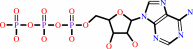 ATP
ATP
|
=
|
O-phospho-L-seryl-[protein]
|
+
|
 ADP
ADP
|
+
|
H(+)
|
|
|
|
|
|
|
L-threonyl-[protein]
|
+
|
ATP
|
=
|
O-phospho-L-threonyl-[protein]
|
+
|
ADP
|
+
|
H(+)
|
|
|
|
|
|
|
|
|
|
|
|
|
Molecule diagrams generated from .mol files obtained from the
KEGG ftp site
|
|
|
|
|
|
|
|
|
|
|
|
|
|
 |
|
|
|
|
|
|
| |
|
|
| |
|
DOI no:
|
Chem Biol
13:201-211
(2006)
|
|
PubMed id:
|
|
|
|
|
|
| |
|
Differential binding of inhibitors to active and inactive CDK2 provides insights for drug design.
|
|
G.Kontopidis,
C.McInnes,
S.R.Pandalaneni,
I.McNae,
D.Gibson,
M.Mezna,
M.Thomas,
G.Wood,
S.Wang,
M.D.Walkinshaw,
P.M.Fischer.
|
|
|
|
|
| |
ABSTRACT
|
|
|
|
| |
|
|
The cyclin-dependent kinases (CDKs) have been characterized in complex with a
variety of inhibitors, but the majority of structures solved are in the inactive
form. We have solved the structures of six inhibitors in both the monomeric CDK2
and binary CDK2/cyclinA complexes and demonstrate that significant differences
in ligand binding occur depending on the activation state. The binding mode of
two ligands in particular varies substantially in active and inactive CDK2.
Furthermore, energetic analysis of CDK2/cyclin/inhibitors demonstrates that a
good correlation exists between the in vitro potency and the calculated energies
of interaction, but no such relationship exists for CDK2/inhibitor structures.
These results confirm that monomeric CDK2 ligand complexes do not fully reflect
active conformations, revealing significant implications for inhibitor design
while also suggesting that the monomeric CDK2 conformation can be selectively
inhibited.
|
|
|
|
|
|
| |
Selected figure(s)
|
|
|
|
| |
|
|

|
|

|
|
Figure 2.
Figure 2. Richardson Diagram of the Overlay of Active and
Inactive apo-CDK2
(A) Active apo-CDK2 is shown in yellow;
inactive apo-CDK2 is shown in blue. The differences in the
orientation of the N and C domains and in the large movement of
the T-loop upon cyclin binding can be observed upon overlay of
the active and inactive structures from residues 170–285.
(B) Electron density difference maps (2F[o] − 1F[c]) in the
ATP binding site of the CDK2/cyclin A/4 complex.
|
|
Figure 3.
Figure 3. Crystal Structures of Ligands 1 and 4 Bound in
Active and Inactive CDK2
(A–C) The overlay shown is
residues 77–143 of the same inhibitor (yellow, active; blue,
inactive) and with the substituted aniline derivative 4 (yellow)
bound in (B) monomeric CDK2 (green) and (C) active (pink) CDK2.
|
|
|
|
|
|
| |
The above figures are
reprinted
by permission from Cell Press:
Chem Biol
(2006,
13,
201-211)
copyright 2006.
|
|
| |
Figures were
selected
by an automated process.
|
|
|
|
|
|
|
|
|
|
|
|
|
|
|
|
 |
 |
 |
|
Literature references that cite this PDB file's key reference
|
|
|
| |
PubMed id
|
|
Reference
|
|
|
|
|
|
A.De Biasio,
R.Sánchez,
J.Prieto,
M.Villate,
R.Campos-Olivas,
and
F.J.Blanco
(2011).
Reduced Stability and Increased Dynamics in the Human Proliferating Cell Nuclear Antigen (PCNA) Relative to the Yeast Homolog.
|
| |
PLoS One,
6,
e16600.
|
|
|
|
|
|
|
N.Zhang,
R.Zhong,
H.Yan,
and
Y.Jiang
(2011).
Structural features underlying selective inhibition of GSK3β by dibromocantharelline: implications for rational drug design.
|
| |
Chem Biol Drug Des,
77,
199-205.
|
|
|
|
|
|
|
G.Kontopidis,
M.J.Andrews,
C.McInnes,
A.Plater,
L.Innes,
S.Renachowski,
A.Cowan,
and
P.M.Fischer
(2009).
Truncation and optimisation of peptide inhibitors of cyclin-dependent kinase 2-cyclin a through structure-guided design.
|
| |
ChemMedChem,
4,
1120-1128.
|
|
|
PDB codes:
|
|
|
|
|
|
|
|
H.Zhang,
T.Zhang,
K.Chen,
S.Shen,
J.Ruan,
and
L.Kurgan
(2009).
On the relation between residue flexibility and local solvent accessibility in proteins.
|
| |
Proteins,
76,
617-636.
|
|
|
|
|
|
|
P.Taylor,
E.Blackburn,
Y.G.Sheng,
S.Harding,
K.Y.Hsin,
D.Kan,
S.Shave,
and
M.D.Walkinshaw
(2008).
Ligand discovery and virtual screening using the program LIDAEUS.
|
| |
Br J Pharmacol,
153,
S55-S67.
|
|
|
|
|
|
The most recent references are shown first.
Citation data come partly from CiteXplore and partly
from an automated harvesting procedure. Note that this is likely to be
only a partial list as not all journals are covered by
either method. However, we are continually building up the citation data
so more and more references will be included with time.
Where a reference describes a PDB structure, the PDB
codes are
shown on the right.
|
|
|


 Links
Links


