|
|
|
|
|
 |
Contents |
 |
|
|
|
|
|
|
|
|
* Residue conservation analysis
|
|
|
|
|
|
PDB id:
|
|
|
|
| Name: |
|
Protein binding
|
|
|
Title:
|
|
Solution structure of sumo-1 in complex with a sumo-binding motif (sbm)
|
|
Structure:
|
|
Small ubiquitin-related modifier 1. Chain: a. Fragment: structured region of sumo-1 (residues 21-97). Synonym: sumo-1, ubiquitin-like protein smt3c, smt3 homolog 3, ubiquitin-homology domain protein pic1, ubiquitin-like protein ubl1, gap modifying protein 1, gmp1, sentrin. Engineered: yes. Protein inhibitor of activated stat2. Chain: b.
|
|
Source:
|
|
Homo sapiens. Human. Organism_taxid: 9606. Gene: sumo1, smt3c, smt3h3, ubl1. Expressed in: escherichia coli. Expression_system_taxid: 562. Gene: pias2, piasx.
|
|
NMR struc:
|
|
10 models
|
|
|
Authors:
|
|
J.Song,Z.Zhang,W.Hu,Y.Chen
|
Key ref:

|
|
J.Song
et al.
(2005).
Small ubiquitin-like modifier (SUMO) recognition of a SUMO binding motif: a reversal of the bound orientation.
J Biol Chem,
280,
40122-40129.
PubMed id:
DOI:

|
|
|
Date:
|
|
|
23-Aug-05
|
Release date:
|
11-Oct-05
|
|
|
|
|
|
|
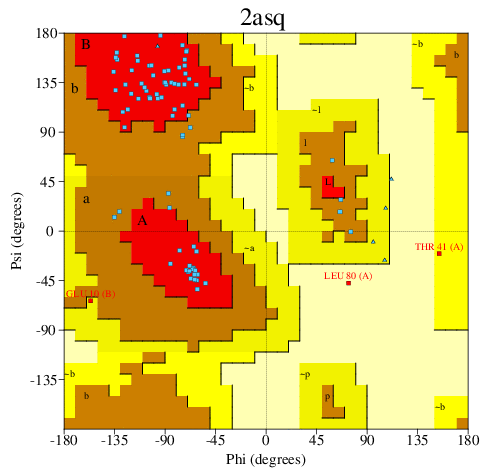
PROCHECK
|
|
|
|
|
|
Headers
|
|
|
|
References
|
|
|
|
|
|
|
|
|
|
|
|
Enzyme class 2:
|
|
Chain A:
E.C.?
|
|
|
|
|
|
|
Enzyme class 3:
|
|
Chain B:
E.C.2.3.2.-
- ?????
|
|
|
|
|
|
|
|
|
|
Note, where more than one E.C. class is given (as above), each may
correspond to a different protein domain or, in the case of polyprotein
precursors, to a different mature protein.
|
|
|
|
|
|
|
|
|
|
|
|
|
|
 |
|
|
|
|
|
|
| |
|
DOI no:
|
J Biol Chem
280:40122-40129
(2005)
|
|
PubMed id:
|
|
|
|
|
|
| |
|
Small ubiquitin-like modifier (SUMO) recognition of a SUMO binding motif: a reversal of the bound orientation.
|
|
J.Song,
Z.Zhang,
W.Hu,
Y.Chen.
|
|
|
|
|
| |
ABSTRACT
|
|
|
|
| |
|
|
Sumoylation has recently been identified as an important mechanism that
regulates protein interactions and localization in essential cellular functions,
such as gene transcription, subnuclear structure formation, viral infection, and
cell cycle progression. A SUMO binding amino acid sequence motif (SBM), which
recognizes the SUMO moiety of modified proteins in sumoylation-dependent
cellular functions, has been consistently identified by several recent studies.
To understand the mechanism of SUMO recognition by the SBM, we have solved the
solution structure of SUMO-1 in complex with a peptide containing the SBM
derived from the protein PIASX (KVDVIDLTIESSSDEEEDPPAKR). Surprisingly, the
structure reveals that the bound orientation of the SBM can reverse depending on
the sequence context. The structure also reveals a novel mechanism of
recognizing target sequences by a ubiquitin-like module. Unlike ubiquitin
binding motifs, which all form helices and bind to the main beta-sheet of
ubiquitin, the SBM forms an extended structure that binds between the
alpha-helix and a beta-strand of SUMO-1. This study provides a clear mechanism
of the SBM sequence variations and its recognition of the SUMO moiety in
sumoylated proteins.
|
|
|
|
|
|
| |
Selected figure(s)
|
|
|
|
| |
|
|

|
|

|
|
Figure 2.
FIGURE 2. Solution structure of the PIASX-P·SUMO-1
complex. A, stereo view of the superimposed C[  ]traces
of 10 NMR structures of the PIASX-P·SUMO-1 complex.
SUMO-1 is shown in deep pink, and residues 2-8 and other
residues of the PIASX-P peptide are shown in blue and orange,
respectively. B, stereo view of a ribbon diagram of a
representative structure from the ensemble of NMR structures in
the same orientation. The color code is the same as in A. ]traces
of 10 NMR structures of the PIASX-P·SUMO-1 complex.
SUMO-1 is shown in deep pink, and residues 2-8 and other
residues of the PIASX-P peptide are shown in blue and orange,
respectively. B, stereo view of a ribbon diagram of a
representative structure from the ensemble of NMR structures in
the same orientation. The color code is the same as in A.
|
|
Figure 3.
FIGURE 3. The binding interface of the
PIASX-P·SUMO-1 complex. A, stereo view of a ribbon
diagram of SUMO-1 (pink) in complex with the PIASX-P peptide
(light blue). The side chains of the key interface residues
(from which the intermolecular NOEs were observed) from SUMO-1
are shown in deep pink, and the side chains of residues of
PIASX-P involved in the interaction are shown in blue. B, a
similar view as that shown in A except that SUMO-1 is shown as a
surface representation with hydrophobic and aromatic residues
indicated in green. C, a similar view as in B with the surface
of SUMO-1 color-coded according to the electrostatic potentials.
Red to blue corresponds to negative to positive electrostatic
potentials. The side chains of residues 1-8 of the peptide are
shown with acidic side chains indicated in red, and basic side
chains indicated in blue. The side chains of all others residues
are indicated in green.
|
|
|
|
|
|
| |
The above figures are
reprinted
by permission from the ASBMB:
J Biol Chem
(2005,
280,
40122-40129)
copyright 2005.
|
|
| |
Figures were
selected
by an automated process.
|
|
|
|
|
|
|
|
|
|
|
|
|
|
|
|
 |
 |
 |
|
Literature references that cite this PDB file's key reference
|
|
|
| |
PubMed id
|
|
Reference
|
|
|
|
|
|
A.A.Armstrong,
F.Mohideen,
and
C.D.Lima
(2012).
Recognition of SUMO-modified PCNA requires tandem receptor motifs in Srs2.
|
| |
Nature,
483,
59-63.
|
|
|
PDB codes:
|
|
|
|
|
|
|
|
A.G.Murachelli,
J.Ebert,
C.Basquin,
H.Le Hir,
and
E.Conti
(2012).
The structure of the ASAP core complex reveals the existence of a Pinin-containing PSAP complex.
|
| |
Nat Struct Mol Biol,
19,
378-386.
|
|
|
PDB codes:
|
|
|
|
|
|
|
|
C.M.Hickey,
N.R.Wilson,
and
M.Hochstrasser
(2012).
Function and regulation of SUMO proteases.
|
| |
Nat Rev Mol Cell Biol,
13,
755-766.
|
|
|
|
|
|
|
A.Plechanovová,
E.G.Jaffray,
S.A.McMahon,
K.A.Johnson,
I.Navrátilová,
J.H.Naismith,
and
R.T.Hay
(2011).
Mechanism of ubiquitylation by dimeric RING ligase RNF4.
|
| |
Nat Struct Mol Biol,
18,
1052-1059.
|
|
|
PDB code:
|
|
|
|
|
|
|
|
C.C.Chang,
M.T.Naik,
Y.S.Huang,
J.C.Jeng,
P.H.Liao,
H.Y.Kuo,
C.C.Ho,
Y.L.Hsieh,
C.H.Lin,
N.J.Huang,
N.M.Naik,
C.C.Kung,
S.Y.Lin,
R.H.Chen,
K.S.Chang,
T.H.Huang,
and
H.M.Shih
(2011).
Structural and functional roles of Daxx SIM phosphorylation in SUMO paralog-selective binding and apoptosis modulation.
|
| |
Mol Cell,
42,
62-74.
|
|
|
PDB code:
|
|
|
|
|
|
|
|
C.Smet-Nocca,
J.M.Wieruszeski,
H.Léger,
S.Eilebrecht,
and
A.Benecke
(2011).
SUMO-1 regulates the conformational dynamics of Thymine-DNA Glycosylase regulatory domain and competes with its DNA binding activity.
|
| |
BMC Biochem,
12,
4.
|
|
|
|
|
|
|
C.V.Segré,
and
S.Chiocca
(2011).
Regulating the regulators: the post-translational code of class I HDAC1 and HDAC2.
|
| |
J Biomed Biotechnol,
2011,
690848.
|
|
|
|
|
|
|
R.N.Gilbreth,
K.Truong,
I.Madu,
A.Koide,
J.B.Wojcik,
N.S.Li,
J.A.Piccirilli,
Y.Chen,
and
S.Koide
(2011).
Isoform-specific monobody inhibitors of small ubiquitin-related modifiers engineered using structure-guided library design.
|
| |
Proc Natl Acad Sci U S A,
108,
7751-7756.
|
|
|
PDB code:
|
|
|
|
|
|
|
|
S.K.Mishra,
T.Ammon,
G.M.Popowicz,
M.Krajewski,
R.J.Nagel,
M.Ares,
T.A.Holak,
and
S.Jentsch
(2011).
Role of the ubiquitin-like protein Hub1 in splice-site usage and alternative splicing.
|
| |
Nature,
474,
173-178.
|
|
|
PDB codes:
|
|
|
|
|
|
|
|
T.Saether,
D.R.Pattabiraman,
A.H.Alm-Kristiansen,
L.T.Vogt-Kielland,
T.J.Gonda,
and
O.S.Gabrielsen
(2011).
A functional SUMO-interacting motif in the transactivation domain of c-Myb regulates its myeloid transforming ability.
|
| |
Oncogene,
30,
212-222.
|
|
|
|
|
|
|
A.F.Yousef,
G.J.Fonseca,
P.Pelka,
J.N.Ablack,
C.Walsh,
F.A.Dick,
D.P.Bazett-Jones,
G.S.Shaw,
and
J.S.Mymryk
(2010).
Identification of a molecular recognition feature in the E1A oncoprotein that binds the SUMO conjugase UBC9 and likely interferes with polySUMOylation.
|
| |
Oncogene,
29,
4693-4704.
|
|
|
|
|
|
|
C.W.Liew,
H.Sun,
T.Hunter,
and
C.L.Day
(2010).
RING domain dimerization is essential for RNF4 function.
|
| |
Biochem J,
431,
23-29.
|
|
|
PDB code:
|
|
|
|
|
|
|
|
J.C.Merrill,
T.A.Melhuish,
M.H.Kagey,
S.H.Yang,
A.D.Sharrocks,
and
D.Wotton
(2010).
A role for non-covalent SUMO interaction motifs in Pc2/CBX4 E3 activity.
|
| |
PLoS One,
5,
e8794.
|
|
|
|
|
|
|
J.M.Winget,
and
T.Mayor
(2010).
The diversity of ubiquitin recognition: hot spots and varied specificity.
|
| |
Mol Cell,
38,
627-635.
|
|
|
|
|
|
|
J.R.Gareau,
and
C.D.Lima
(2010).
The SUMO pathway: emerging mechanisms that shape specificity, conjugation and recognition.
|
| |
Nat Rev Mol Cell Biol,
11,
861-871.
|
|
|
|
|
|
|
S.Eilebrecht,
C.Smet-Nocca,
J.M.Wieruszeski,
and
A.Benecke
(2010).
SUMO-1 possesses DNA binding activity.
|
| |
BMC Res Notes,
3,
146.
|
|
|
|
|
|
|
S.H.Yang,
and
A.D.Sharrocks
(2010).
The SUMO E3 ligase activity of Pc2 is coordinated through a SUMO interaction motif.
|
| |
Mol Cell Biol,
30,
2193-2205.
|
|
|
|
|
|
|
Y.J.Li,
J.M.Stark,
D.J.Chen,
D.K.Ann,
and
Y.Chen
(2010).
Role of SUMO:SIM-mediated protein-protein interaction in non-homologous end joining.
|
| |
Oncogene,
29,
3509-3518.
|
|
|
|
|
|
|
Y.Xie,
E.M.Rubenstein,
T.Matt,
and
M.Hochstrasser
(2010).
SUMO-independent in vivo activity of a SUMO-targeted ubiquitin ligase toward a short-lived transcription factor.
|
| |
Genes Dev,
24,
893-903.
|
|
|
|
|
|
|
C.S.Seu,
and
Y.Chen
(2009).
Identification of SUMO-binding motifs by NMR.
|
| |
Methods Mol Biol,
497,
121-138.
|
|
|
|
|
|
|
M.B.Kroetz,
and
M.Hochstrasser
(2009).
Identification of SUMO-interacting proteins by yeast two-hybrid analysis.
|
| |
Methods Mol Biol,
497,
107-120.
|
|
|
|
|
|
|
M.C.Geoffroy,
and
R.T.Hay
(2009).
An additional role for SUMO in ubiquitin-mediated proteolysis.
|
| |
Nat Rev Mol Cell Biol,
10,
564-568.
|
|
|
|
|
|
|
M.Hochstrasser
(2009).
Origin and function of ubiquitin-like proteins.
|
| |
Nature,
458,
422-429.
|
|
|
|
|
|
|
M.M.Rytinki,
S.Kaikkonen,
P.Pehkonen,
T.Jääskeläinen,
and
J.J.Palvimo
(2009).
PIAS proteins: pleiotropic interactors associated with SUMO.
|
| |
Cell Mol Life Sci,
66,
3029-3041.
|
|
|
|
|
|
|
C.Ng,
R.A.Jackson,
J.P.Buschdorf,
Q.Sun,
G.R.Guy,
and
J.Sivaraman
(2008).
Structural basis for a novel intrapeptidyl H-bond and reverse binding of c-Cbl-TKB domain substrates.
|
| |
EMBO J,
27,
804-816.
|
|
|
PDB codes:
|
|
|
|
|
|
|
|
F.Mohideen,
and
C.D.Lima
(2008).
SUMO takes control of a ubiquitin-specific protease.
|
| |
Mol Cell,
30,
539-540.
|
|
|
|
|
|
|
J.J.Perry,
J.A.Tainer,
and
M.N.Boddy
(2008).
A SIM-ultaneous role for SUMO and ubiquitin.
|
| |
Trends Biochem Sci,
33,
201-208.
|
|
|
|
|
|
|
K.Thakar,
R.Niedenthal,
E.Okaz,
S.Franken,
A.Jakobs,
S.Gupta,
S.Kelm,
and
F.Dietz
(2008).
SUMOylation of the hepatoma-derived growth factor negatively influences its binding to chromatin.
|
| |
FEBS J,
275,
1411-1426.
|
|
|
|
|
|
|
P.Knipscheer,
A.Flotho,
H.Klug,
J.V.Olsen,
W.J.van Dijk,
A.Fish,
E.S.Johnson,
M.Mann,
T.K.Sixma,
and
A.Pichler
(2008).
Ubc9 sumoylation regulates SUMO target discrimination.
|
| |
Mol Cell,
31,
371-382.
|
|
|
PDB code:
|
|
|
|
|
|
|
|
Z.Tang,
C.M.Hecker,
A.Scheschonka,
and
H.Betz
(2008).
Protein interactions in the sumoylation cascade: lessons from X-ray structures.
|
| |
FEBS J,
275,
3003-3015.
|
|
|
|
|
|
|
A.D.Capili,
and
C.D.Lima
(2007).
Taking it step by step: mechanistic insights from structural studies of ubiquitin/ubiquitin-like protein modification pathways.
|
| |
Curr Opin Struct Biol,
17,
726-735.
|
|
|
|
|
|
|
A.V.Ivanov,
H.Peng,
V.Yurchenko,
K.L.Yap,
D.G.Negorev,
D.C.Schultz,
E.Psulkowski,
W.J.Fredericks,
D.E.White,
G.G.Maul,
M.J.Sadofsky,
M.M.Zhou,
and
F.J.Rauscher
(2007).
PHD domain-mediated E3 ligase activity directs intramolecular sumoylation of an adjacent bromodomain required for gene silencing.
|
| |
Mol Cell,
28,
823-837.
|
|
|
|
|
|
|
B.T.Dye,
and
B.A.Schulman
(2007).
Structural mechanisms underlying posttranslational modification by ubiquitin-like proteins.
|
| |
Annu Rev Biophys Biomol Struct,
36,
131-150.
|
|
|
|
|
|
|
D.M.Duda,
R.C.van Waardenburg,
L.A.Borg,
S.McGarity,
A.Nourse,
M.B.Waddell,
M.A.Bjornsti,
and
B.A.Schulman
(2007).
Structure of a SUMO-binding-motif mimic bound to Smt3p-Ubc9p: conservation of a non-covalent ubiquitin-like protein-E2 complex as a platform for selective interactions within a SUMO pathway.
|
| |
J Mol Biol,
369,
619-630.
|
|
|
PDB code:
|
|
|
|
|
|
|
|
H.Sun,
J.D.Leverson,
and
T.Hunter
(2007).
Conserved function of RNF4 family proteins in eukaryotes: targeting a ubiquitin ligase to SUMOylated proteins.
|
| |
EMBO J,
26,
4102-4112.
|
|
|
|
|
|
|
J.X.Du,
C.C.Yun,
A.Bialkowska,
and
V.W.Yang
(2007).
Protein inhibitor of activated STAT1 interacts with and up-regulates activities of the pro-proliferative transcription factor Krüppel-like factor 5.
|
| |
J Biol Chem,
282,
4782-4793.
|
|
|
|
|
|
|
K.Janssen,
T.G.Hofmann,
D.A.Jans,
R.T.Hay,
K.Schulze-Osthoff,
and
U.Fischer
(2007).
Apoptin is modified by SUMO conjugation and targeted to promyelocytic leukemia protein nuclear bodies.
|
| |
Oncogene,
26,
1557-1566.
|
|
|
|
|
|
|
N.Stankovic-Valentin,
S.Deltour,
J.Seeler,
S.Pinte,
G.Vergoten,
C.Guérardel,
A.Dejean,
and
D.Leprince
(2007).
An acetylation/deacetylation-SUMOylation switch through a phylogenetically conserved psiKXEP motif in the tumor suppressor HIC1 regulates transcriptional repression activity.
|
| |
Mol Cell Biol,
27,
2661-2675.
|
|
|
|
|
|
|
O.Kerscher
(2007).
SUMO junction-what's your function? New insights through SUMO-interacting motifs.
|
| |
EMBO Rep,
8,
550-555.
|
|
|
|
|
|
|
R.D.Mohan,
A.Rao,
J.Gagliardi,
and
M.Tini
(2007).
SUMO-1-dependent allosteric regulation of thymine DNA glycosylase alters subnuclear localization and CBP/p300 recruitment.
|
| |
Mol Cell Biol,
27,
229-243.
|
|
|
|
|
|
|
R.Geiss-Friedlander,
and
F.Melchior
(2007).
Concepts in sumoylation: a decade on.
|
| |
Nat Rev Mol Cell Biol,
8,
947-956.
|
|
|
|
|
|
|
S.Martin,
K.A.Wilkinson,
A.Nishimune,
and
J.M.Henley
(2007).
Emerging extranuclear roles of protein SUMOylation in neuronal function and dysfunction.
|
| |
Nat Rev Neurosci,
8,
948-959.
|
|
|
|
|
|
|
B.T.Seet,
I.Dikic,
M.M.Zhou,
and
T.Pawson
(2006).
Reading protein modifications with interaction domains.
|
| |
Nat Rev Mol Cell Biol,
7,
473-483.
|
|
|
|
|
|
|
H.Remaut,
and
G.Waksman
(2006).
Protein-protein interaction through beta-strand addition.
|
| |
Trends Biochem Sci,
31,
436-444.
|
|
|
|
|
|
|
H.V.Nguyen,
J.L.Chen,
J.Zhong,
K.J.Kim,
E.D.Crandall,
Z.Borok,
Y.Chen,
and
D.K.Ann
(2006).
SUMOylation attenuates sensitivity toward hypoxia- or desferroxamine-induced injury by modulating adaptive responses in salivary epithelial cells.
|
| |
Am J Pathol,
168,
1452-1463.
|
|
|
|
|
|
|
J.W.Harper,
and
B.A.Schulman
(2006).
Structural complexity in ubiquitin recognition.
|
| |
Cell,
124,
1133-1136.
|
|
|
|
|
|
|
L.Penengo,
M.Mapelli,
A.G.Murachelli,
S.Confalonieri,
L.Magri,
A.Musacchio,
P.P.Di Fiore,
S.Polo,
and
T.R.Schneider
(2006).
Crystal structure of the ubiquitin binding domains of rabex-5 reveals two modes of interaction with ubiquitin.
|
| |
Cell,
124,
1183-1195.
|
|
|
PDB codes:
|
|
|
|
|
|
|
|
O.Kerscher,
R.Felberbaum,
and
M.Hochstrasser
(2006).
Modification of proteins by ubiquitin and ubiquitin-like proteins.
|
| |
Annu Rev Cell Dev Biol,
22,
159-180.
|
|
|
|
|
|
|
R.Boggio,
and
S.Chiocca
(2006).
Viruses and sumoylation: recent highlights.
|
| |
Curr Opin Microbiol,
9,
430-436.
|
|
|
|
|
|
The most recent references are shown first.
Citation data come partly from CiteXplore and partly
from an automated harvesting procedure. Note that this is likely to be
only a partial list as not all journals are covered by
either method. However, we are continually building up the citation data
so more and more references will be included with time.
Where a reference describes a PDB structure, the PDB
codes are
shown on the right.
|
 |


 Links
Links