 |
PDBsum entry 2a91

|
|
|
|
|
|

|

|

|

|
|

|
|

|
|

|
|

|
|

|
|

|
|
|
 |

|

|
|
|
|
|
|
|
|
|
|
|
|
|
|
|
|
|
|
|
|
|
|
|
|
|
|
|
|
|
|
|
|
|
|
|
Signaling protein,transferase,membrane p
|
PDB id
|
|
|
|
2a91
|
|
|
|
|
|
|
|
|
|
|
|
|
|
|

|

|

|
|
|
|
|
|
|
|
 |
Contents |
 |
|
|
|
|
|
|
|
|
|
|
|
|
* Residue conservation analysis
|
|
|
|
|
|
PDB id:
|
|
|
|
| Name: |
|
Signaling protein,transferase,membrane p
|
|
|
Title:
|
|
Crystal structure of erbb2 domains 1-3
|
|
Structure:
|
|
Receptor tyrosine-protein kinase erbb-2. Chain: a. Fragment: residues 1-510 + flag peptide. Synonym: p185erbb2. C-erbb-2. Neu proto-oncogene. Tyrosine kinase- type cell surface receptor her2. Mln 19. Engineered: yes
|
|
Source:
|
|
Homo sapiens. Human. Organism_taxid: 9606. Gene: erbb2, her2, neu, ngl. Expressed in: cricetulus griseus. Expression_system_taxid: 10029. Expression_system_cell: hampster ovary cells.
|
|
Resolution:
|
|
|
2.50Å
|
R-factor:
|
0.226
|
R-free:
|
0.264
|
|
|
Authors:
|
|
T.P.J.Garrett,N.M.Mckern,M.Lou,T.C.Elleman,T.E.Adams,G.O.Lovrecz, M.Kofler,R.N.Jorissen,E.C.Nice,A.W.Burgess
|
Key ref:

|
|
T.P.Garrett
et al.
(2003).
The crystal structure of a truncated ErbB2 ectodomain reveals an active conformation, poised to interact with other ErbB receptors.
Mol Cell,
11,
495-505.
PubMed id:
DOI:

|
|
|
Date:
|
|
|
11-Jul-05
|
Release date:
|
26-Jul-05
|
|
|
|
|
|
|
PROCHECK
|

|
|
|
|
|
Headers
|
|
|
|
References
|
|
|
|
|
|

|
|
P04626
(ERBB2_HUMAN) -
Receptor tyrosine-protein kinase erbB-2 from Homo sapiens
|
|
|
|
Seq:
Struc:
|
|
|
|
1255 a.a.
506 a.a.*
|
|

|

|
|
|
|
|
|
|
|
|
|
|
|
Key: |
 |
PfamA domain |
|
|
 |
Secondary structure |
|
 |
CATH domain |
|
|
*
PDB and UniProt seqs differ
at 3 residue positions (black
crosses)
|
|
|
|
|
|
|
|
|
|
|
|
|
Enzyme class:
|
|
E.C.2.7.10.1
- receptor protein-tyrosine kinase.
|
|
|
|
|
|
|
Reaction:
|
|
L-tyrosyl-[protein] + ATP = O-phospho-L-tyrosyl-[protein] + ADP + H+
|
|
|
|
|
|
L-tyrosyl-[protein]
|
+
|
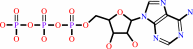 ATP
ATP
|
=
|
O-phospho-L-tyrosyl-[protein]
Bound ligand (Het Group name = )
matches with 41.38% similarity
|
+
|
 ADP
ADP
|
+
|
H(+)
|
|
|
|
|
|
|
|
|
|
|
|
|
Molecule diagrams generated from .mol files obtained from the
KEGG ftp site
|
|
|
|
|
|
|
|
|
|
|
|
|
|
 |
|
|
|
|
|
|
| |
|
|
| |
|
DOI no:
|
Mol Cell
11:495-505
(2003)
|
|
PubMed id:
|
|
|
|
|
|
| |
|
The crystal structure of a truncated ErbB2 ectodomain reveals an active conformation, poised to interact with other ErbB receptors.
|
|
T.P.Garrett,
N.M.McKern,
M.Lou,
T.C.Elleman,
T.E.Adams,
G.O.Lovrecz,
M.Kofler,
R.N.Jorissen,
E.C.Nice,
A.W.Burgess,
C.W.Ward.
|
|
|
|
|
| |
ABSTRACT
|
|
|
|
| |
|
|
ErbB2 does not bind ligand, yet appears to be the major signaling partner for
other ErbB receptors by forming heteromeric complexes with ErbB1, ErbB3, or
ErbB4. The crystal structure of residues 1-509 of ErbB2 at 2.5 A resolution
reveals an activated conformation similar to that of the EGFR when complexed
with ligand and very different from that seen in the unactivated forms of ErbB3
or EGFR. The structure explains the inability of ErbB2 to bind known ligands and
suggests why ErbB2 fails to form homodimers. Together, the data suggest a model
in which ErbB2 is already in the activated conformation and ready to interact
with other ligand-activated ErbB receptors.
|
|
|
|
|
|
| |
Selected figure(s)
|
|
|
|
| |
|
|

|
|

|
|
Figure 1.
Figure 1. Comparison of ErbB2(1–509) with sEGFR501 and
sErbB3(1–621)Helices are indicated by curled, red ribbons and
β strands by broad arrows. The blue, green, and yellow β
strands depict the three prominent parallel β sheets within the
L1 and L2 domains. The β strands in the cys-rich domains are
colored orange, except for those in the CR1 loop which are
colored brown. The side chains of disulfide-linked cysteine
residues are depicted as yellow sticks. Structure sources are:
sEGFR501 (Garrett et al., 2002); sErbB3 (Cho and Leahy, 2002).
Secondary structure for ErbB3 is as defined by the authors.
|
|
Figure 4.
Figure 4. Molecular Surfaces Showing Ligand Binding and L
Domain Contact Regions(A) The L1 domain contact residues are
colored red for atoms which contact ErbB2 L2, blue for atoms
equivalent to those in EGFR which bind TGFα, and purple for
atoms in both regions. Arg13 (yellow) lies in the overlap region
and would prevent ligand binding. The orientation of the L1
domain is shown in the insert ribbon diagram (bottom left),
colored as in Figure 1. Reference to Figure 2 allows the nature
of the contact residues and their location in the structure to
be identified.(B) The L2 domain contact residues are colored red
for atoms which contact ErbB2 L1 domain, blue for atoms
equivalent to those in EGFR, which bind TGFα, and purple for
atoms in both regions. The orientation of the L2 domain is shown
in the insert ribbon diagram (bottom center), colored as in
Figure 1. Reference to Figure 2 allows the nature of the contact
residues and their location in the structure to be identified.
|
|
|
|
|
|
| |
The above figures are
reprinted
by permission from Cell Press:
Mol Cell
(2003,
11,
495-505)
copyright 2003.
|
|
| |
Figures were
selected
by an automated process.
|
|
|
|
|
|
|
|
|
|
|
|
|
|
|
|
 |
 |
 |
|
Literature references that cite this PDB file's key reference
|
|
|
| |
PubMed id
|
|
Reference
|
|
|
|
|
|
Y.Yarden,
and
G.Pines
(2012).
The ERBB network: at last, cancer therapy meets systems biology.
|
| |
Nat Rev Cancer,
12,
553-563.
|
|
|
|
|
|
|
C.D.White,
Z.Li,
and
D.B.Sacks
(2011).
Calmodulin binds HER2 and modulates HER2 signaling.
|
| |
Biochim Biophys Acta,
1813,
1074-1082.
|
|
|
|
|
|
|
J.A.Forster,
A.B.Paul,
P.Harnden,
and
M.A.Knowles
(2011).
Expression of NRG1 and its receptors in human bladder cancer.
|
| |
Br J Cancer,
104,
1135-1143.
|
|
|
|
|
|
|
M.Godinho,
D.Meijer,
B.Setyono-Han,
L.C.Dorssers,
and
T.van Agthoven
(2011).
Characterization of BCAR4, a novel oncogene causing endocrine resistance in human breast cancer cells.
|
| |
J Cell Physiol,
226,
1741-1749.
|
|
|
|
|
|
|
A.B.Pfister,
R.C.Wood,
P.J.Salas,
D.L.Zea,
and
V.P.Ramsauer
(2010).
Early response to ErbB2 over-expression in polarized Caco-2 cells involves partial segregation from ErbB3 by relocalization to the apical surface and initiation of survival signaling.
|
| |
J Cell Biochem,
111,
643-652.
|
|
|
|
|
|
|
C.Eigenbrot,
M.Ultsch,
A.Dubnovitsky,
L.Abrahmsén,
and
T.Härd
(2010).
Structural basis for high-affinity HER2 receptor binding by an engineered protein.
|
| |
Proc Natl Acad Sci U S A,
107,
15039-15044.
|
|
|
PDB codes:
|
|
|
|
|
|
|
|
D.N.Amin,
N.Sergina,
D.Ahuja,
M.McMahon,
J.A.Blair,
D.Wang,
B.Hann,
K.M.Koch,
K.M.Shokat,
and
M.M.Moasser
(2010).
Resiliency and vulnerability in the HER2-HER3 tumorigenic driver.
|
| |
Sci Transl Med,
2,
16ra7.
|
|
|
|
|
|
|
E.Lantz,
I.Cunningham,
and
G.M.Higa
(2010).
Targeting HER2 in breast cancer: overview of long-term experience.
|
| |
Int J Womens Health,
1,
155-171.
|
|
|
|
|
|
|
F.J.Esteva,
D.Yu,
M.C.Hung,
and
G.N.Hortobagyi
(2010).
Molecular predictors of response to trastuzumab and lapatinib in breast cancer.
|
| |
Nat Rev Clin Oncol,
7,
98.
|
|
|
|
|
|
|
G.A.Kozloski,
C.A.Carraway,
and
K.L.Carraway
(2010).
Mechanistic and signaling analysis of Muc4-ErbB2 signaling module: new insights into the mechanism of ligand-independent ErbB2 activity.
|
| |
J Cell Physiol,
224,
649-657.
|
|
|
|
|
|
|
H.Chen,
G.Pimienta,
Y.Gu,
X.Sun,
J.Hu,
M.S.Kim,
R.Chaerkady,
M.Gucek,
R.N.Cole,
S.Sukumar,
and
A.Pandey
(2010).
Proteomic characterization of Her2/neu-overexpressing breast cancer cells.
|
| |
Proteomics,
10,
3800-3810.
|
|
|
|
|
|
|
J.H.Bae,
and
J.Schlessinger
(2010).
Asymmetric tyrosine kinase arrangements in activation or autophosphorylation of receptor tyrosine kinases.
|
| |
Mol Cells,
29,
443-448.
|
|
|
|
|
|
|
J.Monsey,
W.Shen,
P.Schlesinger,
and
R.Bose
(2010).
Her4 and Her2/neu tyrosine kinase domains dimerize and activate in a reconstituted in vitro system.
|
| |
J Biol Chem,
285,
7035-7044.
|
|
|
|
|
|
|
M.Hollmén,
and
K.Elenius
(2010).
Potential of ErbB4 antibodies for cancer therapy.
|
| |
Future Oncol,
6,
37-53.
|
|
|
|
|
|
|
N.Hedhli,
and
K.S.Russell
(2010).
Cytostatic drugs, neuregulin activation of erbB receptors, and angiogenesis.
|
| |
Curr Hypertens Rep,
12,
411-417.
|
|
|
|
|
|
|
P.Nagy,
J.Claus,
T.M.Jovin,
and
D.J.Arndt-Jovin
(2010).
Distribution of resting and ligand-bound ErbB1 and ErbB2 receptor tyrosine kinases in living cells using number and brightness analysis.
|
| |
Proc Natl Acad Sci U S A,
107,
16524-16529.
|
|
|
|
|
|
|
P.Paudyal,
B.Paudyal,
H.Hanaoka,
N.Oriuchi,
Y.Iida,
H.Yoshioka,
H.Tominaga,
S.Watanabe,
S.Watanabe,
N.S.Ishioka,
and
K.Endo
(2010).
Imaging and biodistribution of Her2/neu expression in non-small cell lung cancer xenografts with Cu-labeled trastuzumab PET.
|
| |
Cancer Sci,
101,
1045-1050.
|
|
|
|
|
|
|
P.Sanchez-Soria,
and
T.D.Camenisch
(2010).
ErbB signaling in cardiac development and disease.
|
| |
Semin Cell Dev Biol,
21,
929-935.
|
|
|
|
|
|
|
S.R.Wu,
T.S.Cheng,
W.C.Chen,
H.Y.Shyu,
C.J.Ko,
H.P.Huang,
C.H.Teng,
C.H.Lin,
M.D.Johnson,
C.Y.Lin,
and
M.S.Lee
(2010).
Matriptase is involved in ErbB-2-induced prostate cancer cell invasion.
|
| |
Am J Pathol,
177,
3145-3158.
|
|
|
|
|
|
|
D.Alvarado,
D.E.Klein,
and
M.A.Lemmon
(2009).
ErbB2 resembles an autoinhibited invertebrate epidermal growth factor receptor.
|
| |
Nature,
461,
287-291.
|
|
|
PDB code:
|
|
|
|
|
|
|
|
J.A.Freudenberg,
Q.Wang,
M.Katsumata,
J.Drebin,
I.Nagatomo,
and
M.I.Greene
(2009).
The role of HER2 in early breast cancer metastasis and the origins of resistance to HER2-targeted therapies.
|
| |
Exp Mol Pathol,
87,
1.
|
|
|
|
|
|
|
J.Barth,
C.Jackisch,
and
M.Untch
(2009).
Antibodies and Tyrosine Kinase Inhibitors in Breast Cancer Therapies.
|
| |
Breast Care (Basel),
4,
46-50.
|
|
|
|
|
|
|
J.Baselga,
and
S.M.Swain
(2009).
Novel anticancer targets: revisiting ERBB2 and discovering ERBB3.
|
| |
Nat Rev Cancer,
9,
463-475.
|
|
|
|
|
|
|
K.L.Carraway,
and
G.A.Kozloski
(2009).
Conformational changes in receptor tyrosine kinase signaling: an ErbB garden of delights.
|
| |
F1000 Biol Rep,
1,
1-4.
|
|
|
|
|
|
|
K.L.Carraway,
G.Theodoropoulos,
G.A.Kozloski,
and
C.A.Carothers Carraway
(2009).
Muc4/MUC4 functions and regulation in cancer.
|
| |
Future Oncol,
5,
1631-1640.
|
|
|
|
|
|
|
K.Pedersen,
P.D.Angelini,
S.Laos,
A.Bach-Faig,
M.P.Cunningham,
C.Ferrer-Ramón,
A.Luque-García,
J.García-Castillo,
J.L.Parra-Palau,
M.Scaltriti,
S.Ramón y Cajal,
J.Baselga,
and
J.Arribas
(2009).
A naturally occurring HER2 carboxy-terminal fragment promotes mammary tumor growth and metastasis.
|
| |
Mol Cell Biol,
29,
3319-3331.
|
|
|
|
|
|
|
K.R.Schmitz,
and
K.M.Ferguson
(2009).
Interaction of antibodies with ErbB receptor extracellular regions.
|
| |
Exp Cell Res,
315,
659-670.
|
|
|
|
|
|
|
M.A.Lemmon
(2009).
Ligand-induced ErbB receptor dimerization.
|
| |
Exp Cell Res,
315,
638-648.
|
|
|
|
|
|
|
M.Yamauchi,
and
N.Gotoh
(2009).
Theme: oncology--molecular mechanisms determining the efficacy of EGF receptor-specific tyrosine kinase inhibitors help to identify biomarker candidates.
|
| |
Biomark Med,
3,
139-151.
|
|
|
|
|
|
|
N.Yamamoto,
Y.Yamada,
Y.Fujiwara,
K.Yamada,
Y.Fujisaka,
T.Shimizu,
and
T.Tamura
(2009).
Phase I and pharmacokinetic study of HER2-targeted rhuMAb 2C4 (Pertuzumab, RO4368451) in Japanese patients with solid tumors.
|
| |
Jpn J Clin Oncol,
39,
260-266.
|
|
|
|
|
|
|
N.Zeng,
L.Liu,
M.G.McCabe,
D.T.Jones,
K.Ichimura,
and
V.P.Collins
(2009).
Real-time quantitative polymerase chain reaction (qPCR) analysis with fluorescence resonance energy transfer (FRET) probes reveals differential expression of the four ERBB4 juxtamembrane region variants between medulloblastoma and pilocytic astrocytoma.
|
| |
Neuropathol Appl Neurobiol,
35,
353-366.
|
|
|
|
|
|
|
P.Jin,
J.Zhang,
M.Beryt,
L.Turin,
C.Brdlik,
Y.Feng,
X.Bai,
J.Liu,
B.Jorgensen,
and
H.M.Shepard
(2009).
Rational optimization of a bispecific ligand trap targeting EGF receptor family ligands.
|
| |
Mol Med,
15,
11-20.
|
|
|
|
|
|
|
R.Bose,
and
X.Zhang
(2009).
The ErbB kinase domain: structural perspectives into kinase activation and inhibition.
|
| |
Exp Cell Res,
315,
649-658.
|
|
|
|
|
|
|
R.Knittelfelder,
A.B.Riemer,
and
E.Jensen-Jarolim
(2009).
Mimotope vaccination--from allergy to cancer.
|
| |
Expert Opin Biol Ther,
9,
493-506.
|
|
|
|
|
|
|
S.A.Perera,
D.Li,
T.Shimamura,
M.G.Raso,
H.Ji,
L.Chen,
C.L.Borgman,
S.Zaghlul,
K.A.Brandstetter,
S.Kubo,
M.Takahashi,
L.R.Chirieac,
R.F.Padera,
R.T.Bronson,
G.I.Shapiro,
H.Greulich,
M.Meyerson,
U.Guertler,
P.G.Chesa,
F.Solca,
I.I.Wistuba,
and
K.K.Wong
(2009).
HER2YVMA drives rapid development of adenosquamous lung tumors in mice that are sensitive to BIBW2992 and rapamycin combination therapy.
|
| |
Proc Natl Acad Sci U S A,
106,
474-479.
|
|
|
|
|
|
|
S.E.Telesco,
and
R.Radhakrishnan
(2009).
Atomistic insights into regulatory mechanisms of the HER2 tyrosine kinase domain: a molecular dynamics study.
|
| |
Biophys J,
96,
2321-2334.
|
|
|
|
|
|
|
T.Ben-Kasus,
B.Schechter,
S.Lavi,
Y.Yarden,
and
M.Sela
(2009).
Persistent elimination of ErbB-2/HER2-overexpressing tumors using combinations of monoclonal antibodies: relevance of receptor endocytosis.
|
| |
Proc Natl Acad Sci U S A,
106,
3294-3299.
|
|
|
|
|
|
|
W.H.Fry,
L.Kotelawala,
C.Sweeney,
and
K.L.Carraway
(2009).
Mechanisms of ErbB receptor negative regulation and relevance in cancer.
|
| |
Exp Cell Res,
315,
697-706.
|
|
|
|
|
|
|
A.E.Sirica
(2008).
Role of ErbB family receptor tyrosine kinases in intrahepatic cholangiocarcinoma.
|
| |
World J Gastroenterol,
14,
7033-7058.
|
|
|
|
|
|
|
C.Qiu,
M.K.Tarrant,
S.H.Choi,
A.Sathyamurthy,
R.Bose,
S.Banjade,
A.Pal,
W.G.Bornmann,
M.A.Lemmon,
P.A.Cole,
and
D.J.Leahy
(2008).
Mechanism of activation and inhibition of the HER4/ErbB4 kinase.
|
| |
Structure,
16,
460-467.
|
|
|
PDB codes:
|
|
|
|
|
|
|
|
D.J.Leahy
(2008).
A molecular view of anti-ErbB monoclonal antibody therapy.
|
| |
Cancer Cell,
13,
291-293.
|
|
|
|
|
|
|
G.Sithanandam,
and
L.M.Anderson
(2008).
The ERBB3 receptor in cancer and cancer gene therapy.
|
| |
Cancer Gene Ther,
15,
413-448.
|
|
|
|
|
|
|
J.M.Lafky,
J.A.Wilken,
A.T.Baron,
and
N.J.Maihle
(2008).
Clinical implications of the ErbB/epidermal growth factor (EGF) receptor family and its ligands in ovarian cancer.
|
| |
Biochim Biophys Acta,
1785,
232-265.
|
|
|
|
|
|
|
K.M.Ferguson
(2008).
Structure-based view of epidermal growth factor receptor regulation.
|
| |
Annu Rev Biophys,
37,
353-373.
|
|
|
|
|
|
|
K.Roepstorff,
L.Grøvdal,
M.Grandal,
M.Lerdrup,
and
B.van Deurs
(2008).
Endocytic downregulation of ErbB receptors: mechanisms and relevance in cancer.
|
| |
Histochem Cell Biol,
129,
563-578.
|
|
|
|
|
|
|
K.Sidera,
M.Gaitanou,
D.Stellas,
R.Matsas,
and
E.Patsavoudi
(2008).
A Critical Role for HSP90 in Cancer Cell Invasion Involves Interaction with the Extracellular Domain of HER-2.
|
| |
J Biol Chem,
283,
2031-2041.
|
|
|
|
|
|
|
M.J.Wieduwilt,
and
M.M.Moasser
(2008).
The epidermal growth factor receptor family: biology driving targeted therapeutics.
|
| |
Cell Mol Life Sci,
65,
1566-1584.
|
|
|
|
|
|
|
M.Landau,
and
N.Ben-Tal
(2008).
Dynamic equilibrium between multiple active and inactive conformations explains regulation and oncogenic mutations in ErbB receptors.
|
| |
Biochim Biophys Acta,
1785,
12-31.
|
|
|
|
|
|
|
O.Samna Soumana,
N.Garnier,
and
M.Genest
(2008).
Insight into the recognition patterns of the ErbB receptor family transmembrane domains: heterodimerization models through molecular dynamics search.
|
| |
Eur Biophys J,
37,
851-864.
|
|
|
|
|
|
|
P.Arora,
B.D.Cuevas,
A.Russo,
G.L.Johnson,
and
J.Trejo
(2008).
Persistent transactivation of EGFR and ErbB2/HER2 by protease-activated receptor-1 promotes breast carcinoma cell invasion.
|
| |
Oncogene,
27,
4434-4445.
|
|
|
|
|
|
|
S.Li,
P.Kussie,
and
K.M.Ferguson
(2008).
Structural basis for EGF receptor inhibition by the therapeutic antibody IMC-11F8.
|
| |
Structure,
16,
216-227.
|
|
|
PDB codes:
|
|
|
|
|
|
|
|
Y.X.Fan,
L.Wong,
J.Ding,
N.A.Spiridonov,
R.C.Johnson,
and
G.R.Johnson
(2008).
Mutational activation of ErbB2 reveals a new protein kinase autoinhibition mechanism.
|
| |
J Biol Chem,
283,
1588-1596.
|
|
|
|
|
|
|
A.Kolb,
J.Kleeff,
N.Arnold,
N.A.Giese,
T.Giese,
M.Korc,
and
H.Friess
(2007).
Expression and differential signaling of heregulins in pancreatic cancer cells.
|
| |
Int J Cancer,
120,
514-523.
|
|
|
|
|
|
|
C.W.Ward,
M.C.Lawrence,
V.A.Streltsov,
T.E.Adams,
and
N.M.McKern
(2007).
The insulin and EGF receptor structures: new insights into ligand-induced receptor activation.
|
| |
Trends Biochem Sci,
32,
129-137.
|
|
|
|
|
|
|
D.J.Riese,
R.M.Gallo,
and
J.Settleman
(2007).
Mutational activation of ErbB family receptor tyrosine kinases: insights into mechanisms of signal transduction and tumorigenesis.
|
| |
Bioessays,
29,
558-565.
|
|
|
|
|
|
|
D.Kedrin,
J.van Rheenen,
L.Hernandez,
J.Condeelis,
and
J.E.Segall
(2007).
Cell motility and cytoskeletal regulation in invasion and metastasis.
|
| |
J Mammary Gland Biol Neoplasia,
12,
143-152.
|
|
|
|
|
|
|
D.S.Hirsch,
and
W.J.Wu
(2007).
Cdc42: an effector and regulator of ErbB1 as a strategic target in breast cancer therapy.
|
| |
Expert Rev Anticancer Ther,
7,
147-157.
|
|
|
|
|
|
|
E.M.Bublil,
and
Y.Yarden
(2007).
The EGF receptor family: spearheading a merger of signaling and therapeutics.
|
| |
Curr Opin Cell Biol,
19,
124-134.
|
|
|
|
|
|
|
G.M.Higa,
and
J.Abraham
(2007).
Lapatinib in the treatment of breast cancer.
|
| |
Expert Rev Anticancer Ther,
7,
1183-1192.
|
|
|
|
|
|
|
H.Zhang,
A.Berezov,
Q.Wang,
G.Zhang,
J.Drebin,
R.Murali,
and
M.I.Greene
(2007).
ErbB receptors: from oncogenes to targeted cancer therapies.
|
| |
J Clin Invest,
117,
2051-2058.
|
|
|
|
|
|
|
J.P.Dawson,
Z.Bu,
and
M.A.Lemmon
(2007).
Ligand-induced structural transitions in ErbB receptor extracellular domains.
|
| |
Structure,
15,
942-954.
|
|
|
|
|
|
|
J.Ursini-Siegel,
B.Schade,
R.D.Cardiff,
and
W.J.Muller
(2007).
Insights from transgenic mouse models of ERBB2-induced breast cancer.
|
| |
Nat Rev Cancer,
7,
389-397.
|
|
|
|
|
|
|
L.Rittié,
S.Kansra,
S.W.Stoll,
Y.Li,
J.E.Gudjonsson,
Y.Shao,
L.E.Michael,
G.J.Fisher,
T.M.Johnson,
and
J.T.Elder
(2007).
Differential ErbB1 signaling in squamous cell versus basal cell carcinoma of the skin.
|
| |
Am J Pathol,
170,
2089-2099.
|
|
|
|
|
|
|
M.C.Fisher,
G.M.Clinton,
N.J.Maihle,
and
C.N.Dealy
(2007).
Requirement for ErbB2/ErbB signaling in developing cartilage and bone.
|
| |
Dev Growth Differ,
49,
503-513.
|
|
|
|
|
|
|
M.M.Moasser
(2007).
The oncogene HER2: its signaling and transforming functions and its role in human cancer pathogenesis.
|
| |
Oncogene,
26,
6469-6487.
|
|
|
|
|
|
|
M.M.Moasser
(2007).
Targeting the function of the HER2 oncogene in human cancer therapeutics.
|
| |
Oncogene,
26,
6577-6592.
|
|
|
|
|
|
|
N.V.Sergina,
and
M.M.Moasser
(2007).
The HER family and cancer: emerging molecular mechanisms and therapeutic targets.
|
| |
Trends Mol Med,
13,
527-534.
|
|
|
|
|
|
|
P.Liu,
T.Sudhaharan,
R.M.Koh,
L.C.Hwang,
S.Ahmed,
I.N.Maruyama,
and
T.Wohland
(2007).
Investigation of the dimerization of proteins from the epidermal growth factor receptor family by single wavelength fluorescence cross-correlation spectroscopy.
|
| |
Biophys J,
93,
684-698.
|
|
|
|
|
|
|
R.Landgraf
(2007).
HER2 therapy. HER2 (ERBB2): functional diversity from structurally conserved building blocks.
|
| |
Breast Cancer Res,
9,
202.
|
|
|
|
|
|
|
A.Badache,
and
A.Gonçalves
(2006).
The ErbB2 signaling network as a target for breast cancer therapy.
|
| |
J Mammary Gland Biol Neoplasia,
11,
13-25.
|
|
|
|
|
|
|
A.Citri,
and
Y.Yarden
(2006).
EGF-ERBB signalling: towards the systems level.
|
| |
Nat Rev Mol Cell Biol,
7,
505-516.
|
|
|
|
|
|
|
A.Negro,
B.K.Brar,
Y.Gu,
K.L.Peterson,
W.Vale,
and
K.F.Lee
(2006).
erbB2 is required for G protein-coupled receptor signaling in the heart.
|
| |
Proc Natl Acad Sci U S A,
103,
15889-15893.
|
|
|
|
|
|
|
A.Yasmeen,
T.A.Bismar,
and
A.E.Al Moustafa
(2006).
ErbB receptors and epithelial-cadherin-catenin complex in human carcinomas.
|
| |
Future Oncol,
2,
765-781.
|
|
|
|
|
|
|
C.M.Warren,
K.Kani,
and
R.Landgraf
(2006).
The N-terminal domains of neuregulin 1 confer signal attenuation.
|
| |
J Biol Chem,
281,
27306-27316.
|
|
|
|
|
|
|
C.Sweeney,
J.K.Miller,
D.L.Shattuck,
and
K.L.Carraway
(2006).
ErbB receptor negative regulatory mechanisms: implications in cancer.
|
| |
J Mammary Gland Biol Neoplasia,
11,
89-99.
|
|
|
|
|
|
|
C.W.Adams,
D.E.Allison,
K.Flagella,
L.Presta,
J.Clarke,
N.Dybdal,
K.McKeever,
and
M.X.Sliwkowski
(2006).
Humanization of a recombinant monoclonal antibody to produce a therapeutic HER dimerization inhibitor, pertuzumab.
|
| |
Cancer Immunol Immunother,
55,
717-727.
|
|
|
|
|
|
|
J.N.Contessa,
A.Abell,
R.B.Mikkelsen,
K.Valerie,
and
R.K.Schmidt-Ullrich
(2006).
Compensatory ErbB3/c-Src signaling enhances carcinoma cell survival to ionizing radiation.
|
| |
Breast Cancer Res Treat,
95,
17-27.
|
|
|
|
|
|
|
R.A.Stein,
and
J.V.Staros
(2006).
Insights into the evolution of the ErbB receptor family and their ligands from sequence analysis.
|
| |
BMC Evol Biol,
6,
79.
|
|
|
|
|
|
|
R.Mehra,
and
B.Burtness
(2006).
Antibody therapy for early-stage breast cancer: trastuzumab adjuvant and neoadjuvant trials.
|
| |
Expert Opin Biol Ther,
6,
951-962.
|
|
|
|
|
|
|
S.P.van der Woning,
W.van Rotterdam,
S.B.Nabuurs,
H.Venselaar,
S.Jacobs-Oomen,
M.Wingens,
G.Vriend,
C.Stortelers,
and
E.J.van Zoelen
(2006).
Negative constraints underlie the ErbB specificity of epidermal growth factor-like ligands.
|
| |
J Biol Chem,
281,
40033-40040.
|
|
|
|
|
|
|
T.S.Wehrman,
W.J.Raab,
C.L.Casipit,
R.Doyonnas,
J.H.Pomerantz,
and
H.M.Blau
(2006).
A system for quantifying dynamic protein interactions defines a role for Herceptin in modulating ErbB2 interactions.
|
| |
Proc Natl Acad Sci U S A,
103,
19063-19068.
|
|
|
|
|
|
|
V.P.Ramsauer,
V.Pino,
A.Farooq,
C.A.Carothers Carraway,
P.J.Salas,
and
K.L.Carraway
(2006).
Muc4-ErbB2 complex formation and signaling in polarized CACO-2 epithelial cells indicate that Muc4 acts as an unorthodox ligand for ErbB2.
|
| |
Mol Biol Cell,
17,
2931-2941.
|
|
|
|
|
|
|
X.Liu,
X.Gu,
Z.Li,
X.Li,
H.Li,
J.Chang,
P.Chen,
J.Jin,
B.Xi,
D.Chen,
D.Lai,
R.M.Graham,
and
M.Zhou
(2006).
Neuregulin-1/erbB-activation improves cardiac function and survival in models of ischemic, dilated, and viral cardiomyopathy.
|
| |
J Am Coll Cardiol,
48,
1438-1447.
|
|
|
|
|
|
|
A.H.Clayton,
F.Walker,
S.G.Orchard,
C.Henderson,
D.Fuchs,
J.Rothacker,
E.C.Nice,
and
A.W.Burgess
(2005).
Ligand-induced dimer-tetramer transition during the activation of the cell surface epidermal growth factor receptor-A multidimensional microscopy analysis.
|
| |
J Biol Chem,
280,
30392-30399.
|
|
|
|
|
|
|
B.S.Kochupurakkal,
D.Harari,
A.Di-Segni,
G.Maik-Rachline,
L.Lyass,
G.Gur,
G.Kerber,
A.Citri,
S.Lavi,
R.Eilam,
V.Chalifa-Caspi,
Z.Eshhar,
E.Pikarsky,
R.Pinkas-Kramarski,
S.S.Bacus,
and
Y.Yarden
(2005).
Epigen, the last ligand of ErbB receptors, reveals intricate relationships between affinity and mitogenicity.
|
| |
J Biol Chem,
280,
8503-8512.
|
|
|
|
|
|
|
C.Haslekås,
K.Breen,
K.W.Pedersen,
L.E.Johannessen,
E.Stang,
and
I.H.Madshus
(2005).
The inhibitory effect of ErbB2 on epidermal growth factor-induced formation of clathrin-coated pits correlates with retention of epidermal growth factor receptor-ErbB2 oligomeric complexes at the plasma membrane.
|
| |
Mol Biol Cell,
16,
5832-5842.
|
|
|
|
|
|
|
J.P.Dawson,
M.B.Berger,
C.C.Lin,
J.Schlessinger,
M.A.Lemmon,
and
K.M.Ferguson
(2005).
Epidermal growth factor receptor dimerization and activation require ligand-induced conformational changes in the dimer interface.
|
| |
Mol Cell Biol,
25,
7734-7742.
|
|
|
|
|
|
|
K.Choowongkomon,
C.R.Carlin,
and
F.D.Sönnichsen
(2005).
A structural model for the membrane-bound form of the juxtamembrane domain of the epidermal growth factor receptor.
|
| |
J Biol Chem,
280,
24043-24052.
|
|
|
PDB code:
|
|
|
|
|
|
|
|
N.E.Hynes,
and
H.A.Lane
(2005).
ERBB receptors and cancer: the complexity of targeted inhibitors.
|
| |
Nat Rev Cancer,
5,
341-354.
|
|
|
|
|
|
|
N.K.Dakappagari,
K.D.Lute,
S.Rawale,
J.T.Steele,
S.D.Allen,
G.Phillips,
R.T.Reilly,
and
P.T.Kaumaya
(2005).
Conformational HER-2/neu B-cell epitope peptide vaccine designed to incorporate two native disulfide bonds enhances tumor cell binding and antitumor activities.
|
| |
J Biol Chem,
280,
54-63.
|
|
|
|
|
|
|
P.Aller,
L.Voiry,
N.Garnier,
and
M.Genest
(2005).
Molecular dynamics (MD) investigations of preformed structures of the transmembrane domain of the oncogenic Neu receptor dimer in a DMPC bilayer.
|
| |
Biopolymers,
77,
184-197.
|
|
|
|
|
|
|
P.Bagossi,
G.Horváth,
G.Vereb,
J.Szöllösi,
and
J.Tözsér
(2005).
Molecular modeling of nearly full-length ErbB2 receptor.
|
| |
Biophys J,
88,
1354-1363.
|
|
|
|
|
|
|
S.Bouyain,
P.A.Longo,
S.Li,
K.M.Ferguson,
and
D.J.Leahy
(2005).
The extracellular region of ErbB4 adopts a tethered conformation in the absence of ligand.
|
| |
Proc Natl Acad Sci U S A,
102,
15024-15029.
|
|
|
PDB code:
|
|
|
|
|
|
|
|
A.Badache,
and
N.E.Hynes
(2004).
A new therapeutic antibody masks ErbB2 to its partners.
|
| |
Cancer Cell,
5,
299-301.
|
|
|
|
|
|
|
C.D.Austin,
A.M.De Mazière,
P.I.Pisacane,
S.M.van Dijk,
C.Eigenbrot,
M.X.Sliwkowski,
J.Klumperman,
and
R.H.Scheller
(2004).
Endocytosis and sorting of ErbB2 and the site of action of cancer therapeutics trastuzumab and geldanamycin.
|
| |
Mol Biol Cell,
15,
5268-5282.
|
|
|
|
|
|
|
D.Alvarado,
A.H.Rice,
and
J.B.Duffy
(2004).
Bipartite inhibition of Drosophila epidermal growth factor receptor by the extracellular and transmembrane domains of Kekkon1.
|
| |
Genetics,
167,
187-202.
|
|
|
|
|
|
|
F.Walker,
S.G.Orchard,
R.N.Jorissen,
N.E.Hall,
H.H.Zhang,
P.A.Hoyne,
T.E.Adams,
T.G.Johns,
C.Ward,
T.P.Garrett,
H.J.Zhu,
M.Nerrie,
A.M.Scott,
E.C.Nice,
and
A.W.Burgess
(2004).
CR1/CR2 interactions modulate the functions of the cell surface epidermal growth factor receptor.
|
| |
J Biol Chem,
279,
22387-22398.
|
|
|
|
|
|
|
M.C.Franklin,
K.D.Carey,
F.F.Vajdos,
D.J.Leahy,
A.M.de Vos,
and
M.X.Sliwkowski
(2004).
Insights into ErbB signaling from the structure of the ErbB2-pertuzumab complex.
|
| |
Cancer Cell,
5,
317-328.
|
|
|
PDB code:
|
|
|
|
|
|
|
|
T.Holbro,
and
N.E.Hynes
(2004).
ErbB receptors: directing key signaling networks throughout life.
|
| |
Annu Rev Pharmacol Toxicol,
44,
195-217.
|
|
|
|
|
|
|
A.W.Burgess,
H.S.Cho,
C.Eigenbrot,
K.M.Ferguson,
T.P.Garrett,
D.J.Leahy,
M.A.Lemmon,
M.X.Sliwkowski,
C.W.Ward,
and
S.Yokoyama
(2003).
An open-and-shut case? Recent insights into the activation of EGF/ErbB receptors.
|
| |
Mol Cell,
12,
541-552.
|
|
|
|
|
|
|
B.Power,
and
P.Hudson
(2003).
Keystone symposia: antibody-based therapeutics for cancer.
|
| |
Expert Opin Biol Ther,
3,
385-389.
|
|
|
|
|
|
|
M.Azemar,
S.Djahansouzi,
E.Jäger,
C.Solbach,
M.Schmidt,
A.B.Maurer,
K.Mross,
C.Unger,
G.von Minckwitz,
P.Dall,
B.Groner,
and
W.S.Wels
(2003).
Regression of cutaneous tumor lesions in patients intratumorally injected with a recombinant single-chain antibody-toxin targeted to ErbB2/HER2.
|
| |
Breast Cancer Res Treat,
82,
155-164.
|
|
|
|
|
|
The most recent references are shown first.
Citation data come partly from CiteXplore and partly
from an automated harvesting procedure. Note that this is likely to be
only a partial list as not all journals are covered by
either method. However, we are continually building up the citation data
so more and more references will be included with time.
Where a reference describes a PDB structure, the PDB
codes are
shown on the right.
|
|


 Links
Links


