 |
PDBsum entry 2r2t

|
|
|
|
|
|

|

|

|

|
|

|
|

|
|

|
|
|
 |

|

|
|
|
|
|
|
|
|
|
|
|
|
|
|
|
|
|
|
|
|
|
|
|
|
|
|
|
|
|
|
|
|
Transferase/DNA
|
PDB id
|
|
|
|
2r2t
|
|
|
|
|
|
|
|
|
|
|
|
|
|
|

|

|

|
|
|
|
|
|
|
|
 |
Contents |
 |
|
|
|
|
|
|
|
|
|
|
|
|
* Residue conservation analysis
|
|
|
|
|
|
|
|
|
|
|
Enzyme class 2:
|
|
E.C.2.7.7.-
- ?????
|
|
|
|
|
|
|
Enzyme class 3:
|
|
E.C.2.7.7.49
- RNA-directed Dna polymerase.
|
|
|
|
|
|
|
Reaction:
|
|
DNA(n) + a 2'-deoxyribonucleoside 5'-triphosphate = DNA(n+1) + diphosphate
|
|
|
|
|
|
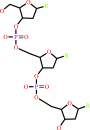 DNA(n)
|
+
|
2'-deoxyribonucleoside 5'-triphosphate
|
=
|
DNA(n+1)
|
+
|
 diphosphate
|
|
|
|
|
|
|
|
|
|
Enzyme class 4:
|
|
E.C.2.7.7.7
- DNA-directed Dna polymerase.
|
|
|
|
|
|
|
Reaction:
|
|
DNA(n) + a 2'-deoxyribonucleoside 5'-triphosphate = DNA(n+1) + diphosphate
|
|
|
|
|
|
DNA(n)
|
+
|
2'-deoxyribonucleoside 5'-triphosphate
|
=
|
DNA(n+1)
|
+
|
diphosphate
|
|
|
|
|
|
|
|
|
|
Enzyme class 5:
|
|
E.C.3.1.-.-
|
|
|
|
|
|
|
Enzyme class 6:
|
|
E.C.3.1.26.4
- ribonuclease H.
|
|
|
|
|
|
|
Reaction:
|
|
Endonucleolytic cleavage to 5'-phosphomonoester.
|
|
|
|
|
|
Enzyme class 7:
|
|
E.C.3.4.23.-
- ?????
|
|
|
|
|
|
|
|
|
|
Note, where more than one E.C. class is given (as above), each may
correspond to a different protein domain or, in the case of polyprotein
precursors, to a different mature protein.
|
|
|
|
Molecule diagrams generated from .mol files obtained from the
KEGG ftp site
|
|
|
|
|
|
|
|
|
|
|
|
|
|
 |
|
|
|
|
|
|
| |
|
|
| |
|
DOI no:
|
Proc Natl Acad Sci U S A
105:5052-5056
(2008)
|
|
PubMed id:
|
|
|
|
|
|
| |
|
Crystal structure of DNA-bound Co(III) bleomycin B2: Insights on intercalation and minor groove binding.
|
|
K.D.Goodwin,
M.A.Lewis,
E.C.Long,
M.M.Georgiadis.
|
|
|
|
|
| |
ABSTRACT
|
|
|
|
| |
|
|
Bleomycins constitute a widely studied class of complex DNA cleaving natural
products that are used to treat various cancers. Since their first isolation,
the bleomycins have provided a paradigm for the development and discovery of
additional DNA-cleaving chemotherapeutic agents. The bleomycins consist of a
disaccharide-modified metal-binding domain connected to a bithiazole/C-terminal
tail via a methylvalerate-Thr linker and induce DNA damage after oxygen
activation through site-selective cleavage of duplex DNA at 5'-GT/C sites. Here,
we present crystal structures of two different 5'-GT containing oligonucleotides
in both the presence and absence of bound Co(III).bleomycin B(2). Several
findings from our studies impact the current view of bleomycin binding to DNA.
First, we report that the bithiazole intercalates in two distinct modes and can
do so independently of well ordered minor groove binding of the metal
binding/disaccharide domains. Second, the Co(III)-coordinating equatorial
ligands in our structure include the imidazole, histidine amide, pyrimidine N1,
and the secondary amine of the beta aminoalanine, whereas the primary amine acts
as an axial ligand. Third, minor groove binding of Co(III).bleomycin involves
direct hydrogen bonding interactions of the metal binding domain and
disaccharide with the DNA. Finally, modeling of a hydroperoxide ligand
coordinated to Co(III) suggests that it is ideally positioned for initiation of
C4'-H abstraction.
|
|
|
|
|
|
| |
Selected figure(s)
|
|
|
|
| |
|
|

|
|

|
|
Figure 4.
Interactions of the bithiazole/C-terminal tail and linker
with the DNA. (A) Stereodiagram of 1 with DNA (gray) and
intercalated bithiazole/C-terminal tail (blue) and linker (red)
as a ball-and-stick model with waters (magenta) that contribute
to bithiazole/C-terminal tail positioning. Hydrogen bonds
represented as black dashed lines. Oxygen atoms in red (DNA) or
pink (BLM) and nitrogen atoms in blue (DNA) or cyan
(Co·BLM) are involved in H-bonding. Sulfur atoms are
yellow. (B) Superimposed 1 (gray) and 2 (black) 5′-GTT sites
with intercalated bithiazole/C-terminal tails (1, blue; 2,
orange) and relevant water from 1 (magenta) (rmsd of 5′-GT
base pairs = 0.54 Å).
|
|
Figure 5.
Interactions of the metal-binding domain and disaccharide
with the DNA. (A) Stereodiagram of the minor groove of DNA
(gray) shown with the metal-binding (yellow with Co in green)
and disaccharide (purple) domains and a modeled peroxide ligand
(cyan) as a ball-and-stick model. Hydrogen bonds are represented
as dashed lines with interacting O atoms in red and N atoms in
blue. Intermolecular bonds are black, intramolecular bonds are
blue, and magenta bonds represent interactions of the
propionamide as modeled (the propioanamide is absent in electron
density). The red stick indicates the connection to the linker
domain. (B) Schematic showing the hydrogen-bonding interactions
of the metal-binding and disaccharide domains in the minor
groove with bonds colored as in A.
|
|
|
|
| |
Figures were
selected
by an automated process.
|
|
|
|
|
|
|
|
|
|
|
|
|
|
|
|
 |
 |
 |
|
Literature references that cite this PDB file's key reference
|
|
|
| |
PubMed id
|
|
Reference
|
|
|
|
|
|
L.V.Liu,
C.B.Bell,
S.D.Wong,
S.A.Wilson,
Y.Kwak,
M.S.Chow,
J.Zhao,
K.O.Hodgson,
B.Hedman,
and
E.I.Solomon
(2010).
Definition of the intermediates and mechanism of the anticancer drug bleomycin using nuclear resonance vibrational spectroscopy and related methods.
|
| |
Proc Natl Acad Sci U S A,
107,
22419-22424.
|
|
|
|
|
|
|
M.Tao,
L.Wang,
E.Wendt-Pienkowski,
N.Zhang,
D.Yang,
U.Galm,
J.M.Coughlin,
Z.Xu,
and
B.Shen
(2010).
Functional characterization of tlmH in Streptoalloteichus hindustanus E465-94 ATCC 31158 unveiling new insight into tallysomycin biosynthesis and affording a novel bleomycin analog.
|
| |
Mol Biosyst,
6,
349-356.
|
|
|
|
|
|
|
Q.Li,
T.A.van den Berg,
B.L.Feringa,
and
G.Roelfes
(2010).
Mononuclear Fe(II)-N4Py complexes in oxidative DNA cleavage: structure, activity and mechanism.
|
| |
Dalton Trans,
39,
8012-8021.
|
|
|
|
|
|
|
L.S.Glass,
B.Nguyen,
K.D.Goodwin,
C.Dardonville,
W.D.Wilson,
E.C.Long,
and
M.M.Georgiadis
(2009).
Crystal structure of a trypanocidal 4,4'-bis(imidazolinylamino)diphenylamine bound to DNA.
|
| |
Biochemistry,
48,
5943-5952.
|
|
|
PDB code:
|
|
|
|
|
|
|
|
L.Wang,
M.Tao,
E.Wendt-Pienkoski,
U.Galm,
J.M.Coughlin,
and
B.Shen
(2009).
Functional characterization of tlmK unveiling unstable carbinolamide intermediates in the tallysomycin biosynthetic pathway.
|
| |
J Biol Chem,
284,
8256-8264.
|
|
|
|
|
|
|
X.Zhang,
L.Chen,
X.C.Fei,
Y.S.Ma,
and
H.W.Gao
(2009).
Binding of PFOS to serum albumin and DNA: insight into the molecular toxicity of perfluorochemicals.
|
| |
BMC Mol Biol,
10,
16.
|
|
|
|
|
|
|
U.Galm,
L.Wang,
E.Wendt-Pienkowski,
R.Yang,
W.Liu,
M.Tao,
J.M.Coughlin,
and
B.Shen
(2008).
In vivo manipulation of the bleomycin biosynthetic gene cluster in Streptomyces verticillus ATCC15003 revealing new insights into its biosynthetic pathway.
|
| |
J Biol Chem,
283,
28236-28245.
|
|
|
|
|
|
The most recent references are shown first.
Citation data come partly from CiteXplore and partly
from an automated harvesting procedure. Note that this is likely to be
only a partial list as not all journals are covered by
either method. However, we are continually building up the citation data
so more and more references will be included with time.
Where a reference describes a PDB structure, the PDB
code is
shown on the right.
|
|


 Links
Links


