 |
PDBsum entry 2hny

|
|
|
|
|
 |
Contents |
 |
|
|
|
|
|
|
|
|
|
|
|
|
|
|
* Residue conservation analysis
|
|
|
|
|
|
|
|
|
|
Enzyme class 1:
|
|
Chains A, B:
E.C.2.7.7.-
- ?????
|
|
|
|
|
|
|
Enzyme class 2:
|
|
Chains A, B:
E.C.2.7.7.49
- RNA-directed Dna polymerase.
|
|
|
|
|
|
|
Reaction:
|
|
DNA(n) + a 2'-deoxyribonucleoside 5'-triphosphate = DNA(n+1) + diphosphate
|
|
|
|
|
|
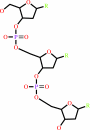 DNA(n)
|
+
|
2'-deoxyribonucleoside 5'-triphosphate
|
=
|
DNA(n+1)
Bound ligand (Het Group name = )
matches with 55.56% similarity
|
+
|
 diphosphate
|
|
|
|
|
|
|
|
|
|
Enzyme class 3:
|
|
Chains A, B:
E.C.2.7.7.7
- DNA-directed Dna polymerase.
|
|
|
|
|
|
|
Reaction:
|
|
DNA(n) + a 2'-deoxyribonucleoside 5'-triphosphate = DNA(n+1) + diphosphate
|
|
|
|
|
|
DNA(n)
|
+
|
2'-deoxyribonucleoside 5'-triphosphate
|
=
|
DNA(n+1)
Bound ligand (Het Group name = )
matches with 55.56% similarity
|
+
|
diphosphate
|
|
|
|
|
|
|
|
|
|
Enzyme class 4:
|
|
Chains A, B:
E.C.3.1.-.-
|
|
|
|
|
|
|
Enzyme class 5:
|
|
Chains A, B:
E.C.3.1.13.2
- exoribonuclease H.
|
|
|
|
|
|
|
Reaction:
|
|
Exonucleolytic cleavage to 5'-phosphomonoester oligonucleotides in both 5'- to 3'- and 3'- to 5'-directions.
|
|
|
|
|
|
Enzyme class 6:
|
|
Chains A, B:
E.C.3.1.26.13
- retroviral ribonuclease H.
|
|
|
|
|
|
|
Enzyme class 7:
|
|
Chains A, B:
E.C.3.4.23.16
- HIV-1 retropepsin.
|
|
|
|
|
|
|
Reaction:
|
|
Specific for a P1 residue that is hydrophobic, and P1' variable, but often Pro.
|
|
|
|
|
|
|
|
|
Note, where more than one E.C. class is given (as above), each may
correspond to a different protein domain or, in the case of polyprotein
precursors, to a different mature protein.
|
|
|
|
Molecule diagrams generated from .mol files obtained from the
KEGG ftp site
|
|
|
|
|
|
|
|
|
|
|
|
|
|
 |
|
|
|
|
|
|
| |
|
|
| |
|
DOI no:
|
FEBS J
273:3850-3860
(2006)
|
|
PubMed id:
|
|
|
|
|
|
| |
|
Structural insights into mechanisms of non-nucleoside drug resistance for HIV-1 reverse transcriptases mutated at codons 101 or 138.
|
|
J.Ren,
C.E.Nichols,
A.Stamp,
P.P.Chamberlain,
R.Ferris,
K.L.Weaver,
S.A.Short,
D.K.Stammers.
|
|
|
|
|
| |
ABSTRACT
|
|
|
|
| |
|
|
Lys101Glu is a drug resistance mutation in reverse transcriptase clinically
observed in HIV-1 from infected patients treated with the non-nucleoside
inhibitor (NNRTI) drugs nevirapine and efavirenz. In contrast to many NNRTI
resistance mutations, Lys101(p66 subunit) is positioned at the surface of the
NNRTI pocket where it interacts across the reverse transcriptase (RT) subunit
interface with Glu138(p51 subunit). However, nevirapine contacts Lys101 and
Glu138 only indirectly, via water molecules, thus the structural basis of drug
resistance induced by Lys101Glu is unclear. We have determined crystal
structures of RT(Glu138Lys) and RT(Lys101Glu) in complexes with nevirapine to
2.5 A, allowing the determination of water structure within the NNRTI-binding
pocket, essential for an understanding of nevirapine binding. Both RT(Glu138Lys)
and RT(Lys101Glu) have remarkably similar protein conformations to wild-type RT,
except for significant movement of the mutated side-chains away from the NNRTI
pocket induced by charge inversion. There are also small shifts in the position
of nevirapine for both mutant structures which may influence ring stacking
interactions with Tyr181. However, the reduction in hydrogen bonds in the
drug-water-side-chain network resulting from the mutated side-chain movement
appears to be the most significant contribution to nevirapine resistance for
RT(Lys101Glu). The movement of Glu101 away from the NNRTI pocket can also
explain the resistance of RT(Lys101Glu) to efavirenz but in this case is due to
a loss of side-chain contacts with the drug. RT(Lys101Glu) is thus a distinctive
NNRTI resistance mutant in that it can give rise to both direct and indirect
mechanisms of drug resistance, which are inhibitor-dependent.
|
|
|
|
|
|
| |
Selected figure(s)
|
|
|
|
| |
|
|

|
|

|
|
Figure 1.
Fig. 1. Simulated annealing omit electron density maps
contoured at 3.5  showing bound
inhibitors, waters and mutated residues within one of the HIV-1
RT subunits as indicated. (A) Lys101Glu in p66 and nevirapine.
(B) Glu138Lys in p51 and nevirapine. (C) Glu138Lys in p51 and
PETT-2. showing bound
inhibitors, waters and mutated residues within one of the HIV-1
RT subunits as indicated. (A) Lys101Glu in p66 and nevirapine.
(B) Glu138Lys in p51 and nevirapine. (C) Glu138Lys in p51 and
PETT-2.
|
|
Figure 2.
Fig. 2. Stereo-diagrams comparing the NNRTI binding sites
of wild-type and mutant RTs for the following complexes: (A)
Lys101Glu and nevirapine, (B) Glu138Lys and nevirapine, and (C)
Glu138Lys and PETT-2. The thinner and thicker bonds show the CA
backbone and side-chains with wild-type RT coloured orange and
the mutant RTs coloured blue, respectively. Inhibitors and water
molecules are shown in ball-and-stick representation and
coloured red for wild-type RT and cyan for mutant RTs. For
clarity, the side-chains at the site of mutation are shown in
magenta for wild-type and green for the mutants. Hydrogen bonds
linking drug to protein and drug to water molecules are marked
in dashed lines, coloured yellow for wild-type and blue for
mutant RTs.
|
|
|
|
|
|
| |
The above figures are
reprinted
by permission from the Federation of European Biochemical Societies:
FEBS J
(2006,
273,
3850-3860)
copyright 2006.
|
|
|
|
|
|
|
|
|
|
|
|
|
|
 |
 |
 |
|
Literature references that cite this PDB file's key reference
|
|
|
| |
PubMed id
|
|
Reference
|
|
|
|
|
|
K.Singh,
B.Marchand,
K.A.Kirby,
E.Michailidis,
and
S.G.Sarafianos
(2010).
Structural Aspects of Drug Resistance and Inhibition of HIV-1 Reverse Transcriptase.
|
| |
Viruses,
2,
606-638.
|
|
|
|
|
|
|
R.K.Raju,
N.A.Burton,
and
I.H.Hillier
(2010).
Modelling the binding of HIV-reverse transcriptase and nevirapine: an assessment of quantum mechanical and force field approaches and predictions of the effect of mutations on binding.
|
| |
Phys Chem Chem Phys,
12,
7117-7125.
|
|
|
|
|
|
|
R.M.Kagan,
P.Sista,
T.Pattery,
L.Bacheler,
and
D.A.Schwab
(2009).
Additional HIV-1 mutation patterns associated with reduced phenotypic susceptibility to etravirine in clinical samples.
|
| |
AIDS,
23,
1602-1605.
|
|
|
|
|
|
The most recent references are shown first.
Citation data come partly from CiteXplore and partly
from an automated harvesting procedure. Note that this is likely to be
only a partial list as not all journals are covered by
either method. However, we are continually building up the citation data
so more and more references will be included with time.
|
|
|


 Links
Links


