
|
|
|
|
|
 |
Contents |
 |
|
|
|
|
|
|
|
|
|
|
|
|
|
|
* Residue conservation analysis
|
|
|
|
|
|
|
|
|
|
Enzyme class 2:
|
|
Chains A, B:
E.C.2.7.7.7
- DNA-directed Dna polymerase.
|
|
|
|
|
|
|
Reaction:
|
|
DNA(n) + a 2'-deoxyribonucleoside 5'-triphosphate = DNA(n+1) + diphosphate
|
|
|
|
|
|
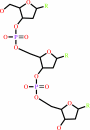 DNA(n)
|
+
|
2'-deoxyribonucleoside 5'-triphosphate
|
=
|
DNA(n+1)
|
+
|
 diphosphate
|
|
|
|
|
|
|
|
|
|
Enzyme class 3:
|
|
Chains A, B:
E.C.3.1.26.4
- ribonuclease H.
|
|
|
|
|
|
|
Reaction:
|
|
Endonucleolytic cleavage to 5'-phosphomonoester.
|
|
|
|
|
|
|
|
|
Note, where more than one E.C. class is given (as above), each may
correspond to a different protein domain or, in the case of polyprotein
precursors, to a different mature protein.
|
|
|
|
Molecule diagrams generated from .mol files obtained from the
KEGG ftp site
|
|
|
|
|
|
|
|
|
|
|
|
|
|
 |
|
|
|
|
|
|
| |
|
|
| |
|
DOI no:
|
J Biol Chem
281:18193-18200
(2006)
|
|
PubMed id:
|
|
|
|
|
|
| |
|
Crystal structure of the herpes simplex virus 1 DNA polymerase.
|
|
S.Liu,
J.D.Knafels,
J.S.Chang,
G.A.Waszak,
E.T.Baldwin,
M.R.Deibel,
D.R.Thomsen,
F.L.Homa,
P.A.Wells,
M.C.Tory,
R.A.Poorman,
H.Gao,
X.Qiu,
A.P.Seddon.
|
|
|
|
|
| |
ABSTRACT
|
|
|
|
| |
|
|
Herpesviruses are the second leading cause of human viral diseases. Herpes
Simplex Virus types 1 and 2 and Varicella-zoster virus produce neurotropic
infections such as cutaneous and genital herpes, chickenpox, and shingles.
Infections of a lymphotropic nature are caused by cytomegalovirus, HSV-6, HSV-7,
and Epstein-Barr virus producing lymphoma, carcinoma, and congenital
abnormalities. Yet another series of serious health problems are posed by
infections in immunocompromised individuals. Common therapies for herpes viral
infections employ nucleoside analogs, such as Acyclovir, and target the viral
DNA polymerase, essential for viral DNA replication. Although clinically useful,
this class of drugs exhibits a narrow antiviral spectrum, and resistance to
these agents is an emerging problem for disease management. A better
understanding of herpes virus replication will help the development of new safe
and effective broad spectrum anti-herpetic drugs that fill an unmet need. Here,
we present the first crystal structure of a herpesvirus polymerase, the Herpes
Simplex Virus type 1 DNA polymerase, at 2.7 A resolution. The structural
similarity of this polymerase to other alpha polymerases has allowed us to
construct high confidence models of a replication complex of the polymerase and
of Acyclovir as a DNA chain terminator. We propose a novel inhibition mechanism
in which a representative of a series of non-nucleosidic viral polymerase
inhibitors, the 4-oxo-dihydroquinolines, binds at the polymerase active site
interacting non-covalently with both the polymerase and the DNA duplex.
|
|
|
|
|
|
| |
Selected figure(s)
|
|
|
|
| |
|
|

|
|

|
|
Figure 2.
FIGURE 2. Unique functional domains of herpes simplex 1 DNA
polymerase. A, a ribbon diagram of the pre-NH[2]-terminal domain
in cyan, with electrostatic surface representation of the
putative single-stranded DNA binding groove. For clarity, only
surfaces from NH[2]-terminal and exonuclease domains are shown.
The DNA duplex is modeled. B, ribbon diagram of the
NH[2]-terminal domain embedded in the electrostatic surface
representation to show the putative RNA binding cleft. The   motif is
on the left. motif is
on the left.
|
|
Figure 3.
FIGURE 3. HSV POL replicating and inhibiting model. A,
replicating model. The carbon atoms of HSV POL shown in stick
are light gray, whereas those of primer DNA strand and dTTP are
dark gray and those of the template are purple. Black dashed
lines are shown for hydrogen bonds and ion interactions
involving the incoming nucleotide and catalytic ions. B, model
of Acyclovir·HSV POL dead-end complex. Hydrogen bonds
involving Acyclovir are shown in black dashes. Key residues
interacting with the Acyclovir-incorporated DNA, including the
conserved KKKY motif (938-941), are shown. C, chemical structure
of PNU-183792, a 4-oxo-DHQ type of herpes polymerase inhibitor.
D, a novel inhibition mechanism of a family of broad spectrum
inhibitor 4-oxo-DHQ. Residues interacting with inhibitor are
highlighted.
|
|
|
|
|
|
| |
The above figures are
reprinted
by permission from the ASBMB:
J Biol Chem
(2006,
281,
18193-18200)
copyright 2006.
|
|
| |
Figures were
selected
by the author.
|
|
|
|
|
|
|
|
|
|
|
|
|
|
|
|
 |
 |
 |
|
Literature references that cite this PDB file's key reference
|
|
|
| |
PubMed id
|
|
Reference
|
|
|
|
|
|
R.E.Hubbard
(2011).
Structure-based drug discovery and protein targets in the CNS.
|
| |
Neuropharmacology,
60,
7.
|
|
|
|
|
|
|
E.Johansson,
and
S.A.Macneill
(2010).
The eukaryotic replicative DNA polymerases take shape.
|
| |
Trends Biochem Sci,
35,
339-347.
|
|
|
|
|
|
|
G.Ma,
C.Lu,
and
N.Osterrieder
(2010).
Residue 752 in DNA polymerase of equine herpesvirus type 1 is non-essential for virus growth in vitro.
|
| |
J Gen Virol,
91,
1817-1822.
|
|
|
|
|
|
|
S.Pronost,
R.F.Cook,
G.Fortier,
P.J.Timoney,
and
U.B.Balasuriya
(2010).
Relationship between equine herpesvirus-1 myeloencephalopathy and viral genotype.
|
| |
Equine Vet J,
42,
672-674.
|
|
|
|
|
|
|
E.P.Tchesnokov,
A.Obikhod,
R.F.Schinazi,
and
M.Götte
(2009).
Engineering of a chimeric RB69 DNA polymerase sensitive to drugs targeting the cytomegalovirus enzyme.
|
| |
J Biol Chem,
284,
26439-26446.
|
|
|
|
|
|
|
J.L.Baltz,
D.J.Filman,
M.Ciustea,
J.E.Silverman,
C.L.Lautenschlager,
D.M.Coen,
R.P.Ricciardi,
and
J.M.Hogle
(2009).
The crystal structure of PF-8, the DNA polymerase accessory subunit from Kaposi's sarcoma-associated herpesvirus.
|
| |
J Virol,
83,
12215-12228.
|
|
|
PDB codes:
|
|
|
|
|
|
|
|
M.K.Swan,
R.E.Johnson,
L.Prakash,
S.Prakash,
and
A.K.Aggarwal
(2009).
Structural basis of high-fidelity DNA synthesis by yeast DNA polymerase delta.
|
| |
Nat Struct Mol Biol,
16,
979-986.
|
|
|
PDB code:
|
|
|
|
|
|
|
|
N.A.Cavanaugh,
M.Urban,
J.Beckman,
T.E.Spratt,
and
R.D.Kuchta
(2009).
Identifying the features of purine dNTPs that allow accurate and efficient DNA replication by herpes simplex virus I DNA polymerase.
|
| |
Biochemistry,
48,
3554-3564.
|
|
|
|
|
|
|
W.Tian,
Y.T.Hwang,
Q.Lu,
and
C.B.Hwang
(2009).
Finger domain mutation affects enzyme activity, DNA replication efficiency, and fidelity of an exonuclease-deficient DNA polymerase of herpes simplex virus type 1.
|
| |
J Virol,
83,
7194-7201.
|
|
|
|
|
|
|
C.Y.Hsiang,
and
T.Y.Ho
(2008).
Emodin is a novel alkaline nuclease inhibitor that suppresses herpes simplex virus type 1 yields in cell cultures.
|
| |
Br J Pharmacol,
155,
227-235.
|
|
|
|
|
|
|
D.B.Gammon,
R.Snoeck,
P.Fiten,
M.Krecmerová,
A.Holý,
E.De Clercq,
G.Opdenakker,
D.H.Evans,
and
G.Andrei
(2008).
Mechanism of antiviral drug resistance of vaccinia virus: identification of residues in the viral DNA polymerase conferring differential resistance to antipoxvirus drugs.
|
| |
J Virol,
82,
12520-12534.
|
|
|
|
|
|
|
F.Bogani,
and
P.E.Boehmer
(2008).
The replicative DNA polymerase of herpes simplex virus 1 exhibits apurinic/apyrimidinic and 5'-deoxyribose phosphate lyase activities.
|
| |
Proc Natl Acad Sci U S A,
105,
11709-11714.
|
|
|
|
|
|
|
K.F.Bryant,
and
D.M.Coen
(2008).
Inhibition of translation by a short element in the 5' leader of the herpes simplex virus 1 DNA polymerase transcript.
|
| |
J Virol,
82,
77-85.
|
|
|
|
|
|
|
N.B.de la Cruz,
F.C.Peterson,
and
B.F.Volkman
(2008).
Solution structure of At3g28950 from Arabidopsis thaliana.
|
| |
Proteins,
71,
546-551.
|
|
|
PDB code:
|
|
|
|
|
|
|
|
S.Chou,
and
G.I.Marousek
(2008).
Accelerated evolution of maribavir resistance in a cytomegalovirus exonuclease domain II mutant.
|
| |
J Virol,
82,
246-253.
|
|
|
|
|
|
|
S.Chou,
G.Marousek,
S.Li,
and
A.Weinberg
(2008).
Contrasting drug resistance phenotypes resulting from cytomegalovirus DNA polymerase mutations at the same exonuclease locus.
|
| |
J Clin Virol,
43,
107-109.
|
|
|
|
|
|
|
W.Tian,
Y.T.Hwang,
and
C.B.Hwang
(2008).
The enhanced DNA replication fidelity of a mutant herpes simplex virus type 1 DNA polymerase is mediated by an improved nucleotide selectivity and reduced mismatch extension ability.
|
| |
J Virol,
82,
8937-8941.
|
|
|
|
|
|
|
G.M.Scott,
A.Weinberg,
W.D.Rawlinson,
and
S.Chou
(2007).
Multidrug resistance conferred by novel DNA polymerase mutations in human cytomegalovirus isolates.
|
| |
Antimicrob Agents Chemother,
51,
89-94.
|
|
|
|
|
|
|
H.Choo,
J.R.Beadle,
Y.Chong,
J.Trahan,
and
K.Y.Hostetler
(2007).
Synthesis of the 5-phosphono-pent-2-en-1-yl nucleosides: a new class of antiviral acyclic nucleoside phosphonates.
|
| |
Bioorg Med Chem,
15,
1771-1779.
|
|
|
|
|
|
|
L.B.Goodman,
A.Loregian,
G.A.Perkins,
J.Nugent,
E.L.Buckles,
B.Mercorelli,
J.H.Kydd,
G.Palù,
K.C.Smith,
N.Osterrieder,
and
N.Davis-Poynter
(2007).
A point mutation in a herpesvirus polymerase determines neuropathogenicity.
|
| |
PLoS Pathog,
3,
e160.
|
|
|
|
|
|
|
S.Chou,
G.I.Marousek,
L.C.Van Wechel,
S.Li,
and
A.Weinberg
(2007).
Growth and drug resistance phenotypes resulting from cytomegalovirus DNA polymerase region III mutations observed in clinical specimens.
|
| |
Antimicrob Agents Chemother,
51,
4160-4162.
|
|
|
|
|
|
|
J.R.Mesters,
J.Tan,
and
R.Hilgenfeld
(2006).
Viral enzymes.
|
| |
Curr Opin Struct Biol,
16,
776-786.
|
|
|
|
|
|
The most recent references are shown first.
Citation data come partly from CiteXplore and partly
from an automated harvesting procedure. Note that this is likely to be
only a partial list as not all journals are covered by
either method. However, we are continually building up the citation data
so more and more references will be included with time.
Where a reference describes a PDB structure, the PDB
codes are
shown on the right.
|
 |


 Links
Links


