 |
PDBsum entry 2ckn

|
|
|
|
|
 |
Contents |
 |
|
|
|
|
|
|
|
|
* Residue conservation analysis
|
|
|
|
|
|
|
|
|
|
|
Enzyme class:
|
|
E.C.2.7.10.1
- receptor protein-tyrosine kinase.
|
|
|
|
|
|
|
Reaction:
|
|
L-tyrosyl-[protein] + ATP = O-phospho-L-tyrosyl-[protein] + ADP + H+
|
|
|
|
|
|
L-tyrosyl-[protein]
|
+
|
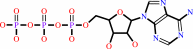 ATP
ATP
|
=
|
O-phospho-L-tyrosyl-[protein]
|
+
|
 ADP
ADP
|
+
|
H(+)
|
|
|
|
|
|
|
|
|
|
|
|
|
Molecule diagrams generated from .mol files obtained from the
KEGG ftp site
|
|
|
|
|
|
|
|
|
|
|
|
|
|
 |
|
|
|
|
|
|
| |
|
|
| |
|
DOI no:
|
Protein Sci
15:1512-1515
(2006)
|
|
PubMed id:
|
|
|
|
|
|
| |
|
NMR structure of the first Ig module of mouse FGFR1.
|
|
V.V.Kiselyov,
E.Bock,
V.Berezin,
F.M.Poulsen.
|
|
|
|
|
| |
ABSTRACT
|
|
|
|
| |
|
|
Fibroblast growth factor (FGF) receptors (FGFRs) regulate a multitude of
cellular processes during embryogenesis and in the adult. The extracellular part
of the prototypical FGFR consists of three Ig modules (Ig1 - Ig3), in which Ig2
and Ig3 determine affinity and specificity for FGF and heparin, while the Ig1
module is thought to have a regulatory function. The crystal structures of the
Ig2 and Ig3 modules alone and in complex with FGF have previously been reported.
The structure of the Ig1 module is unknown, and very little is known about the
structural determinants for the regulatory function of this module. We describe
here the NMR structure of the Ig1 module of mouse FGFR1. The three-dimensional
fold of the module belongs to the intermediate Ig subgroup and can be described
as a beta-barrel consisting of two beta-sheets. One sheet is formed by A', G, F,
C, and C', and the other by A, B, B', E, and D beta-strands. The overall strand
topology of the Ig1 module is similar to that of the Ig2 and Ig3 modules.
However, the A/A' loop of the Ig1 module is much longer than that of the Ig2 and
Ig3 modules. It contains eight extra residues compared to the Ig3 module, and
five extra residues compared to Ig2.
|
|
|
|
|
|
| |
Selected figure(s)
|
|
|
|
| |
|
|

|
|

|
|
Figure 1.
Structure of the FGFR1 Ig1 module. Stereo view of an overlay
of the backbone atoms of 20 superimposed structures of the Ig1
module.
|
|
Figure 2.
Comparison of the secondary structures of the Ig1 and Ig3
modules of FGFR. (A) Ribbon representation of the structure of
the Ig1 module. (B) Comparison of the structures of the
A/A[prime prime or minute] loop region of the Ig1 and Ig3
modules.
|
|
|
|
|
|
| |
The above figures are
reprinted
from an Open Access publication published by the Protein Society:
Protein Sci
(2006,
15,
1512-1515)
copyright 2006.
|
|
|
|
|
|
|
|
|
|
|
|
|
|
 |
 |
 |
|
Literature references that cite this PDB file's key reference
|
|
|
| |
PubMed id
|
|
Reference
|
|
|
|
|
|
A.Kochoyan,
F.M.Poulsen,
V.Berezin,
E.Bock,
and
V.V.Kiselyov
(2008).
Structural basis for the activation of FGFR by NCAM.
|
| |
Protein Sci,
17,
1698-1705.
|
|
|
|
|
|
|
B.M.Riley,
M.A.Mansilla,
J.Ma,
S.Daack-Hirsch,
B.S.Maher,
L.M.Raffensperger,
E.T.Russo,
A.R.Vieira,
C.Dodé,
M.Mohammadi,
M.L.Marazita,
and
J.C.Murray
(2007).
Impaired FGF signaling contributes to cleft lip and palate.
|
| |
Proc Natl Acad Sci U S A,
104,
4512-4517.
|
|
|
|
|
|
|
V.V.Kiselyov,
A.Kochoyan,
F.M.Poulsen,
E.Bock,
and
V.Berezin
(2006).
Elucidation of the mechanism of the regulatory function of the Ig1 module of the fibroblast growth factor receptor 1.
|
| |
Protein Sci,
15,
2318-2322.
|
|
|
|
|
|
The most recent references are shown first.
Citation data come partly from CiteXplore and partly
from an automated harvesting procedure. Note that this is likely to be
only a partial list as not all journals are covered by
either method. However, we are continually building up the citation data
so more and more references will be included with time.
|
|


 Links
Links


