 |
PDBsum entry 2aih

|
|
|
|
|
 |
Contents |
 |
|
|
|
|
|
|
|
|
|
|
* Residue conservation analysis
|
|
|
|
|
|
PDB id:
|
|
|
|
| Name: |
|
Hydrolase
|
|
|
Title:
|
|
1h-nmr solution structure of a trypsin/chymotrypsin bowman-birk inhibitor from lens culinaris.
|
|
Structure:
|
|
Bowman-birk type protease inhibitor, lcti. Chain: a. Fragment: residues 43-109. Synonym: trypsin/chymotrypsin inhibitor
|
|
Source:
|
|
Lens culinaris. Lentil. Organism_taxid: 3864. Strain: macrosperma group. Tissue: seeds
|
|
NMR struc:
|
|
20 models
|
|
|
Authors:
|
|
E.M.Ragg,V.Galbusera,A.Scarafoni,A.Negri,G.Tedeschi,A.Consonni, F.Sessa,M.Duranti
|
|
Key ref:
|
|
E.M.Ragg
et al.
(2006).
Inhibitory properties and solution structure of a potent Bowman-Birk protease inhibitor from lentil (Lens culinaris, L) seeds.
Febs J,
273,
4024-4039.
PubMed id:
|
|
|
Date:
|
|
|
29-Jul-05
|
Release date:
|
01-Aug-06
|
|
|
|
|
|
|
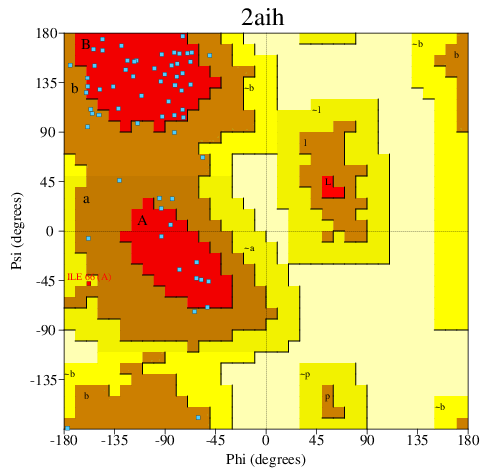
PROCHECK
|
|
|
|
|
|
Headers
|
|
|
|
References
|
|
|
|
|
|

|
|
Q8W4Y8
(IBB_LENCU) -
Bowman-Birk type proteinase inhibitor from Lens culinaris
|
|
|
|
Seq:
Struc:
|
|
|
|
110 a.a.
67 a.a.
|
|

|
|
|
|
|
|
|
|
|
|
|
|
|
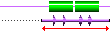
Key: |
 |
PfamA domain |
|
|
 |
Secondary structure |
|
 |
CATH domain |
|
|
|
|
|
|
|
|
|
|
|
|
|
|
|
|
|
 |
|
|
|
|
|
|
| |
|
|
Febs J
273:4024-4039
(2006)
|
|
PubMed id:
|
|
|
|
|
|
| |
|
Inhibitory properties and solution structure of a potent Bowman-Birk protease inhibitor from lentil (Lens culinaris, L) seeds.
|
|
E.M.Ragg,
V.Galbusera,
A.Scarafoni,
A.Negri,
G.Tedeschi,
A.Consonni,
F.Sessa,
M.Duranti.
|
|
|
|
|
| |
ABSTRACT
|
|
|
|
| |
|
|
Bowman-Birk serine protease inhibitors are a family of small plant proteins,
whose physiological role has not been ascertained as yet, while chemopreventive
anticarcinogenic properties have repeatedly been claimed. In this work we
present data on the isolation of a lentil (Lens culinaris, L., var. Macrosperma)
seed trypsin inhibitor (LCTI) and its functional and structural
characterization. LCTI is a 7448 Da double-headed trypsin/chymotrypsin inhibitor
with dissociation constants equal to 0.54 nM and 7.25 nM for the two proteases,
respectively. The inhibitor is, however, hydrolysed by trypsin in a few minutes
timescale, leading to a dramatic loss of its affinity for the enzyme. This is
due to a substantial difference in the kon and k*on values (1.1 microM-1.s-1 vs.
0.002 microM-1.s-1), respectively, for the intact and modified inhibitor. A
similar behaviour was not observed with chymotrypsin. The twenty best NMR
structures concurrently showed a canonical Bowman-Birk inhibitor (BBI)
conformation with two antipodal beta-hairpins containing the inhibitory domains.
The tertiary structure is stabilized by ion pairs and hydrogen bonds involving
the side chain and backbone of Asp10-Asp26-Arg28 and Asp36-Asp52 residues. At
physiological pH, the final structure results in an asymmetric distribution of
opposite charges with a negative electrostatic potential, centred on the
C-terminus, and a highly positive potential, surrounding the antitryptic domain.
The segment 53-55 lacks the anchoring capacity found in analogous BBIs, thus
rendering the protein susceptible to hydrolysis. The inhibitory properties of
LCTI, related to the simultaneous presence of two key amino acids (Gln18 and
His54), render the molecule unusual within the natural Bowman-Birk inhibitor
family.
|
|
|
|
|
|
|
|
|
|
|
|
|
|
|
|
|
|
 |
 |
 |
|
Literature references that cite this PDB file's key reference
|
|
|
| |
PubMed id
|
|
Reference
|
|
|
|
|
|
A.Clemente,
F.J.Moreno,
M.d.e.l. .C.Marín-Manzano,
E.Jiménez,
and
C.Domoney
(2010).
The cytotoxic effect of Bowman-Birk isoinhibitors, IBB1 and IBBD2, from soybean (Glycine max) on HT29 human colorectal cancer cells is related to their intrinsic ability to inhibit serine proteases.
|
| |
Mol Nutr Food Res,
54,
396-405.
|
|
|
|
|
|
|
L.Shan,
C.Li,
F.Chen,
S.Zhao,
and
G.Xia
(2008).
A Bowman-Birk type protease inhibitor is involved in the tolerance to salt stress in wheat.
|
| |
Plant Cell Environ,
31,
1128-1137.
|
|
|
|
|
|
The most recent references are shown first.
Citation data come partly from CiteXplore and partly
from an automated harvesting procedure. Note that this is likely to be
only a partial list as not all journals are covered by
either method. However, we are continually building up the citation data
so more and more references will be included with time.
|
|


 Links
Links


