 |
PDBsum entry 1ztz

|
|
|
|
|
 |
Contents |
 |
|
|
|
|
|
|
|
|
|
|
|
|
* Residue conservation analysis
|
|
|
|
|
|
PDB id:
|
|
|
|
| Name: |
|
Hydrolase
|
|
|
Title:
|
|
Crystal structure of HIV protease- metallacarborane complex
|
|
Structure:
|
|
Protease retropepsin. Chain: a, b. Synonym: HIV-1 protease. Engineered: yes. Mutation: yes. Autoproteolytic tetrapeptide. Chain: p. Engineered: yes
|
|
Source:
|
|
Human immunodeficiency virus 1. Organism_taxid: 11676. Gene: gag-pol. Expressed in: escherichia coli bl21(de3). Expression_system_taxid: 469008. Synthetic: yes
|
|
Biol. unit:
|
|
 Hexamer (from
)
Hexamer (from
)
|
|
Resolution:
|
|
|
2.15Å
|
R-factor:
|
0.179
|
R-free:
|
0.233
|
|
|
Authors:
|
|
P.Cigler,M.Kozisek,P.Rezacova,J.Brynda,Z.Otwinowski,J.Sedlacek, J.Bodem,H.-G.Kraeusslich,V.Kral,J.Konvalinka
|
Key ref:

|
|
P.Cígler
et al.
(2005).
From nonpeptide toward noncarbon protease inhibitors: metallacarboranes as specific and potent inhibitors of HIV protease.
Proc Natl Acad Sci U S A,
102,
15394-15399.
PubMed id:
DOI:

|
|
|
Date:
|
|
|
28-May-05
|
Release date:
|
01-Nov-05
|
|
|
|
|
|
|
PROCHECK
|

|
|
|
|
|
Headers
|
|
|
|
References
|
|
|
|
|
|

|
|
P03367
(POL_HV1BR) -
Gag-Pol polyprotein from Human immunodeficiency virus type 1 group M subtype B (isolate BRU/LAI)
|
|
|
|
Seq:
Struc:
|
|
|
|
1447 a.a.
99 a.a.*
|
|

|

|

|
|
|
|
|
|
|
|
|
|
|
Key: |
 |
PfamA domain |
|
|
 |
Secondary structure |
|
 |
CATH domain |
|
|
*
PDB and UniProt seqs differ
at 3 residue positions (black
crosses)
|
|
|
|
|
|
|
|
|
|
|
|
|
Enzyme class 1:
|
|
E.C.2.7.7.49
- RNA-directed Dna polymerase.
|
|
|
|
|
|
|
Reaction:
|
|
DNA(n) + a 2'-deoxyribonucleoside 5'-triphosphate = DNA(n+1) + diphosphate
|
|
|
|
|
|
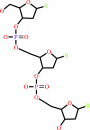 DNA(n)
|
+
|
2'-deoxyribonucleoside 5'-triphosphate
|
=
|
DNA(n+1)
|
+
|
 diphosphate
|
|
|
|
|
|
|
|
|
|
Enzyme class 2:
|
|
E.C.2.7.7.7
- DNA-directed Dna polymerase.
|
|
|
|
|
|
|
Reaction:
|
|
DNA(n) + a 2'-deoxyribonucleoside 5'-triphosphate = DNA(n+1) + diphosphate
|
|
|
|
|
|
DNA(n)
|
+
|
2'-deoxyribonucleoside 5'-triphosphate
|
=
|
DNA(n+1)
|
+
|
diphosphate
|
|
|
|
|
|
|
|
|
|
Enzyme class 3:
|
|
E.C.3.1.13.2
- exoribonuclease H.
|
|
|
|
|
|
|
Reaction:
|
|
Exonucleolytic cleavage to 5'-phosphomonoester oligonucleotides in both 5'- to 3'- and 3'- to 5'-directions.
|
|
|
|
|
|
Enzyme class 4:
|
|
E.C.3.1.26.13
- retroviral ribonuclease H.
|
|
|
|
|
|
|
Enzyme class 5:
|
|
E.C.3.4.23.16
- HIV-1 retropepsin.
|
|
|
|
|
|
|
Reaction:
|
|
Specific for a P1 residue that is hydrophobic, and P1' variable, but often Pro.
|
|
|
|
|
|
|
|
|
Note, where more than one E.C. class is given (as above), each may
correspond to a different protein domain or, in the case of polyprotein
precursors, to a different mature protein.
|
|
|
|
Molecule diagrams generated from .mol files obtained from the
KEGG ftp site
|
|
|
|
|
|
|
|
|
|
|
|
|
|
 |
|
|
|
|
|
|
| |
|
|
| |
|
DOI no:
|
Proc Natl Acad Sci U S A
102:15394-15399
(2005)
|
|
PubMed id:
|
|
|
|
|
|
| |
|
From nonpeptide toward noncarbon protease inhibitors: metallacarboranes as specific and potent inhibitors of HIV protease.
|
|
P.Cígler,
M.Kozísek,
P.Rezácová,
J.Brynda,
Z.Otwinowski,
J.Pokorná,
J.Plesek,
B.Grüner,
L.Dolecková-Maresová,
M.Mása,
J.Sedlácek,
J.Bodem,
H.G.Kräusslich,
V.Král,
J.Konvalinka.
|
|
|
|
|
| |
ABSTRACT
|
|
|
|
| |
|
|
HIV protease (PR) represents a prime target for rational drug design, and
protease inhibitors (PI) are powerful antiviral drugs. Most of the current PIs
are pseudopeptide compounds with limited bioavailability and stability, and
their use is compromised by high costs, side effects, and development of
resistant strains. In our search for novel PI structures, we have identified a
group of inorganic compounds, icosahedral metallacarboranes, as candidates for a
novel class of nonpeptidic PIs. Here, we report the potent, specific, and
selective competitive inhibition of HIV PR by substituted metallacarboranes. The
most active compound, sodium hydrogen butylimino
bis-8,8-[5-(3-oxa-pentoxy)-3-cobalt bis(1,2-dicarbollide)]di-ate, exhibited a
K(i) value of 2.2 nM and a submicromolar EC(50) in antiviral tests, showed no
toxicity in tissue culture, weakly inhibited human cathepsin D and pepsin, and
was inactive against trypsin, papain, and amylase. The structure of the parent
cobalt bis(1,2-dicarbollide) in complex with HIV PR was determined at 2.15 A
resolution by protein crystallography and represents the first carborane-protein
complex structure determined. It shows the following mode of PR inhibition: two
molecules of the parent compound bind to the hydrophobic pockets in the
flap-proximal region of the S3 and S3' subsites of PR. We suggest, therefore,
that these compounds block flap closure in addition to filling the corresponding
binding pockets as conventional PIs. This type of binding and inhibition,
chemical and biological stability, low toxicity, and the possibility to
introduce various modifications make boron clusters attractive pharmacophores
for potent and specific enzyme inhibition.
|
|
|
|
|
|
| |
Selected figure(s)
|
|
|
|
| |
|
|

|
|

|
|
Figure 1.
Fig. 1. Ring opening reaction of 8-dioxane-3-cobalt
bis(1,2-dicarbollide) 7 by different nucleofiles Nu0 (e.g.,
NH[3]) and Nu- (e.g., RO-) yielding zwitterionic and anionic
compounds, respectively.
|
|
Figure 3.
Fig. 3. Interactions of compound 1 with the amino acid
residues in the corresponding PR-binding pocket. (A) Binding of
compound 1 molecule Cb1 by PR monomer A (red tube). (B) Binding
of compound 1 molecule Cb2 by PR monomer B (blue tube). Compound
1 is represented by a stick model in gray, with cobalt shown as
a magenta sphere. PR residues in contact with compound 1 are
represented by stick models, and their solvent-accessible
surfaces are colored by atom charge (blue, positive; red,
negative). (C) Superposition of the two compound 1-binding
modes. The color scheme and representation for PR is the same as
in A and B, and atoms in compound 1 are colored with the color
of the interacting PR chain.
|
|
|
|
| |
Figures were
selected
by an automated process.
|
|
|
|
|
|
|
|
|
|
|
|
|
|
|
|
 |
 |
 |
|
Literature references that cite this PDB file's key reference
|
|
|
| |
PubMed id
|
|
Reference
|
|
|
|
|
|
D.Sykora,
M.Vosmanska,
P.Matejka,
and
V.Kral
(2011).
Immobilized metallacarborane as a new type of stationary phase for high performance liquid chromatography.
|
| |
J Chromatogr A,
1218,
3029-3036.
|
|
|
|
|
|
|
H.Horáková,
B.Grüner,
and
R.Vespalec
(2011).
Emerging subject for chiral separation science: Cluster boron compounds.
|
| |
Chirality,
23,
307-319.
|
|
|
|
|
|
|
O.Guzyr,
C.Viñas,
H.Wada,
S.Hayashi,
W.Nakanishi,
F.Teixidor,
A.V.Puga,
and
V.David
(2011).
Synthesis, structural, spectroscopic and electrochemical studies of carborane substituted naphthyl selenides.
|
| |
Dalton Trans,
40,
3402-3411.
|
|
|
|
|
|
|
C.H.Shen,
Y.F.Wang,
A.Y.Kovalevsky,
R.W.Harrison,
and
I.T.Weber
(2010).
Amprenavir complexes with HIV-1 protease and its drug-resistant mutants altering hydrophobic clusters.
|
| |
FEBS J,
277,
3699-3714.
|
|
|
PDB codes:
|
|
|
|
|
|
|
|
C.Wu,
B.Xu,
J.Zhao,
Q.Jiang,
F.Wei,
H.Jiang,
X.Wang,
and
H.Yan
(2010).
Ferrocene-substituted dithio-o-carborane isomers: influence on the native conformation of myoglobin protein.
|
| |
Chemistry,
16,
8914-8922.
|
|
|
|
|
|
|
I.Snajdr,
Z.Janoušek,
J.Jindřich,
and
M.Kotora
(2010).
Cross-metathesis of allylcarboranes with O-allylcyclodextrins.
|
| |
Beilstein J Org Chem,
6,
1099-1105.
|
|
|
|
|
|
|
M.J.Hartl,
K.Schweimer,
M.H.Reger,
S.Schwarzinger,
J.Bodem,
P.Rösch,
and
B.M.Wöhrl
(2010).
Formation of transient dimers by a retroviral protease.
|
| |
Biochem J,
427,
197-203.
|
|
|
|
|
|
|
T.O.Pennanen,
J.Machácek,
S.Taubert,
J.Vaara,
and
D.Hnyk
(2010).
Ferrocene-like iron bis(dicarbollide), [3-Fe(III)-(1,2-C(2)B(9)H(11))(2)](-). The first experimental and theoretical refinement of a paramagnetic (11)B NMR spectrum.
|
| |
Phys Chem Chem Phys,
12,
7018-7025.
|
|
|
|
|
|
|
S.X.Tian,
H.B.Li,
and
J.Yang
(2009).
Monoanion BH4(-) can stabilize zwitterionic glycine with dihydrogen bonds.
|
| |
Chemphyschem,
10,
1435-1437.
|
|
|
|
|
|
|
V.Sícha,
J.Plesek,
M.Kvícalová,
I.Císarová,
and
B.Grüner
(2009).
Boron(8) substituted nitrilium and ammonium derivatives, versatile cobalt bis(1,2-dicarbollide) building blocks for synthetic purposes.
|
| |
Dalton Trans,
(),
851-860.
|
|
|
|
|
|
|
A.A.Semioshkin,
I.B.Sivaev,
and
V.I.Bregadze
(2008).
Cyclic oxonium derivatives of polyhedral boron hydrides and their synthetic applications.
|
| |
Dalton Trans,
(),
977-992.
|
|
|
|
|
|
|
J.Böttcher,
A.Blum,
S.Dörr,
A.Heine,
W.E.Diederich,
and
G.Klebe
(2008).
Targeting the open-flap conformation of HIV-1 protease with pyrrolidine-based inhibitors.
|
| |
ChemMedChem,
3,
1337-1344.
|
|
|
PDB code:
|
|
|
|
|
|
|
|
M.Kozísek,
K.G.Sasková,
P.Rezácová,
J.Brynda,
N.M.van Maarseveen,
D.De Jong,
C.A.Boucher,
R.M.Kagan,
M.Nijhuis,
and
J.Konvalinka
(2008).
Ninety-nine is not enough: molecular characterization of inhibitor-resistant human immunodeficiency virus type 1 protease mutants with insertions in the flap region.
|
| |
J Virol,
82,
5869-5878.
|
|
|
PDB codes:
|
|
|
|
|
|
|
|
G.Chevrot,
R.Schurhammer,
and
G.Wipff
(2007).
Molecular dynamics study of dicarbollide anions in nitrobenzene solution and at its aqueous interface. Synergistic effect in the Eu(III) assisted extraction.
|
| |
Phys Chem Chem Phys,
9,
5928-5938.
|
|
|
|
|
|
|
H.Horáková,
and
R.Vespalec
(2007).
Chiral separability of hydrophobic boron cluster anions with native cyclodextrins in water-methanol background electrolytes.
|
| |
Electrophoresis,
28,
3639-3649.
|
|
|
|
|
|
|
J.Fanfrlík,
D.Hnyk,
M.Lepsík,
and
P.Hobza
(2007).
Interaction of heteroboranes with biomolecules. Part 2. The effect of various metal vertices and exo-substitutions.
|
| |
Phys Chem Chem Phys,
9,
2085-2093.
|
|
|
|
|
|
|
R.L.Julius,
O.K.Farha,
J.Chiang,
L.J.Perry,
and
M.F.Hawthorne
(2007).
Synthesis and evaluation of transthyretin amyloidosis inhibitors containing carborane pharmacophores.
|
| |
Proc Natl Acad Sci U S A,
104,
4808-4813.
|
|
|
|
|
|
|
J.Fanfrlík,
M.Lepsík,
D.Horinek,
Z.Havlas,
and
P.Hobza
(2006).
Interaction of carboranes with biomolecules: formation of dihydrogen bonds.
|
| |
Chemphyschem,
7,
1100-1105.
|
|
|
|
|
|
The most recent references are shown first.
Citation data come partly from CiteXplore and partly
from an automated harvesting procedure. Note that this is likely to be
only a partial list as not all journals are covered by
either method. However, we are continually building up the citation data
so more and more references will be included with time.
Where a reference describes a PDB structure, the PDB
codes are
shown on the right.
|
|


 Links
Links


